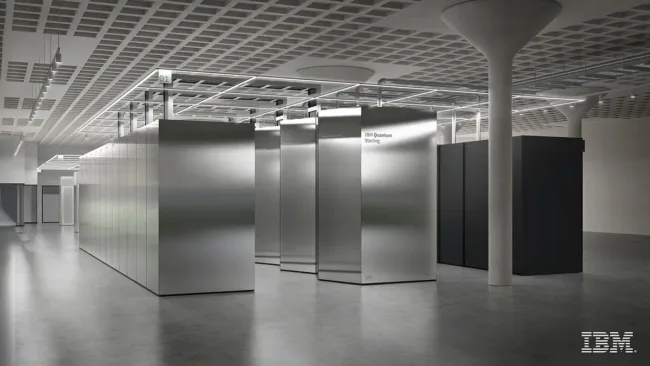
IBM (NYSE: IBM) and Cisco Systems Inc. (NASDAQ: CSCO) have unveiled plans for a long-term collaboration to develop a distributed quantum computing network. The goal is to interconnect large-scale, fault-tolerant quantum computers by the early 2030s, creating the foundation for what could eventually evolve into a global quantum computing internet. In a joint announcement on November 20, 2025, the two technology leaders confirmed they will begin working toward a demonstration of multi-node quantum networks within five years. The proof-of-concept system would connect IBM quantum machines to enable computations involving tens to hundreds of thousands of qubits, a step that could support trillions of quantum gate operations across distributed hardware.
This initiative marks a significant evolution in the quantum computing strategy pursued by both companies. Rather than focusing solely on building larger standalone quantum machines, IBM and Cisco now aim to explore horizontal scale-out by networking multiple quantum systems. Analysts tracking the space believe the partnership signals a push to commercialize fault-tolerant quantum workloads through a distributed architecture that mirrors the trajectory of classical high-performance computing over the past two decades.

How the IBM and Cisco quantum roadmap aims to connect machines across data centers
IBM plans to contribute quantum hardware advancements and define the machine-level architecture, including a new interface called the quantum networking unit (QNU). This unit will act as a bridge between the quantum processing unit (QPU) and the broader network. Cisco will develop the network layer required to transmit entangled quantum information across QNUs. Together, the companies intend to demonstrate how multiple IBM quantum computers can work in concert, effectively becoming a unified compute environment for advanced quantum applications.
This effort will require the invention of new supporting technologies, including microwave-optical transducers that convert quantum information from microwave frequencies into optical photons suitable for transmission through fiber networks. Cisco’s high-speed protocol framework will dynamically allocate entanglement across different network paths to allow multiple QNUs to communicate, compute, and synchronize their operations with sub-nanosecond precision. These combined efforts aim to deliver a scalable architecture that can operate within and eventually across data centers.
IBM has already committed to building large-scale, fault-tolerant quantum systems before the end of the decade. This new partnership extends that ambition by enabling those systems to collaborate on single workloads across a distributed fabric. Cisco’s vision of a quantum-ready data center further integrates networking intelligence, latency management, and compute orchestration to support large-scale deployments.
What makes fault-tolerant quantum computers suitable for distributed computing frameworks
The focus on fault tolerance is not incidental. Current quantum computers, including those already deployed by IBM, operate with limited coherence times and error rates that make them suitable for only short-duration calculations. The next generation of machines being pursued under IBM’s roadmap will include error-corrected qubits capable of supporting long-running computations and algorithmic fault tolerance.
By connecting such machines into a distributed system, IBM and Cisco hope to unlock what researchers refer to as quantum modularity. This involves dividing a complex quantum task across multiple systems that collaborate to solve a problem through quantum teleportation, entanglement distribution, and multi-qubit coordination. For instance, simulations of molecular systems or optimization of logistics networks could be decomposed into subproblems that are computed independently but coordinated through quantum correlations.
To enable this modular approach, IBM will design the QNUs to facilitate bidirectional exchange of quantum states between machines. Each QNU will take “stationary” quantum information inside the QPU and convert it into “flying” quantum information, which can then be routed through Cisco’s network layer. Cisco, for its part, will ensure that the quantum information arrives at the appropriate QNU at the right moment, synchronized with partial results from other machines.
How quantum networking research with Fermilab and SQMS will advance early milestones
As part of its roadmap, IBM is working with the Superconducting Quantum Materials and Systems (SQMS) Center led by Fermilab. This partnership, under the U.S. Department of Energy’s National Quantum Information Science and Research Centers program, is exploring how many QNUs can be hosted inside a single quantum data center. The goal is to demonstrate multiple connected QPUs within three years, using the same distributed network architecture being developed jointly with Cisco.
This early demonstration will take place within a single physical environment, where machines are close enough to share short-distance quantum links. It is expected to serve as the foundation for scaling the same architecture across wider physical geographies in the years ahead. By connecting QPUs across buildings, cities, or continents, IBM and Cisco hope to realize a quantum computing internet.
Researchers from both firms have noted that a successful architecture must preserve quantum coherence throughout transmission. This will require precise control over entanglement fidelity, network synchronization, and photon interference patterns. These engineering challenges are being approached with a mix of classical high-performance compute architecture and emerging quantum communication protocols.
What the quantum computing internet could mean for sensors, simulations, and security
A connected quantum computing network has implications well beyond faster simulations. IBM and Cisco envision a future where quantum computers, quantum sensors, and quantum communication nodes work together to form an internet-like infrastructure. Such a system could support quantum-secure messaging, ultra-sensitive distributed sensor arrays, or even coordinated quantum time-keeping systems for scientific research.
For example, the quantum internet could enable national defense institutions to detect stealth threats via quantum radar arrays or allow pharma companies to simulate drug binding interactions at atomic fidelity across multiple supercooled machines. Climate scientists may use this infrastructure to run large-scale weather prediction models that classical machines struggle to process. Cybersecurity firms could deploy quantum key distribution over these networks to ensure zero-trust data communication with unprecedented guarantees.
According to experts in quantum architecture, building this quantum computing internet will require innovation in both physical-layer hardware and software-layer orchestration. IBM’s efforts in building the QPU–QNU–network interface and Cisco’s work on multi-path entanglement routing are viewed as essential components of this next-generation platform.
How IBM and Cisco could position themselves as first movers in quantum-classical convergence
For IBM, this partnership supports its broader vision of quantum-centric supercomputing. That strategy involves combining quantum and classical systems, using conventional HPC infrastructure to support error correction, data transfer, and workload optimization. As part of its hybrid compute roadmap, IBM anticipates linking quantum QPUs with classical GPU-accelerated systems to build an adaptive supercomputing framework.
Cisco sees this collaboration as a natural extension of its existing dominance in classical networking. By becoming the de facto standard for quantum network infrastructure, the company could carve out a defensible position in a high-growth market before it matures. Cisco executives said they view this not as a niche research project, but as a foundational transformation of how compute networks are built over the next two decades.
Industry observers believe the partnership could enable IBM and Cisco to influence emerging standards in quantum networking, which remain fragmented today. Academic and government stakeholders may also gravitate toward this architecture for their own national research facilities. Joint co-investment in research, intellectual property, and ecosystem development is already underway, including joint academic grant programs.
What researchers and investors should watch in the next five years
The most immediate milestone will be the successful demonstration of a networked quantum testbed with entangled QPUs in the next three years. This will validate the microwave-optical transduction pathway, the QNU interface, and the entanglement-swapping protocol being developed. Technical publications, government grants, and patent filings over the next 18–36 months will provide additional insight into the progress being made.
Investors will also track institutional demand for quantum compute-as-a-service models that might use this distributed architecture. Government contracts, particularly in defense, climate modeling, and pharmaceutical sectors, are likely early adopters. Capital expenditure disclosures from IBM and Cisco regarding cryogenic infrastructure, fiber photonic links, or data center retrofits will offer early signals of market readiness.
While commercial quantum advantage remains several years away, IBM and Cisco are clearly positioning themselves to lead the next phase of the quantum computing evolution, one where networks, not just machines, will matter most.
What are the key takeaways from IBM and Cisco’s quantum networking initiative?
- IBM and Cisco have partnered to develop a distributed quantum computing network by the early 2030s, aiming to link fault-tolerant quantum computers.
- The collaboration will combine IBM’s QPU and QNU architecture with Cisco’s expertise in entanglement-based quantum networking and protocol infrastructure.
- A proof-of-concept demonstration of connected quantum systems is expected within five years, enabling multi-machine workloads with tens of thousands of qubits.
- IBM is also working with the Superconducting Quantum Materials and Systems (SQMS) Center at Fermilab to test interconnected quantum machines in a single data center.
- The companies envision building a future quantum computing internet that spans cities and continents, supporting ultra-secure communication and large-scale simulations.
- Cisco’s proposed quantum data center design includes dynamic entanglement routing, teleportation protocols, and sub-nanosecond synchronization between machines.
- IBM’s long-term vision aligns with hybrid quantum–classical supercomputing, integrating QPUs with HPC infrastructure for scalable workloads.
- The initiative could place both companies at the forefront of standard-setting in quantum networking, a space currently lacking dominant infrastructure players.
- Government and institutional researchers are expected to be early adopters, especially in sectors such as defense, materials science, and advanced manufacturing.
- Investors and industry analysts will monitor upcoming demonstrations, IP filings, and ecosystem expansion as indicators of commercial readiness and technological maturity.
Share this:
Discover more from Business-News-Today.com
Subscribe to get the latest posts sent to your email.