Brazil’s deepwater pre-salt basins, once the exclusive playground of national oil giant Petróleo Brasileiro S.A. (Petrobras), are increasingly becoming a hotspot for a new wave of foreign energy investment. More than a decade after Brazil’s initial pre-salt hype led to a flurry of mega-developments and production milestones, 2025 is shaping up as a crucial test for whether international oil companies are willing to double down on Latin America’s most mature ultra-deepwater frontier.
The recent string of investment commitments, final investment decisions, and appraisal campaigns by companies such as BP p.l.c., Shell Brasil Petróleo Ltda., Equinor ASA, TotalEnergies SE, and ExxonMobil Corporation has reinvigorated interest in the potential of Brazil’s pre-salt province. At the center of this second wave is a dramatically changed investment environment compared to the Petrobras-dominated first wave of the 2010s.
The big question now facing investors and policymakers alike is whether this renewed interest will lead to a sustained flow of foreign capital, drilling campaigns, and project sanctions—or whether the current momentum will prove temporary amid regulatory complexity, capital discipline, and competition from emerging offshore regions such as Guyana, Namibia, and the Eastern Mediterranean.
What factors are making Brazil’s pre-salt region more attractive for foreign investment in 2025?
Several macro and micro factors have converged in 2025 to position Brazil as one of the most attractive jurisdictions for deepwater investment. First, Brazil’s geological advantage remains unmatched. The pre-salt layer, buried beneath thick salt formations in the Santos and Campos Basins, holds high-quality, light crude with some of the lowest upstream carbon intensity globally. Reservoirs in these zones routinely deliver high flow rates with fewer wells, lowering breakeven costs and increasing capital efficiency.
Second, regulatory reforms initiated over the last decade have gradually reduced Petrobras’ sole operatorship over strategic pre-salt areas. This has opened the door for international operators to take on more active roles, including operating assets, participating in Production Sharing Contracts (PSCs), and accessing seismic data earlier in the licensing process. The Brazilian National Petroleum Agency (ANP) has been instrumental in making auction rounds more transparent and investor-friendly.
Third, global oil prices have stabilized above USD 80 per barrel in 2025, offering sufficient headroom for international oil companies to pursue high-margin, capital-intensive offshore projects. This is particularly true for companies under pressure to deliver short-cycle returns with high cash margins, but who also need to balance low-emissions credentials. Brazil’s pre-salt—already a decarbonization leader among offshore plays—is increasingly viewed as a bridge asset that satisfies both imperatives.
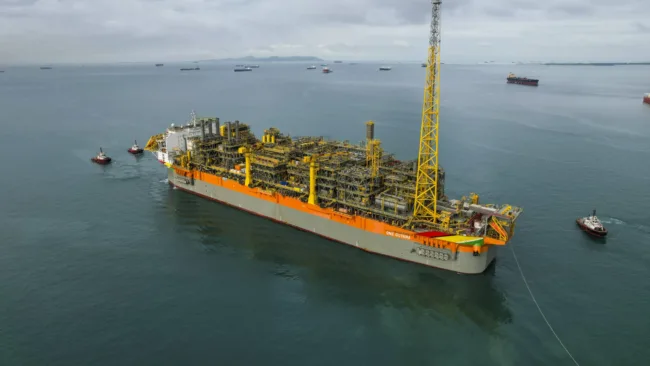
In parallel, the country’s service and logistics ecosystem has matured significantly. The presence of global suppliers, shipyards, floating production storage and offloading (FPSO) contractors, and digital offshore infrastructure has de-risked supply chain execution. This allows for faster project timelines, which is critical in an era where investor patience for multi-decade greenfield developments has worn thin.
Which foreign oil companies have already committed or signalled moves into Brazil’s pre-salt this year?
Several recent developments underscore that foreign players are not only watching Brazil but actively recommitting capital to its pre-salt sector. In April 2025, Shell Brasil Petróleo Ltda. made headlines by announcing the final investment decision for the Gato do Mato project in the Santos Basin. The field, discovered in 2018 and jointly held with Colombia’s Ecopetrol S.A., is expected to produce over 120,000 barrels of oil equivalent per day at peak and is now moving into full-field development.
BP p.l.c., meanwhile, has begun preparing for appraisal drilling at its Bumerangue discovery, also in the Santos Basin. This discovery, made in the Pau Brasil PSC block, is operated by BP with partners Petrobras and China National Offshore Oil Corporation. The move marks BP’s most active return to Brazil since the Libra consortium, and is viewed as a strategic re-entry into the country’s deepwater opportunity set.
Equinor ASA is progressing its Bacalhau development, which remains one of the largest foreign-operated oil projects under construction in Brazil. The company has also been actively acquiring acreage in recent PSC auctions, often in consortia with ExxonMobil Corporation and Petrogal Brasil. TotalEnergies SE, too, has increased its presence, with new seismic work in blocks near the prolific Lula and Búzios fields.
Notably, Asian capital has become more visible. Companies like China National Petroleum Corporation and CNOOC Limited continue to build non-operator positions across multiple PSCs. These strategic footholds give Chinese entities exposure to long-life, low-risk barrels without the reputational burden of operatorship or the same exposure to environmental scrutiny.
What regulatory, fiscal or infrastructure hurdles could block a broader investment wave in Brazil’s pre-salt?
Despite the enthusiasm, Brazil’s offshore sector still presents significant headwinds that could limit how far this second wave of foreign investment extends. The regulatory environment, while improved, is not without complexity. The dual-track system of PSCs and concession agreements, coupled with royalty negotiations, local content obligations, and slow environmental licensing, can lead to protracted timelines between discovery and development.
The cost of compliance remains high. Requirements for domestic shipbuilding, labor participation, and equipment sourcing have historically delayed project sanctioning and limited the number of FPSOs delivered on schedule. Although Brazil’s government has taken steps to simplify local content rules, enforcement still varies by region and political administration.
Fiscal incentives have also become a hot-button issue. Some international players have pushed for greater cost recovery allowances under the PSC regime and more favorable terms in future auction rounds. Others worry that fiscal policy is vulnerable to shifts in presidential administrations, particularly as climate politics and resource nationalism resurface in national elections.
Infrastructure bottlenecks present an additional challenge. As more players enter the pre-salt space, there is rising competition for subsea contractors, drilling rigs, and FPSO units. While companies such as Modec, SBM Offshore, and TechnipFMC have significant presence in Brazil, capacity constraints in global yards and vessel fleets may stretch lead times for new greenfield projects, especially if multiple projects move toward FID in parallel.
How much room remains in the Santos Basin and other pre-salt provinces for new entrants to make meaningful plays?
Although Brazil’s pre-salt basins are mature by exploration standards, substantial upside remains. The Santos Basin alone still has underexplored regions that have not been fully covered by 3D seismic, and recent drilling successes suggest a second layer of potential beneath the original pre-salt reservoirs. In addition, frontier blocks closer to the São Paulo Plateau or deeper into ultra-deepwater terrain remain largely untested.
The Campos Basin, once considered a sunset province, is undergoing a technical renaissance. Companies are now reinterpreting older datasets using AI-powered geophysical tools, unlocking bypassed pay and new play concepts in both post-salt and pre-salt layers. TotalEnergies SE and PetroRio S.A. have both made plays in Campos, leveraging existing FPSOs to lower breakevens.
Beyond geology, the opportunity for infrastructure-led exploration is rising. With multiple FPSO units already producing in adjacent fields, smaller discoveries can now be tied back at lower cost. This is especially attractive to mid-sized players like Karoon Energy Ltd., Enauta Participações S.A., and PetroReconcavo S.A., which are actively bidding in smaller rounds and looking to fast-track monetization.
What are the likely scenarios and timelines if a second wave of foreign investment into Brazil’s pre-salt succeeds or falters?
If current momentum continues, Brazil could see a clustering of final investment decisions between 2026 and 2028, particularly from PSC blocks awarded between 2017 and 2021. This would create a sustained ramp-up in offshore activity through 2030, solidifying Brazil’s role as the second-largest deepwater producer globally after the United States. It would also allow international oil companies to book material reserves and production in politically stable, ESG-compliant jurisdictions—an increasing priority for institutional capital allocators.
On the flip side, failure to deliver predictable regulatory timelines, fiscal clarity, or execution efficiency could stall the second wave before it matures. In such a case, Brazil risks becoming a holding ground for dormant discoveries while capital flows to newer basins like Namibia’s Orange Basin or Angola’s Kwanza Shelf.
At the core of this inflection point is Petrobras itself. As it continues to rebalance its role between operator and partner, and decides which assets to retain or divest, it will shape the competitive landscape for all incoming investors. The success of the second wave may well depend on how Petrobras sets the tempo for FPSO ordering, project prioritization, and pre-salt infrastructure planning.
Discover more from Business-News-Today.com
Subscribe to get the latest posts sent to your email.