




Why did Boeing’s stock price fall despite higher Q3 2025 revenue and aircraft deliveries?
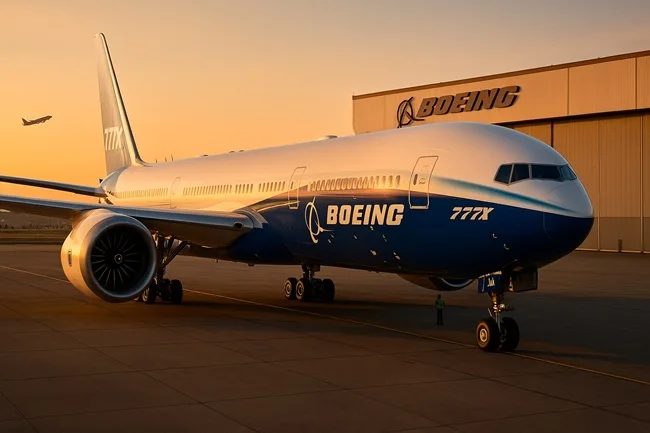
Boeing Company (NYSE: BA) reported third-quarter revenue of USD 23.3 billion, marking a 30 percent year-over-year increase. This surge was fueled by the delivery of 160 commercial aircraft—its highest quarterly volume since 2018. Operating cash flow improved significantly to USD 1.1 billion, and free cash flow turned positive at USD 238 million, reversing a USD 1.96 billion outflow a year earlier. However, investor reaction remained negative as the company booked a pre-tax charge of USD 4.9 billion related to the 777X certification program. That charge alone inflated Boeing’s core loss per share to negative USD 7.47, despite otherwise improving operational trends. Shares of Boeing Company dropped over 2.5 percent in early trading following the earnings announcement.
How did the $4.9 billion charge related to the 777X program impact Boeing’s net loss?
The USD 4.9 billion charge, driven by updated timelines for the 777-9 certification and first delivery, pushed Boeing’s total GAAP net loss for the quarter to USD 5.34 billion, down only slightly from the USD 6.17 billion loss posted in the same period last year. Diluted loss per share stood at negative USD 7.14. Core loss per share, which excludes certain pension and postretirement service costs, landed at negative USD 7.47. The charge contributed USD 6.45 to that figure. Analysts noted that while the 777X program continues to perform well in flight testing, the repeated delays have eroded institutional confidence in Boeing’s ability to stabilize its wide-body aircraft portfolio. The new timeline pushes the first 777X delivery into 2027.
What are the latest updates on Boeing’s 737 and 787 production ramps after FAA approval?
The 737 program reached a significant inflection point during the quarter, stabilizing at a production rate of 38 aircraft per month. In October, Boeing secured joint approval from the Federal Aviation Administration to increase production to 42 per month. This marks a major milestone in the post-grounding recovery of the 737 MAX. The 787 Dreamliner program also held steady at seven aircraft per month, supported by ongoing capital investments to expand the company’s South Carolina operations. Segment revenue for Commercial Airplanes surged 49 percent to USD 11.1 billion year-over-year. Boeing delivered 121 737s and 24 787s during the quarter, contributing to the overall total of 160 deliveries. Despite volume improvements, the segment reported an operating loss of USD 5.35 billion, mostly due to the 777X program charge.
How did Boeing’s defense and space segment return to profitability in Q3 2025?
Boeing’s Defense, Space & Security segment delivered a sharp turnaround in the third quarter of FY25, posting a profit of USD 114 million versus a USD 2.38 billion loss in Q3 2024. Segment revenue rose to USD 6.9 billion, reflecting a combination of improved operational performance and increased order volume. Notably, Boeing secured a high-profile contract with the United States Space Force aimed at enhancing strategic satellite communications. The company also successfully demonstrated autonomous operational capabilities of the MQ-28 Ghost Bat in partnership with the Royal Australian Air Force. The segment’s backlog expanded to USD 76 billion, with approximately 20 percent derived from international customers.
What is driving the continued strength in Boeing’s global services business this year?
Global Services continued to deliver consistent performance, reporting third-quarter revenue of USD 5.4 billion, up 10 percent year-over-year. Operating margin held steady at 17.5 percent, driven by a favorable commercial services mix and higher volume. The segment secured a repair contract from the United States Navy for F/A-18 aircraft landing gear and entered into a strategic collaboration with Korean Air focused on predictive maintenance analytics. With a growing backlog of USD 24.6 billion and continued interest in Boeing’s aftermarket solutions, Global Services remains a stable source of revenue and cash flow across economic cycles.
How much backlog does Boeing have in commercial aircraft, defense, and services segments?
Boeing closed the quarter with a total backlog of USD 636 billion, up from USD 521 billion at the end of December 2024. The Commercial Airplanes division contributed USD 535 billion of this figure, representing over 5,900 aircraft. Defense, Space & Security accounted for USD 76 billion, while Global Services added another USD 24.6 billion. Within this backlog, USD 598.6 billion was categorized as contractual, with the remaining USD 37.1 billion in unobligated backlog. This sustained demand indicates long-term revenue visibility and a solid pipeline across Boeing’s three primary segments, though the path to monetization depends heavily on execution and regulatory clearance.
What do Boeing’s liquidity, cash position, and negative shareholders’ equity reveal?
Boeing’s cash and marketable securities position remained stable at USD 23 billion, including USD 6.17 billion in cash and USD 16.81 billion in short-term investments. The company retains access to USD 10 billion in undrawn credit facilities, providing additional liquidity cushion. However, total debt ticked up slightly to USD 53.4 billion, and the company continues to operate with negative shareholders’ equity. As of September 30, 2025, Boeing reported a shareholders’ deficit of USD 8.25 billion, due to accumulated losses and charges. This dynamic, while not unusual for aerospace firms recovering from multi-year disruptions, has prompted concerns among analysts tracking balance sheet repair and credit quality.
What are analysts saying about Boeing’s execution risk and investor sentiment outlook?
Analyst sentiment remains split. On one hand, the return to positive free cash flow, strong services margins, and the 737 production ramp are seen as signs of operational progress. On the other, execution risk—particularly in the wide-body segment—and ballooning costs related to development programs such as the 777X continue to weigh on investor confidence. The commercial aircraft segment still posted a loss exceeding USD 5 billion despite delivery volume growth, leading institutional investors to remain cautious. Many fund managers are taking a “wait and see” approach until Boeing proves it can maintain cash flow consistency while avoiding further program delays or charges.
Will the Spirit AeroSystems acquisition help Boeing’s cost control and supply chain strategy?
Boeing did not elaborate further on its pending acquisition of Spirit AeroSystems Holdings, Inc. during the third quarter. However, the deal is expected to play a strategic role in Boeing’s efforts to vertically integrate and better manage supply chain risks. Spirit AeroSystems, which manufactures fuselages and other aerostructures for Boeing, has been a long-time supplier. The acquisition, if completed, could reduce production bottlenecks, streamline quality control, and cut costs over the long term. That said, integration complexity and potential short-term disruptions are key risks investors are monitoring closely as Boeing moves toward closing the transaction.
What should investors expect from Boeing in Q4 2025 and into fiscal year 2026?
Looking ahead, Boeing’s ability to sustain positive free cash flow and meet production targets will be central to its recovery narrative. The company’s strong backlog and defense tailwinds offer some insulation from macroeconomic headwinds. However, further delays in 777X certification, cost overruns, or setbacks in the Spirit AeroSystems integration could weigh on Q4 sentiment. Boeing’s leadership has reiterated its focus on safety, quality, and development execution. If management can stabilize the wide-body program and avoid further material charges, analysts expect a gradual normalization in margin profile and institutional re-entry as early as FY26.
Key takeaways from Boeing’s Q3 FY2025 earnings results
- Boeing Company posted Q3 2025 revenue of $23.3 billion, up 30% year-over-year, driven by a surge in commercial aircraft deliveries.
- A $4.9 billion charge related to the 777X pushed core EPS to a loss of $7.47, causing a sharp drop in share price despite operational gains.
- Free cash flow turned positive at $238 million, supported by delivery volume and working capital improvements.
- The 737 program secured FAA approval to ramp production to 42 per month, signaling operational recovery momentum.
- Defense returned to profitability, while Global Services maintained strong margins and steady contract wins.
- Total backlog rose to $636 billion, including $535 billion in commercial aircraft and $76 billion in defense.
- Liquidity remained stable with $23 billion in cash and marketable securities; debt stood at $53.4 billion.
- Investors remain cautious due to program execution risks and negative equity, despite improving cash metrics.
Discover more from Business-News-Today.com
Subscribe to get the latest posts sent to your email.

