




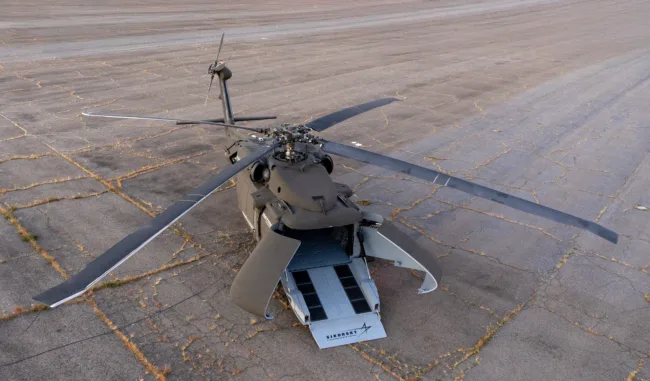
In a striking demonstration of engineering speed and battlefield innovation, Sikorsky, a Lockheed Martin company (NYSE: LMT), has introduced the U-Hawk—an autonomous, uncrewed version of the Black Hawk helicopter. Officially designated the S-70UAS U-Hawk, this new variant is a complete departure from convention. It removes the cockpit and all crew stations, replacing human pilots with MATRIX autonomy technology and a fly-by-wire control system. The result is a reimagined Black Hawk that offers 25 percent more cargo volume, tablet-based mission control, and multi-domain capabilities—all developed in under 10 months.
The U-Hawk prototype was revealed during the 2025 Association of the United States Army (AUSA) exposition in Washington. Its emergence comes at a time when the U.S. Department of Defense and allied militaries are investing heavily in scalable uncrewed logistics systems. With the first flight of the U-Hawk scheduled for 2026, the project underscores how Lockheed Martin aims to extend the life and utility of legacy platforms like the UH-60L through autonomy-first upgrades.

What structural and technological changes were made to turn the UH-60L into a fully autonomous U-Hawk?
The transformation of the legacy UH-60L Black Hawk into the uncrewed U-Hawk was spearheaded by Sikorsky Innovations, the rapid prototyping division within the helicopter manufacturer. Engineers completely removed the traditional cockpit, including flight controls, seating, and instrumentation. In its place, Sikorsky installed clamshell doors and a rear cargo ramp, significantly increasing usable cabin space for oversized payloads.
Technologically, the aircraft is now powered by a third-generation fly-by-wire system designed to be low-cost and retrofit-friendly. The MATRIX autonomy system—a suite of onboard processors, sensors, and machine learning algorithms—serves as the central brain of the U-Hawk. It is capable of generating flight plans, avoiding obstacles, and navigating dynamic environments, all without human intervention inside the aircraft.
This integration marks the first time a Black Hawk airframe has been fully automated and stripped of its piloting infrastructure. Notably, the U-Hawk retains its original side doors for traditional cargo loading and still uses the Black Hawk’s external cargo hook, which can lift up to 9,000 pounds. Internally, new fuel tank options can be added to extend operational range and loiter time, offering versatility for logistics, ISR, and strike support roles.
How does Sikorsky’s MATRIX autonomy enable tablet-based command of the U-Hawk?
Unlike conventional military helicopters that require trained pilots, the U-Hawk can be operated entirely by a tablet interface. Ground operators simply input mission parameters, such as destination, cargo requirements, or time-on-station, and MATRIX generates a complete flight plan.
Once the aircraft is loaded—either via the side door or the new rear ramp—a series of autonomous preflight checks begin. The clamshell doors close, the ramp retracts, and the aircraft lifts off without a pilot on board. Using its suite of cameras, sensors, and terrain-mapping algorithms, the U-Hawk autonomously adjusts for environmental conditions and dynamically reroutes in case of threats or obstacles.
The key advantage here is operational accessibility. Virtually any ground commander can task the U-Hawk without needing aviation training. This opens up the potential for more decentralized logistics planning and rapid support in forward operating environments. It also means higher throughput in contested zones where traditional manned aircraft face greater risk.
What types of missions can the U-Hawk support that conventional Black Hawks cannot?
By eliminating the crew compartment, Sikorsky has unlocked a new class of mission profiles tailored for the autonomy era. The U-Hawk offers approximately 25 percent more internal cargo space than its predecessor, allowing it to accommodate bulkier payloads such as a HIMARS missile pod or two Naval Strike Missiles internally.
The cargo bay can house up to four Joint Modular Intermodal Containers—double the standard load capacity for a crewed UH-60L. Ground vehicles such as the HDT Hunter Wolf 6×6 UGV can drive on and off via the rear ramp, making the U-Hawk ideal for battlefield resupply and unmanned ground coordination.
One of the most forward-looking capabilities involves the launch of “effects” such as drones equipped with sensors or kinetic payloads. Through an innovative quiver launch system, the U-Hawk can deploy a swarm of reconnaissance or strike drones mid-flight. This capability transforms the aircraft into a multi-mission platform supporting not only logistics but also electronic warfare and precision strikes.
Endurance is another critical enhancement. Configured with auxiliary fuel tanks, the U-Hawk can loiter for up to 14 hours or self-deploy across distances exceeding 1,600 nautical miles. That range makes it suitable for maritime operations, humanitarian missions, and ISR roles across wide geographies.
What are institutional investors and defense analysts saying about the U-Hawk’s market potential?
Initial reactions from defense industry observers and institutional analysts have been cautiously optimistic. The ability to repurpose legacy UH-60L airframes into uncrewed autonomous systems represents a strategic bridge between older platforms and modern mission demands. Analysts note that Lockheed Martin’s modular retrofit approach could accelerate deployment timelines while minimizing procurement costs—a major benefit for defense departments facing budgetary pressures.
Institutional sentiment around Lockheed Martin has remained stable since the announcement, with shares of the defense contractor trading around USD 446 as of October 13, 2025. While the U-Hawk program is still in prototype phase, investors see potential in its alignment with broader autonomy-first trends sweeping the defense sector. The U.S. military and allied nations are increasingly prioritizing scalable, attritable, and modular UAS capabilities that reduce risk to personnel.
The U-Hawk also offers Lockheed Martin a competitive foothold in the medium-lift UAS segment, currently populated by Northrop Grumman’s MQ series, Boeing’s cargo UAVs, and emerging vertical lift concepts from defense startups. Its ability to perform multi-mission roles—transport, strike, ISR, and drone launch—without requiring new airframes could translate into export potential once fully certified.
When is the first U-Hawk flight expected, and what’s next in its development timeline?
Sikorsky confirmed that the first flight of the U-Hawk is targeted for 2026, keeping the program on an aggressive but achievable timeline. Following the successful display at AUSA 2025, the prototype is undergoing further systems integration, ground testing, and software validation.
The next stages will likely involve airworthiness certification for the new fly-by-wire system, operational testing with cargo and launch payloads, and defense customer demonstrations. Depending on the use case, future variants may include weapons integration, hardened cyber-resilient communications, and advanced autonomy layers that allow coordinated operation with crewed aircraft in mixed fleets.
Longer term, Sikorsky may offer conversion kits for in-service UH-60 models or pursue direct production of uncrewed variants, depending on interest from the U.S. Army and foreign military sales clients.
As of now, Lockheed Martin has not disclosed specific pricing for the U-Hawk, though the company emphasized that the system is “cost-effective” and leverages the vast global footprint of Black Hawk support infrastructure.
Discover more from Business-News-Today.com
Subscribe to get the latest posts sent to your email.
