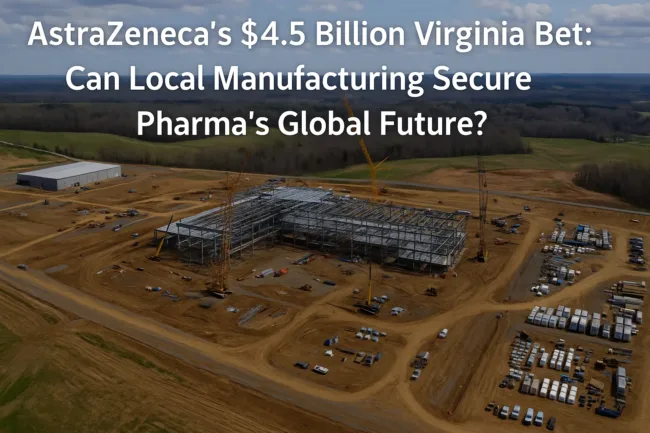
AstraZeneca PLC (NASDAQ: AZN) has broken ground on its largest-ever manufacturing investment — a $4.5 billion active pharmaceutical ingredient (API) plant in Albemarle County, Virginia. The project, expanded by another $500 million to include APIs for its cancer and metabolic portfolios, is part of AstraZeneca’s $50 billion U.S. investment plan through 2030. Beyond infrastructure, this milestone symbolizes a strategic pivot toward domestic production, supply chain resilience, and geopolitical agility in the post-pandemic pharmaceutical landscape.
Analysts interpret the project not just as a factory build but as a realignment of AstraZeneca’s industrial strategy. It fuses production capability with policy positioning at a time when the United States is tightening its stance on imported medicines and incentivizing homegrown drug manufacturing.
Why did AstraZeneca choose Virginia for its $4.5 billion manufacturing site?
The Virginia selection marks a carefully calculated decision. The state offers a combination of workforce depth, infrastructure readiness, and political alignment with U.S. industrial policy goals. AstraZeneca’s decision underscores how state-level incentives are increasingly shaping pharmaceutical investments, mirroring trends seen across technology and clean-energy sectors.
Albemarle County, part of a growing bio-manufacturing corridor, provides access to advanced research institutions and a supportive regulatory ecosystem. For AstraZeneca, this location ensures not only operational convenience but also symbolic weight — signaling commitment to American manufacturing revival and health sovereignty.

The facility will deploy modular, digitally automated production systems, integrating AI-based process optimization to handle next-generation drug chemistries. The plant’s adaptive architecture will allow for multiple drug modalities, ranging from small molecules to complex antibody-drug conjugates (ADCs). This flexibility makes the investment more than just a cost hedge — it becomes a long-term capacity asset for AstraZeneca’s pipeline evolution.
What will the new AstraZeneca API plant produce, and why does it matter?
Initially intended for diabetes and obesity drug manufacturing, the scope of the Virginia plant has widened to include APIs for AstraZeneca’s oncology division — particularly for ADCs and targeted small molecules used in late-stage trials. The inclusion of these high-value therapeutics adds both complexity and profitability potential to the site.
The plant is expected to create around 600 high-skilled roles for scientists, engineers, and process experts, along with nearly 3,000 construction jobs during the build-out phase. Local economic multipliers suggest the project could anchor a new pharmaceutical ecosystem in Virginia, attracting suppliers, contractors, and ancillary biotech firms.
Operational commissioning is projected within four to five years, which, given the plant’s sophistication, is considered an aggressive yet feasible schedule. The investment also positions AstraZeneca to localize manufacturing for drugs targeting metabolic and obesity markets, areas where competition from Eli Lilly’s Mounjaro and Novo Nordisk’s Wegovy has intensified.
How does the project fit into AstraZeneca’s wider U.S. manufacturing and policy strategy?
AstraZeneca’s U.S. expansion is deeply strategic. The Virginia plant is the largest single component of the company’s $50 billion America 2030 investment roadmap, spanning R&D centers, biologics production, and commercial expansion. It aligns with the political drive to “onshore” essential drug manufacturing as Washington pushes for supply chain independence amid ongoing tariff discussions and geopolitical friction.
This initiative also dovetails with AstraZeneca’s policy outreach efforts. The company has reportedly been in active dialogue with U.S. trade officials to secure tariff reliefs and favorable drug pricing frameworks under evolving federal pharmaceutical legislation. By investing locally, AstraZeneca positions itself as a cooperative stakeholder in the government’s reshoring narrative — an optics advantage at a time when global drugmakers are facing scrutiny over pricing and sourcing.
The Virginia project complements AstraZeneca’s other U.S. manufacturing hubs in Delaware and Maryland, creating a vertically integrated network capable of producing APIs, finished formulations, and clinical materials domestically. It also mitigates future risks tied to cross-border logistics disruptions that previously impacted oncology and respiratory product timelines during the pandemic.
How are markets and investors reacting to AstraZeneca’s $4.5 billion investment?
Investor sentiment toward AstraZeneca PLC (NASDAQ: AZN) has trended positive since the announcement. The company’s stock has demonstrated relative stability compared to peers, with modest upside movements reflecting confidence in its long-term strategy. Analysts from major brokerages maintain buy or outperform ratings, citing AstraZeneca’s capital discipline and its balance between innovation and infrastructure growth.
Technical indicators reveal a mildly bullish bias, with moving averages trending upward and investor sentiment scores remaining strong. MarketBeat data shows an average analyst price target implying a 15–20 percent upside, while institutional investors continue holding substantial positions in the stock.
However, sentiment is not unilaterally optimistic. Some market watchers caution that such capital-heavy projects could compress AstraZeneca’s free cash flow in the medium term. Others note that the firm’s reliance on regulatory stability and predictable policy environments introduces long-tail risks. Still, the overall institutional narrative supports the view that this investment strengthens AstraZeneca’s competitive moat in oncology and metabolic therapeutics — two of its highest-growth verticals.
How does this compare to moves by Eli Lilly, Merck, and other global peers?
AstraZeneca’s strategy echoes similar expansions across the sector. Eli Lilly has invested billions in new manufacturing facilities in North Carolina and Virginia, aiming to scale production of its obesity and diabetes treatments. Merck and Pfizer are pursuing comparable expansions in biologics and vaccine capacity, while Novartis continues to diversify its manufacturing footprint in the United States.
What distinguishes AstraZeneca’s approach is the integration of supply chain resilience with therapeutic specialization. While most peers are expanding reactively to meet product demand, AstraZeneca is aligning manufacturing strategy directly with its future drug pipeline. This design-to-pipeline model offers flexibility to produce APIs for multiple drug classes without retooling major systems — a critical differentiator in cost and time efficiency.
From an industry perspective, this shift marks a broader structural pivot toward “pharma de-globalization.” After decades of outsourcing manufacturing to lower-cost countries, global drugmakers are redistributing capacity closer to their key consumer markets, blending logistics resilience with geopolitical prudence. AstraZeneca’s Virginia project is one of the clearest manifestations of that shift.
What are the key risks and variables that could affect AstraZeneca’s execution?
Building an API facility of this scale comes with considerable challenges. The most immediate risk lies in cost overruns and timeline delays. Advanced manufacturing plants often face unforeseen regulatory hurdles, equipment calibration issues, or supply bottlenecks in construction materials.
The second risk stems from policy volatility. Changes in tariff regimes or pharmaceutical incentive structures could affect AstraZeneca’s financial projections. For instance, if future administrations modify drug-pricing frameworks or scale back manufacturing tax credits, the project’s ROI could narrow.
Another critical dependency lies in upstream supply chain localization. Even with domestic API production, AstraZeneca remains reliant on imported intermediates and catalysts, many sourced from Asian suppliers. Unless parallel initiatives address these dependencies, full supply security will remain aspirational.
Finally, technological adaptability will determine long-term competitiveness. The plant must remain compatible with emerging therapeutic modalities like RNA-based small molecules, synthetic biology components, and AI-designed chemical synthesis — areas likely to dominate next-generation pharma.
What should investors and policymakers watch going forward?
Institutional investors should monitor AstraZeneca’s quarterly capital expenditure disclosures and progress milestones for the Virginia site. Variations in cost trajectory or construction timeline could affect medium-term earnings expectations. Analysts also recommend tracking policy developments around U.S. drug pricing and localization incentives, which could influence AstraZeneca’s profitability curve.
For policymakers, AstraZeneca’s project offers a test case for balancing industrial policy with global integration. If the plant demonstrates both scalability and cost efficiency, it could become a model for how U.S.-based API manufacturing can compete globally without protectionist distortions.
In the broader context, this investment aligns with AstraZeneca’s strategic ambition to reinforce its oncology and metabolic franchises, which together contribute over 65 percent of its revenue base. The project is therefore not just a logistics maneuver but an operational backbone for the company’s next decade of growth.
AstraZeneca’s $4.5 billion Virginia API plant signals the pharmaceutical industry’s changing DNA — one that values control, agility, and proximity as much as cost efficiency. Whether the project sets a new benchmark or becomes a case study in capital overreach will depend on its ability to balance innovation with disciplined execution. For now, the move has placed AstraZeneca squarely in the center of a resurgent debate over how — and where — the world’s medicines should be made.
Discover more from Business-News-Today.com
Subscribe to get the latest posts sent to your email.