




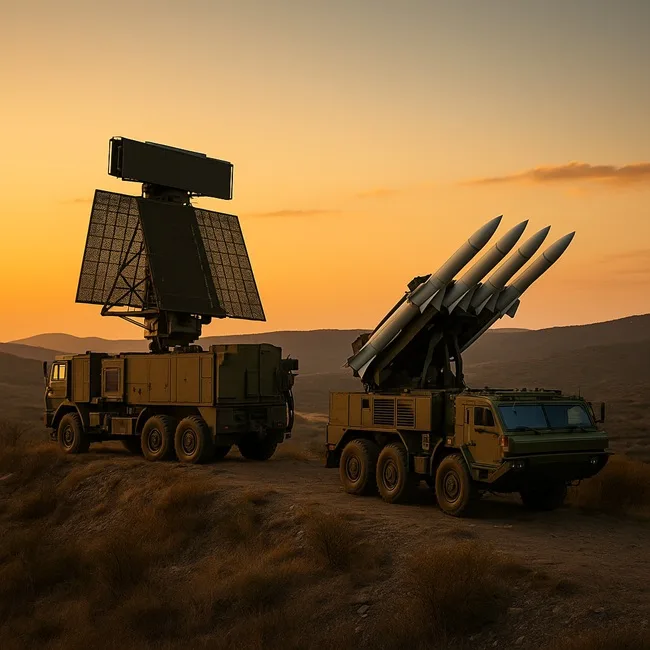
What makes the comparison between India’s Mission Sudarshan Chakra and Israel’s Iron Dome both compelling and incomplete
When Prime Minister Narendra Modi unveiled Mission Sudarshan Chakra on August 15, 2025, the analogy to Israel’s Iron Dome came almost instantly. Television graphics and defence forums dubbed it “India’s Iron Dome moment,” projecting images of interceptor missiles streaking across the sky to protect cities and border towns. But beneath the political symbolism lies a deeper strategic and technological question — can India actually build an air and missile defence ecosystem that matches the responsiveness, accuracy, and integration of Israel’s compact but lethal system?
The answer is complex. Mission Sudarshan Chakra is not a carbon copy of the Iron Dome. It is a much larger and more ambitious project aimed at creating a multi-layered, AI-integrated shield covering civilian zones, strategic installations, and border regions across a subcontinent-sized country. Where Iron Dome focuses on short-range rockets over a compact territory, India’s challenge spans deserts, high mountains, and coastal plains — each demanding different intercept systems, radar geometries, and response timelines.
How Mission Sudarshan Chakra redefines India’s approach to integrated air and missile defence
At its core, Mission Sudarshan Chakra is designed as a system of systems that merges the Army, Air Force, and Navy’s air defence capabilities into a unified sensor-to-shooter network. The framework relies heavily on three technological pillars: the Akashteer command and control grid, Project Kusha long-range interceptors, and emerging directed energy and counter-drone systems.
Akashteer, developed by Bharat Electronics Limited, acts as the real-time backbone. It integrates 3D radars, electro-optical sensors, Akash missile batteries, and communication links into one unified picture. Using artificial intelligence, it shortens the decision cycle between detection and engagement, automatically ranking threats and assigning interceptors based on probability of impact and priority. Defence insiders view Akashteer as the digital nervous system of Sudarshan Chakra, analogous in purpose — though not yet in maturity — to the C2 node that powers Iron Dome.
The second key element, Project Kusha, expands India’s interceptor range to 150–350 kilometres. Unlike Iron Dome’s short-range Tamir missiles, Kusha is being built to counter aircraft, cruise missiles, and even limited ballistic threats. Together with Akash, MR-SAM, and S-400 units already deployed, these systems create a stratified umbrella designed to intercept threats at multiple altitudes.
The third element reflects India’s futuristic intent: incorporating directed energy weapons and soft-kill electronic warfare systems for counter-UAV operations. These will allow the military to disable or destroy drones, loitering munitions, or incoming rockets without expending expensive kinetic interceptors.
Why the Iron Dome analogy resonates but falls short of capturing India’s real challenge
Israel’s Iron Dome has earned global admiration for its efficiency, often claiming interception success rates above 90 percent. Its appeal lies in its precision, automation, and cost-control logic — it fires only when an incoming rocket is predicted to hit a populated or critical area. For India, the concept resonates emotionally and politically, especially after years of cross-border shelling and drone incursions.
However, India’s problem set is dramatically broader. The geographic scale multiplies complexity. Where Israel’s coverage area is roughly 22,000 square kilometres, India must safeguard over three million. The threat spectrum is also more diverse — from ballistic and cruise missiles to hypersonic glide vehicles, swarming drones, and stealth aircraft. Each category requires distinct sensors and intercept logic.
Moreover, India’s institutional challenge is coordination. Air defence responsibilities overlap across the Army, Air Force, and Navy, and unless Sudarshan Chakra creates a seamless data and decision architecture, the system could fragment into silos. Integrating radar data from different services, fusing it into a single air picture, and issuing unified fire commands within seconds is as much an organizational feat as it is a technological one.
Finally, cost is a real constraint. Iron Dome’s Tamir missiles cost around $50,000 apiece — manageable for Israel’s smaller force. India’s equivalent scale would require thousands of interceptors across hundreds of batteries, risking prohibitive expenses unless local manufacturing and modular designs drive costs down.
How Operation Sindoor became the wake-up call that accelerated India’s shield strategy
The urgency behind Sudarshan Chakra is rooted in Operation Sindoor, the cross-border conflict of early 2025, during which Pakistan allegedly targeted civilian areas and religious sites with low-flying drones and short-range rockets. India’s existing radar-missile grid managed to prevent mass damage but revealed serious response gaps at very low altitudes.
That experience crystallized the need for a close-in defensive tier — a rapid-fire gun layer complementing missile and radar coverage. The Army’s subsequent tender for AK-630 30 mm multi-barrel rotary guns represents the first physical manifestation of this doctrine. Adapted from naval platforms, these guns are meant to defend forward areas and population centres against drones, mortars, and artillery.
In effect, Operation Sindoor transformed Sudarshan Chakra from a theoretical framework into an actionable procurement roadmap. It demonstrated that air defence must extend beyond military targets to include civilian and cultural zones, giving the mission both strategic and moral impetus.
Can India’s multi-layered architecture achieve the accuracy, efficiency, and adaptability of Iron Dome?
Iron Dome’s strength lies in its predictive intelligence — its radar and software instantly determine whether an incoming projectile threatens a populated area, then engage or ignore accordingly. For Sudarshan Chakra to emulate that logic, it must perfect target discrimination and intercept prioritization.
India’s Akash missile system already shows promise, achieving first-shot kill probabilities nearing 88 percent under controlled trials. When integrated with Akashteer’s AI-based fire control algorithms, the system could theoretically match Iron Dome’s reactive precision. Early field tests during and after Operation Sindoor suggested improved interception times and coordination among radar nodes and missile batteries.
Still, the challenge lies in scalability and resilience. India’s airspace is vastly more dynamic, with civilian aviation, UAV corridors, and military patrols overlapping. The real test will be whether Sudarshan Chakra can handle sustained saturation attacks while avoiding friendly interference and conserving ammunition.
If the architecture can autonomously triage hundreds of threats across multiple states without human bottlenecks, it will represent a generational leap in command automation — one that could position India as a leader in AI-enabled air defence.
What defence experts say about India’s ambition to build an “Iron Dome plus” ecosystem
Military strategists often describe Sudarshan Chakra as a vision born of necessity, not imitation. They note that India’s decision to integrate gun, missile, and AI-enabled layers reflects a doctrinal shift from hardware accumulation to networked warfare. Analysts also highlight the Army’s willingness to repurpose naval systems such as the AK-630 for land defence as a sign of pragmatic innovation.
However, experts remain cautious. They warn that success depends on flawless sensor fusion and decision synchronization — the ability of radar, guns, missiles, and electronic countermeasures to act as one organism. Even a few seconds of delay in relaying radar data could make the difference between interception and impact.
Defence economists also point out that a nationwide Sudarshan Chakra grid will demand billions in investment over a decade, not only in weapons but also in satellite bandwidth, AI training data, and cybersecurity infrastructure. Without consistent budgetary backing and indigenous R&D momentum, India risks building an incomplete shield.
Still, there’s optimism that collaboration between public and private players — BEL, DRDO, Larsen & Toubro, Data Patterns, and emerging startups in AI-driven defence analytics — could accelerate progress. This cross-sector approach could turn Sudarshan Chakra into a “living architecture,” constantly updated with new sensors, interceptors, and software models.
Can Mission Sudarshan Chakra achieve full operational capability by 2030 and prove its Iron Dome-scale potential?
By 2028–2030, India aims to complete full integration of Akashteer command nodes with Project Kusha interceptors, AK-630 gun batteries, and experimental directed energy weapons. The initial goal is to achieve reliable coverage over high-priority border corridors and urban clusters.
A successful Sudarshan Chakra by that timeline would mean India can simultaneously defend multiple sectors against mixed drone, missile, and artillery attacks without manual coordination delays. It would also mean predictive targeting, AI-driven resource allocation, and minimal collateral risk — the very features that define world-class air defence systems.
Even if India does not match Iron Dome’s exact intercept ratios, a scalable, indigenous, AI-linked defensive web spanning 3.3 million sq km would itself be unprecedented. The mission’s success would mark India’s transition from a reactive posture to a proactive deterrent capability — capable of protecting not just air bases, but the country’s most populated and symbolic spaces.
Discover more from Business-News-Today.com
Subscribe to get the latest posts sent to your email.


