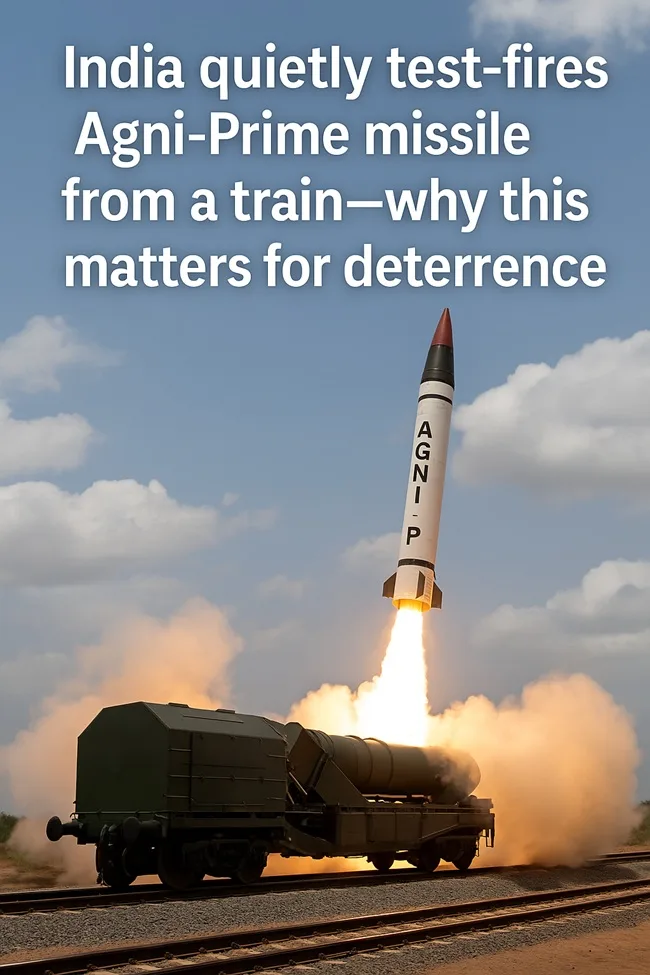
India has successfully conducted the first test of its Agni-Prime ballistic missile from a rail-based mobile launcher, a development that many analysts are calling a watershed moment in the country’s nuclear deterrence architecture. The test, carried out on September 24, 2025, was overseen by the Defence Research and Development Organisation (DRDO) and the Strategic Forces Command. It was designed to simulate a full operational scenario and was declared a complete success.
By validating rail-mobile launch capability, India has joined a small group of countries— including Russia, China, the United States, and potentially North Korea— with the technology to launch long-range ballistic missiles from railway platforms. For a nation that has historically relied on silo-based or road-mobile systems, this milestone significantly enhances survivability, unpredictability, and second-strike capability.
How does Agni-Prime differ from earlier missile systems and what makes rail mobility unique?
Agni-Prime, also referred to as Agni-P, is a next-generation medium-range ballistic missile with a strike range of up to 2,000 kilometres. Unlike heavier predecessors such as Agni-III or Agni-V, Agni-Prime is lighter, canisterised, and designed for rapid deployment. Its compact structure allows it to be launched from both road-based and rail-based systems, offering flexibility across multiple terrains.
The defining feature of this test was the use of a specially developed rail-mobile launcher that can traverse India’s railway network without requiring special track conditions. This means the missile can be transported discreetly across thousands of kilometres and launched from virtually any point along the network. Such a system complicates enemy reconnaissance and makes preemptive strikes against Indian missile assets far more difficult.
Rail-based mobility is not merely about camouflage. It allows the dispersal of launchers across the length and breadth of the country, creating multiple possible launch points and forcing adversaries to account for a wider range of trajectories. Combined with the canisterised design, which permits storage and quick launch readiness, the system represents a leap forward in India’s operational flexibility.
What were the key technical highlights of the test and why are they significant?
During the test, the Agni-Prime missile was launched in a manner consistent with operational protocols rather than experimental demonstrations. The DRDO confirmed that the missile followed a “text-book trajectory” and achieved all mission objectives. The system included a fully integrated communication and command suite, autonomous launch capability, and safety redundancies.
Ground stations and radars tracked the missile from launch to impact, providing real-time performance data. Officials pointed out that the mission demonstrated both the reliability of the missile and the robustness of the new rail-based platform. The success validates years of research into compact propulsion, guidance systems, and mobile launch infrastructure.
Defence Minister Rajnath Singh described the achievement as historic, stating that it firmly places India in an elite league of nations with canisterised rail-launch technology. Senior DRDO officials also emphasised that the test underscored the growing self-reliance of India’s defence industrial base and the operational maturity of its strategic forces.
How does rail mobility enhance India’s nuclear deterrence posture and second-strike capability?
The concept of nuclear deterrence rests on assured retaliation. For India, which follows a declared no-first-use doctrine, survivability of its strategic assets is central to credibility. Until now, India relied on road-mobile launchers and hardened silos, both of which are vulnerable to satellite surveillance and precision strikes.
Rail-mobile launchers change this calculus. They can move continuously across the railway grid, blending with commercial freight trains, and can be positioned in areas difficult to monitor. This makes it far more challenging for adversaries to locate and neutralise launchers in a first strike. The ability to disperse missiles also raises the cost of surveillance for adversaries, who would need to track hundreds of kilometres of railway lines simultaneously.
In effect, rail-based systems increase the survivability of India’s missile arsenal, thereby strengthening second-strike capability. This is particularly critical in the context of regional dynamics with China and Pakistan. With a range of 2,000 kilometres, Agni-Prime covers key strategic locations across both countries, giving Indian planners a credible deterrence shield.
What does the Agni-Prime test mean for regional security and global strategic balances?
The rail-mobile test will be closely scrutinised in both Beijing and Islamabad. For Pakistan, India’s ability to launch missiles from dispersed rail locations makes traditional counter-force strategies less effective. For China, it underscores India’s determination to modernise its nuclear arsenal and develop survivable deterrence.
Internationally, India’s demonstration of rail-launch capability will likely be noted in Washington and Moscow, both of which pioneered similar systems during the Cold War. The United States eventually abandoned rail-mobile launchers due to cost and changing doctrines, while Russia continues to explore such capabilities as part of its nuclear strategy.
Arms control experts may raise concerns about the impact on regional arms races. India has maintained that its programme is defensive and adheres to a no-first-use posture, but such advances inevitably invite scrutiny under the global non-proliferation lens. Balancing transparency with strategic ambiguity will be a key diplomatic challenge for New Delhi.
What operational, logistical, and safety challenges must India address before rail-based Agni-Prime missiles can be fully deployed?
While the test was successful, transitioning from prototype to operational deployment is a complex process. User trials will need to be conducted under different conditions, including extreme climates, varied terrain, and contested environments involving electronic warfare. Integration with India’s command-and-control network is also essential, ensuring that launches can be authorised swiftly but securely.
Rail-based launchers also raise logistical questions. The safety of transporting nuclear-capable missiles across civilian rail networks requires stringent protocols. Infrastructure such as reinforced sidings, dedicated command trains, and secure storage facilities will need to be developed.
Another challenge lies in ensuring operational secrecy. While mobility increases survivability, it also requires careful coordination to prevent accidents, leaks, or sabotage. The integration of advanced encryption, GPS-denied navigation, and redundant communication systems will be critical.
What is the expert view on India’s shift to rail-mobile missile technology?
Defence analysts widely view the test as a major strategic breakthrough. Experts have underlined that survivability is the currency of deterrence, and India’s move towards diversified launch platforms demonstrates maturity in nuclear planning. Some analysts argue that it represents the most significant advance in India’s missile programme since the induction of submarine-launched ballistic missiles.
However, experts also caution that operationalising the system will take years of testing and investment. They note that India must balance capability building with diplomatic communication to avoid misunderstandings. The fact that the launch location was not publicly disclosed reflects the sensitivity of the technology and its implications for security planning.
What are the key takeaways from India’s Agni-Prime rail launch and how will it shape the future of strategic mobility and deterrence?
The successful firing of Agni-Prime from a rail-based launcher marks a transformative step in India’s strategic weapons programme. It provides the country with enhanced flexibility, greater survivability, and the ability to maintain credible deterrence against adversaries with larger nuclear arsenals.
At the same time, it underscores India’s capacity to indigenously develop and integrate sophisticated missile systems with mobile launch technology. The next phase will be about scaling production, integrating with the armed forces, and conducting rigorous user trials to ensure reliability under all conditions.
If India can operationalise rail-mobile launchers at scale, it will fundamentally alter the deterrence equation in South Asia. The technology not only strengthens India’s nuclear doctrine but also signals its arrival as a nation capable of matching global standards in strategic mobility. For adversaries, the test is a reminder that India’s deterrent is no longer tethered to fixed locations or predictable routes. For India, it is a moment of technological confidence and strategic reassurance—missiles on the move, ready to defend the nation’s sovereignty.
Discover more from Business-News-Today.com
Subscribe to get the latest posts sent to your email.