




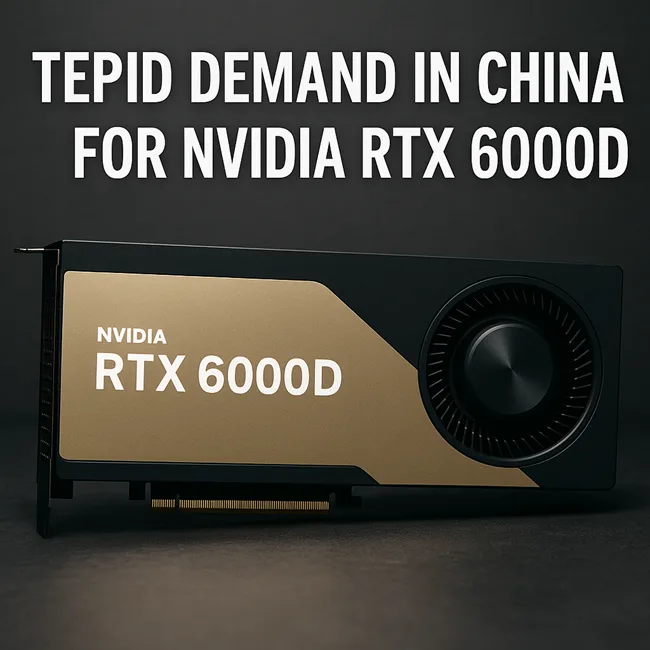
Nvidia Corporation (NASDAQ: NVDA) has found itself navigating a rocky debut for its latest China-specific graphics processing unit, the RTX6000D. According to a Reuters report citing multiple procurement sources, Chinese technology giants including Alibaba Group Holding Limited, Tencent Holdings Limited, and ByteDance Ltd. are showing little interest in placing orders for the new chip. Early tests suggest that the RTX6000D does not deliver enough performance to justify its steep price tag, leaving many potential buyers hesitant to allocate budgets.
Priced at around 50,000 yuan, or roughly US$7,000, the RTX6000D is targeted at AI inference workloads. But in practice, its value proposition is being undermined by comparison with Nvidia’s own RTX5090, which—despite being barred from official export under U.S. trade restrictions—is widely available in China through grey market channels for less than half the cost. Sources quoted in the Reuters coverage suggested that engineers testing the RTX6000D found it to lag behind the RTX5090 in several key performance metrics, further dampening enthusiasm.
How do U.S. export controls shape Nvidia’s chip strategy for the Chinese market?
The RTX6000D is not a normal product cycle release but a tailored response to escalating U.S. government restrictions on advanced semiconductor exports to China. In October 2022, the U.S. Commerce Department imposed sweeping curbs on the export of high-end AI chips, limiting not only raw performance but also bandwidth and interconnect capacity. Nvidia responded by creating a family of “D”-series and “A”-series chips specifically engineered to comply with these restrictions.
The RTX6000D joins earlier restricted-compliant models such as the H20 and the upcoming B30A. These products are designed to fill a demand gap in China’s hyperscale data centers, but they inevitably sacrifice throughput compared to Nvidia’s top-end models like the A100, H100, or RTX5090. Chinese buyers—well aware of what the unrestricted versions are capable of—appear reluctant to settle for less when alternatives, whether through local substitutes or grey market imports, remain available.
This mismatch between policy-driven supply and market-driven demand illustrates the broader challenge Nvidia faces: balancing compliance with Washington while maintaining relevance in one of its largest global markets.
What pricing and performance issues are holding back Chinese demand for the RTX6000D?
At 50,000 yuan, the RTX6000D’s list price positions it as a premium chip. Yet in terms of raw performance, it has been described as underwhelming when stacked against cheaper, restricted models like the RTX5090. For China’s largest cloud providers and internet platforms, which operate at scale, such performance-per-dollar discrepancies become magnified.
Industry insiders told Reuters that early benchmarks of the RTX6000D highlighted clear deficits in compute density and inference throughput compared to expectations. Meanwhile, the RTX5090—though technically not sanctioned for sale in China—can be procured through secondary channels at about 20,000 yuan, less than half the RTX6000D’s official price.
This reality creates a difficult business case for procurement teams. Why pay a premium for a compliant but weaker chip when better-performing models are available at a lower cost? Until Nvidia closes this price-to-performance gap, Chinese demand is unlikely to recover meaningfully.
How are Chinese firms weighing Nvidia chips against domestic semiconductor alternatives?
Another dimension shaping the RTX6000D’s reception is the accelerating push for semiconductor self-sufficiency in China. Beijing has prioritized domestic chip development under its “Made in China 2025” strategy, pouring billions into firms such as Huawei’s HiSilicon, Biren Technology, and Moore Threads. These companies are racing to produce AI accelerators and GPUs that can substitute for restricted foreign offerings.
While domestic chips have yet to match Nvidia’s global benchmarks in many categories, the combination of policy support, pricing competitiveness, and long-term supply security makes them appealing alternatives. For Chinese hyperscalers under pressure to reduce dependence on U.S. technology, a half-step solution like the RTX6000D offers little incentive to shift procurement strategies.
Why did Nvidia stock react to weak RTX6000D demand reports and what does it signal for investors?
Following reports of lackluster demand for the RTX6000D, Nvidia shares slipped by about 1.4 percent in early trading, reflecting concerns over the company’s China growth trajectory. China accounts for an estimated 20 to 25 percent of Nvidia’s data center revenue, making it a critical segment despite export curbs.
Institutional sentiment around Nvidia remains cautious but not uniformly bearish. Some analysts, such as those at Morgan Stanley, had previously projected sales of up to 2 million RTX6000D units in the second half of the year. The Reuters revelations suggest that these projections may be optimistic, raising questions about Nvidia’s short-term revenue mix.
FII/DII flows, particularly in Asia, also highlight divergence in sentiment. While foreign institutional investors have continued to rotate into Nvidia on long-term AI optimism, domestic institutional flows in China are increasingly moving toward local semiconductor equities. For Nvidia stockholders, this creates a tension: the global AI thesis is intact, but China’s near-term contribution could fall short.
For investors, the situation suggests a hold bias rather than aggressive accumulation. Those already long may find comfort in Nvidia’s dominance in non-Chinese markets, while new buyers may prefer to wait for clarity on product traction in restricted regions before committing at current valuations.
How does the RTX6000D compare with Nvidia’s past strategy of “China-compliant” chips?
This is not Nvidia’s first attempt to carve out a regulatory-friendly product line for China. In late 2023, the company introduced the A800 and H800 GPUs, stripped-down versions of the A100 and H100. Those products initially gained traction but ultimately faced similar headwinds: performance compromises, high costs, and uncertainty around future restrictions.
The RTX6000D appears to be repeating this cycle. It serves as a reminder that while Nvidia can technically engineer compliant chips, winning adoption requires more than compliance—it requires aligning with customer expectations on value, performance, and scalability. Unless that equation is recalibrated, history may continue to repeat itself with muted sales.
What does the weak launch of RTX6000D reveal about the broader AI hardware market in China?
The RTX6000D’s struggles underscore the reality that the Chinese AI hardware market is fragmenting. On one side, U.S. companies like Nvidia remain powerful but constrained, forced to deliver neutered versions of their best products. On the other side, domestic Chinese firms are accelerating efforts to close the technology gap, buoyed by state policy, capital investment, and growing demand.
This bifurcation has implications for the global AI industry. If Nvidia’s China-specific chips consistently underperform, it risks ceding long-term market share to emerging domestic rivals. At the same time, Chinese cloud providers may increasingly diversify their supply chains away from U.S. companies, reshaping the global competitive landscape in AI computing.
What comes next for Nvidia’s China strategy and investor outlook?
For Nvidia, the near-term outlook hinges on two factors: the approval and performance of the upcoming B30A chip, and the pace of shipments for the already approved H20. Should these products deliver more favorable price-performance metrics, Nvidia could regain some traction in China.
Investors, however, will remain laser-focused on whether China can continue to contribute meaningfully to Nvidia’s top line. For fiscal 2024, Nvidia’s revenue surged past US$60 billion on the back of AI demand. Yet the China contribution could flatten unless the company recalibrates.
Longer term, analysts expect Nvidia to double down on non-Chinese markets, particularly in the U.S. and Europe, where demand for AI chips in cloud computing and sovereign AI projects remains robust. But the China problem will linger: without resolving pricing and performance concerns, Nvidia risks being seen as a company that complies with regulations but fails to capture market sentiment in one of the world’s largest AI growth arenas.
Why Nvidia’s RTX6000D launch is more than just a chip story
The RTX6000D’s weak reception is not simply a question of sales volume. It encapsulates the complexities of geopolitics, regulatory compliance, and shifting market dynamics in global semiconductors. Nvidia’s dominance in AI computing is intact, but the company now faces a parallel challenge: sustaining growth in regions where politics override technology.
For investors, this means staying alert to institutional flows and quarterly disclosures that reveal the real impact of China-specific chips. For policymakers, it demonstrates how export controls are reshaping market behavior, sometimes in ways that leave both sides dissatisfied.
And for Nvidia, it marks a reminder that winning in AI is not just about building the fastest chips—it is also about aligning with market realities, regulatory frameworks, and competitive ecosystems that are changing faster than ever.
Discover more from Business-News-Today.com
Subscribe to get the latest posts sent to your email.