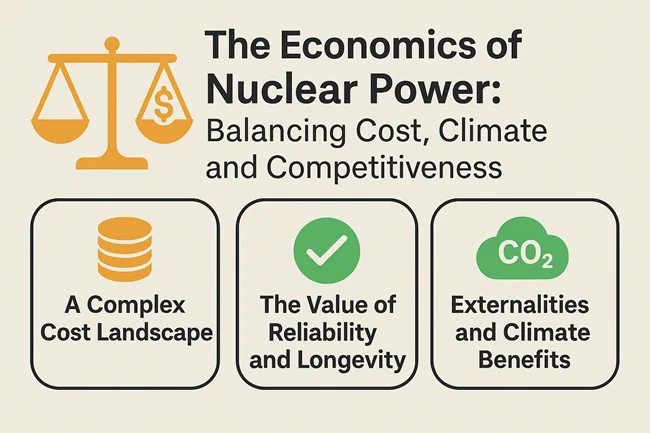
Nuclear energy is a paradox in the global power market. It is lauded as one of the most reliable low-carbon electricity sources, yet regularly criticised for eye-watering upfront costs. The economics cannot be boiled down to a single figure; they involve capital expenses, financing hurdles, operational longevity, and the hard-to-price value of climate benefits. Traditional gigawatt-scale reactors require multibillion-dollar investments and construction timelines that can stretch a decade or longer. By contrast, wind farms and solar parks can be deployed in a matter of months. The International Energy Agency (IEA) has repeatedly observed that nuclear projects face long lead times and a patchy record of meeting deadlines, creating hesitation among investors. This cost-time imbalance has often left nuclear trailing cheaper and faster competitors such as natural gas, wind and solar.
Why nuclear’s longevity and reliability alter the economic picture
Looking at nuclear solely through the lens of upfront costs misses its most powerful economic lever: time. Reactors are designed to operate for 60 years or longer, and they achieve capacity factors consistently above 90 percent. This means they deliver more energy per unit of installed capacity than variable renewables, which hover in the 20–40 percent range depending on geography. When these metrics are plugged into levelised cost of energy (LCOE) calculations, nuclear power begins to look competitive. The IEA estimates that extending the life of existing reactors by 20 years is one of the cheapest sources of low-emission electricity available. These extensions avoid the capital intensity of new builds while slashing carbon emissions by displacing fossil-fuel generation.
How climate benefits and externalities shift the balance in nuclear’s favor
Conventional cost comparisons rarely account for the externalities of carbon. Yet nuclear has prevented nearly 70 gigatonnes of CO₂ emissions over the past half-century, according to the IEA. Without its contribution, emissions from the power sector in advanced economies would have been 60 gigatonnes higher. When a value is assigned to avoided emissions through carbon taxes or cap-and-trade programs, nuclear’s economics improve dramatically. Markets that pay for dispatchable low-emission power through capacity or ancillary services add even more weight to the value proposition. Once climate benefits and system services are factored in, nuclear competes not just on cost per kilowatt-hour but on the holistic economics of decarbonisation.
Why financing models and risk-sharing mechanisms make or break projects
Capital intensity remains the biggest barrier to new reactors, making financing models critical. Government loan guarantees, contracts for difference, and regulated asset base frameworks can cut borrowing costs and attract private capital. In the United Kingdom, for example, regulated asset base models allow costs to be recovered from consumers gradually, reducing risk for investors. The IEA stresses that clear policy signals and stable regulation are essential for lowering the cost of capital. Where policy uncertainty lingers—around electricity pricing, carbon credits, or regulatory approval—projects become riskier, driving up financing costs and delaying construction.
Can nuclear really compete with renewables and gas when reliability is priced in?
For policymakers, the true comparison goes beyond headline costs. Wind and solar have achieved record price declines, now producing some of the cheapest electricity globally, but their intermittency demands large investments in storage and grid balancing. Gas plants provide flexibility but are carbon-intensive and exposed to volatile fuel prices. Nuclear occupies a unique position, offering dispatchable, carbon-free baseload power. Studies of system-wide costs show that grids with substantial nuclear generation often achieve lower overall costs than those relying solely on renewables plus storage, precisely because nuclear reduces the need for costly backup infrastructure.
Will small modular reactors and advanced designs solve nuclear’s cost dilemma?
Small modular reactors (SMRs) are being promoted as the economic reset button for nuclear power. Their smaller size reduces upfront capital, while the potential for mass production could drive down costs through economies of scale. Early SMR projects are expensive, but advocates argue that learning-by-doing will improve cost competitiveness. Advanced reactors using molten salts, sodium, or high-temperature gas also promise higher thermal efficiencies, which could enhance economics over time. If developers succeed in standardisation and modularity, nuclear’s cost profile may look very different in the next two decades.
What lessons can be learned from past cost overruns and rare success stories?
Recent history offers cautionary tales. Finland’s Olkiluoto 3 and France’s Flamanville 3 both suffered multiyear delays and cost blowouts running into billions of euros. Georgia Power’s Vogtle units 3 and 4 in the U.S. have also become notorious for overruns. These failures highlight the risks of first-of-a-kind designs and supply-chain weaknesses. Yet South Korea’s standardised APR-1400 fleet shows a contrasting path: reactors delivered closer to budget and schedule, including the export-built Barakah plant in the UAE. These cases suggest that disciplined project management, standardisation, and mature supply chains are critical for nuclear’s economic viability.
How much do decommissioning and waste really add to nuclear’s economic bill?
Critics often highlight the “back-end” costs of nuclear, including decommissioning and waste disposal. These expenses typically account for 9 to 15 percent of lifecycle costs. Most countries require operators to set aside funds during operation, but cost underestimation can expose taxpayers to liabilities. The UK and Germany have established dedicated nuclear liabilities funds, while others rely on operator-managed accounts. Proponents counter that, with proper planning, decommissioning is financially manageable and can even generate new employment while repurposing sites for other industries.
What happens to energy markets when nuclear is abandoned?
The economics of nuclear also reveal themselves when capacity is removed. Germany’s phase-out under the Energiewende led to higher electricity prices and increased coal and gas dependency, with emissions fluctuating as a result. The Ifo Institute estimated that the decision cost households and industries tens of billions of euros. California’s plan to shutter Diablo Canyon raised alarms about potential 10 percent emissions increases and higher consumer bills. In contrast, Sweden and South Korea maintained or expanded nuclear, stabilising power prices and meeting climate goals. The cost of abandoning nuclear, therefore, is not simply financial—it is systemic.
Why new market designs and financial innovation are crucial for nuclear survival
In liberalised markets, electricity sales alone cannot sustain nuclear plants. Innovative financial tools, such as contracts for difference and capacity markets, are increasingly necessary to bridge the gap. These models guarantee revenue streams, hedge against price volatility, and value reliability alongside generation. Such mechanisms, already familiar to renewables, could equally underpin nuclear. The IEA argues that recognising the full system value of dispatchable low-carbon power is central to keeping nuclear in the mix.
How should the true costs of nuclear power be assessed beyond construction price tags and overruns?
Nuclear energy’s economics are not as bleak as the sticker price of new reactors suggests. High capacity factors, decades-long operating life, and enormous climate benefits make nuclear a strategic asset. The sector’s challenge lies in controlling budgets, standardising designs, and earning public trust. Governments have a role in de-risking projects, especially for SMRs and advanced reactors, where early costs will be steep. In a climate-constrained world, dismissing nuclear on cost grounds alone risks ignoring its long-term value.
How are utilities and vendors navigating nuclear’s investment climate?
Investor sentiment toward nuclear splits along operational lines. Utilities such as France’s EDF and Duke Energy in the U.S. are rewarded for their operating fleets, which generate stable cash flows and benefit from government decarbonisation incentives. Yet companies building new reactors face skepticism after high-profile overruns. Reactor vendors show a similar divide: Westinghouse, now private-equity owned, and NuScale, a publicly traded SMR developer, attract attention for advanced technologies but remain under scrutiny for execution risk. Overall, investors remain bullish on operating assets but cautious about new builds—a reflection of nuclear’s enduring value and persistent risk.
Discover more from Business-News-Today.com
Subscribe to get the latest posts sent to your email.