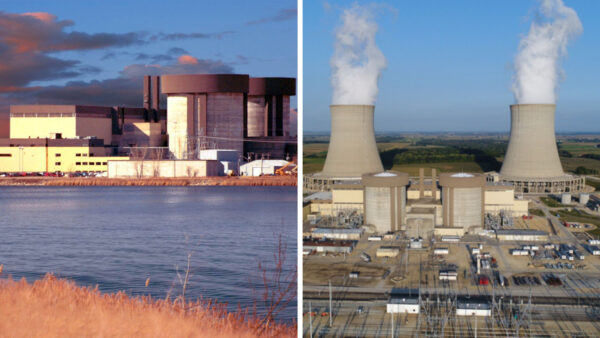



The United States is entering a new phase of accelerated electricity demand growth that is upending decades of grid planning assumptions. The primary drivers of this surge are AI data centers, semiconductor fabrication facilities, electric vehicle charging infrastructure, and the broader trend of industrial reshoring. These emerging loads are pushing the grid to its operational limits, with utilities and grid operators scrambling to source enough capacity to meet future baseload and peak demands.
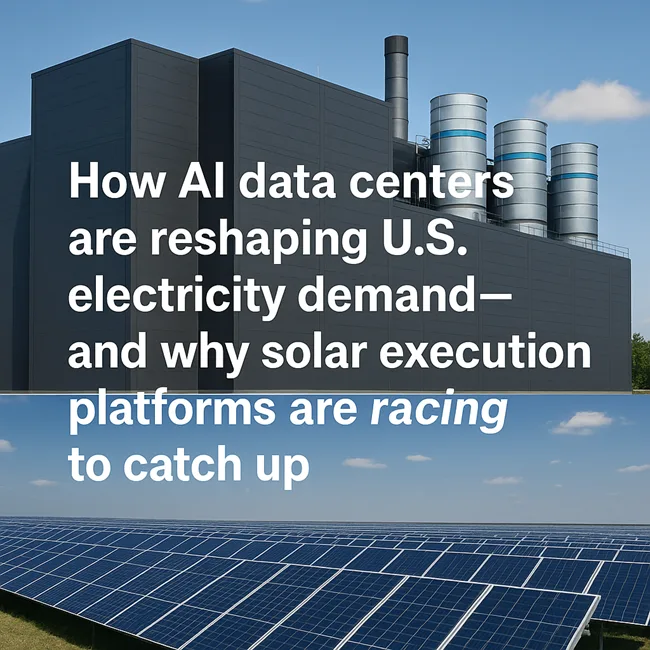
Among these, AI data centers have emerged as the most disruptive force in grid planning. Generative AI workloads require enormous amounts of compute power, which in turn translates into enormous electricity demand. A single next-generation AI data center campus can draw between 100 and 500 megawatts, which is equivalent to the electricity use of a medium-sized city. States such as Virginia, Ohio, Texas, and Georgia are already witnessing strained reserve margins due to a combination of new data center approvals and industrial activity.
According to recent projections from the U.S. Energy Information Administration, national electricity demand is expected to grow by 25% by 2030, reversing decades of relative stagnation. Analysts agree this surge is structural rather than cyclical, with cloud computing, EV adoption, and industrial automation contributing to a new normal. Against this backdrop, utilities are being forced to revise their demand forecasts upward and fast-track capacity procurement. However, fossil fuel additions face environmental restrictions and community opposition, while nuclear expansion remains a decades-long endeavor. This makes renewable energy—particularly utility-scale solar and battery storage—the most viable near-term solution for meeting the surging demand.
How fast is renewable energy growing—and why is execution speed now the limiting factor?
Solar and battery storage are experiencing a historic boom in capacity additions. According to industry forecasts, they are expected to account for more than 93% of new capacity additions in the U.S. in 2025. The Inflation Reduction Act has accelerated this momentum by introducing long-term tax credits, bonus incentives, and demand-pull mechanisms across residential, commercial, and utility-scale segments. Yet despite this rapid growth on paper, the reality on the ground remains more complex.
Execution delays have become the primary constraint in deploying new solar and storage assets. Project developers are routinely slowed down by complex permitting processes, compliance hurdles tied to tax credit qualification, documentation disarray, and bottlenecks in the interconnection process. This execution lag not only delays time to revenue but also introduces financial penalties and project attrition risks. It is no longer sufficient for developers to secure financing and land. They must now also manage multi-stakeholder workflows with high levels of precision and compliance integrity.
Against this backdrop, speed has become the most valuable currency in clean energy development. Being first to reach notice-to-proceed or close financing can mean securing critical interconnection positions or tax equity allocations. The ability to accelerate execution without compromising documentation quality is increasingly seen as a strategic advantage—and a necessity for scaling renewable energy deployment in line with national targets.
What are interconnection delays, and how are they slowing down the clean energy rollout?
Interconnection has emerged as one of the most significant chokepoints in U.S. clean energy deployment. Before any solar or battery project can begin construction, it must be approved by a grid operator through a technical study that assesses the project’s impact on local and regional reliability. These studies often take years due to an overwhelming number of applications and limited engineering resources.
As of 2025, more than 2,600 gigawatts of generation and storage capacity are waiting in interconnection queues across the United States. This backlog reflects an outdated system designed for large, centralized fossil power plants—not for thousands of distributed renewable energy projects. In regions like PJM Interconnection and Midcontinent ISO, developers may wait up to four years to receive a signed interconnection agreement. Delays of this magnitude stall financing, construction, and commissioning schedules, resulting in significant opportunity costs.
Interconnection is not just a technical bottleneck—it is a financial and compliance bottleneck as well. Projects that cannot interconnect on time risk missing out on tax credit deadlines, forfeiting customer delivery obligations, and triggering penalty clauses in offtake agreements. This risk is further compounded when project teams are managing multiple assets in different geographies without centralized tools.
Clean energy software platforms that can track interconnection status, flag regulatory deadlines, and surface queue risks early are rapidly becoming indispensable. These platforms provide developers with the visibility and coordination needed to navigate a highly constrained grid planning environment.
Why compliance and tax credit complexity are overwhelming traditional energy workflows
The compliance landscape for renewable energy projects has evolved dramatically with the passage of the Inflation Reduction Act. The legislation offers lucrative tax credit bonuses to projects that meet a wide range of requirements, including prevailing wage rules, apprenticeship thresholds, domestic content usage, siting within Energy Communities, and low-income benefit provisions.
While these incentives can increase project internal rates of return by 10 to 30 percent, they also introduce significant compliance complexity. Developers must gather, verify, and store large volumes of documentation, from subcontractor payroll records and domestic sourcing certifications to zoning permits and geospatial eligibility maps. For most development firms, this is a labor-intensive process that remains reliant on spreadsheets, shared drives, and third-party legal reviews.
The stakes are high. Failure to meet documentation requirements can lead to disqualification from bonus credits or trigger audits that delay deal execution. Legal and advisory costs are escalating as developers attempt to navigate the shifting compliance landscape while keeping pace with deal timelines. As one institutional investor recently noted at a climate finance roundtable, the bottleneck is no longer capital—it’s compliance readiness.
Platforms like Euclid Power have stepped in to address this pain point directly. By using AI to tag, extract, and standardize project documentation, Euclid helps developers maintain audit-ready files, track tax credit eligibility in real-time, and enforce regulatory timelines across stakeholders. In doing so, it transforms compliance from a risk to a workflow advantage.
How project execution platforms like Euclid Power are accelerating clean energy deals
Euclid Power is emerging as one of the most important execution-layer platforms in the clean energy space. Founded in 2021, the company describes itself as the “operating system” for renewable energy development, combining AI-driven workflow automation with deep domain expertise in solar and battery project lifecycles.
The platform currently supports over 1,000 projects representing more than 12 gigawatts of capacity. It has enabled over $10 billion in transaction volume by helping clients like Apollo Global Management, UBS, and Catalyze reduce diligence and documentation timelines from months to days.
In September 2025, Euclid raised $20 million in Series A funding led by Venrock, with participation from HSBC Asset Management, Spero Ventures, Toba Capital, Designer Fund, and Commonweal Ventures. The capital will be used to expand its AI capabilities, product suite, and services team to meet surging market demand.
Euclid Power’s core differentiation lies in its ability to integrate technical, legal, and commercial workflows into a single cloud-based platform. Its AI engine parses project documentation, highlights risk indicators, extracts cost lines and deadlines, and delivers centralized visibility to all project participants. This orchestration layer allows developers to move faster, with more precision, and with greater confidence in regulatory and financial outcomes.
According to Venrock partner Ethan Batraski, customers are increasingly willing to pay Euclid not just for tools, but to run the workflows that underpin project delivery. This marks a shift from traditional SaaS to execution-as-a-service—an emerging category within climate tech.
What’s next for AI-infrastructure-aligned energy platforms in 2025 and beyond?
The alignment between AI infrastructure growth and clean energy execution platforms is just beginning. As the U.S. grid adapts to a future shaped by high-performance computing, electrified transport, and regional industrial hubs, the demand for rapid renewable deployment will only intensify.
Platforms like Euclid Power are likely to expand into adjacent capabilities, including real-time interconnection queue tracking, utility integration, ESG reporting automation, and digital interfaces for tax equity and debt providers. As clients scale their asset portfolios, Euclid’s value will increasingly come from portfolio-level risk management and compliance orchestration.
At a macro level, the demand for software that enables execution speed and regulatory clarity will become systemic. Developers, financiers, and policymakers will rely on these platforms not only to deploy clean energy—but to ensure that deployment happens within the increasingly tight timelines imposed by load growth, policy incentives, and investor expectations.
Why execution-layer software could be the missing link in America’s clean energy transition strategy
The clean energy transition is no longer bottlenecked by ambition or capital—it is bottlenecked by complexity. The infrastructure exists, the financing is available, and the policy frameworks are largely in place. What is missing is the execution layer: the digital infrastructure that ensures projects can move from paper to power plant at the speed and scale the moment demands.
AI data centers are not waiting. Neither are electric vehicles, industrial clusters, or climate mandates. In this high-stakes environment, platforms like Euclid Power are no longer optional—they are foundational. As America races to meet its energy transition targets, the true advantage may not lie in megawatts alone—but in the software that makes them real.
Discover more from Business-News-Today.com
Subscribe to get the latest posts sent to your email.