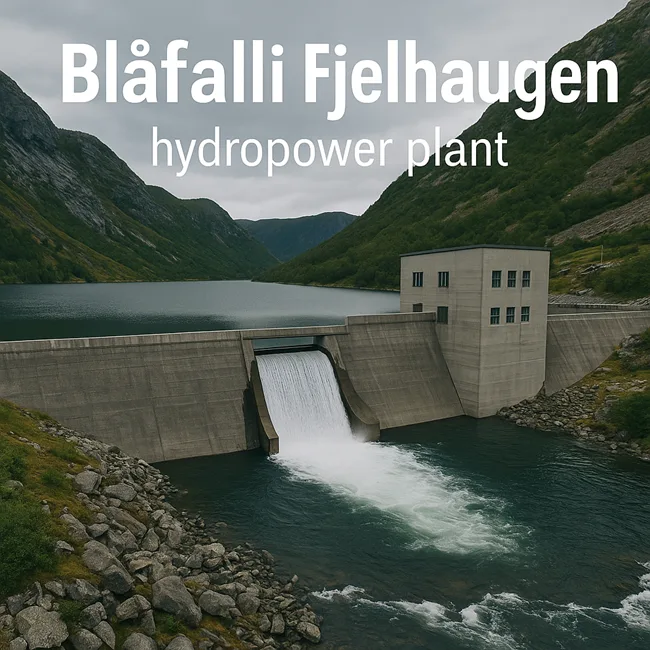
Sunnhordland Kraftlag (SKL) has officially signed construction and supplier contracts for the Blåfalli Fjellhaugen hydropower plant, marking one of the largest hydropower development initiatives in Norway in two decades. With site activities set to commence in September 2025, the Kvinnherad-based project will add 185 megawatts (MW) of new regulated capacity to the national grid and deliver an estimated 70 gigawatt-hours (GWh) of additional annual generation.
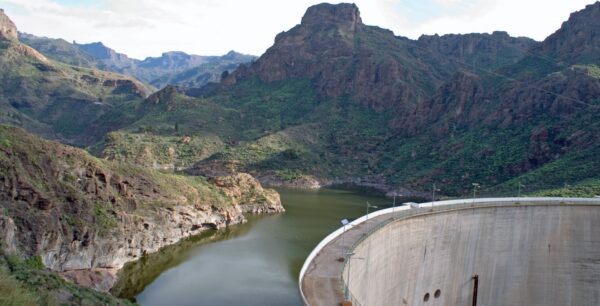
Developed within the already operational Blådalsvassdraget water system in Vestland county, Blåfalli Fjellhaugen represents a cornerstone in SKL’s long-term hydropower upgrade strategy. Once commissioned, the new facility will raise total installed capacity in the Blådalsvassdraget system to approximately 550 MW and lift annual output to 1.7 terawatt-hours (TWh)—a level equivalent to the average electricity consumption of over 100,000 Norwegian households.
What makes the Blåfalli Fjellhaugen hydropower project one of the most significant developments in Norway’s energy sector?
The scale, regulatory integration, and long preparation timeline of Blåfalli Fjellhaugen underscore its national significance. According to SKL Chief Executive Officer John Martin Mjånes, the project is the result of over two decades of consistent modernization efforts across the Blådalsvassdraget catchment. “This is a big and important day for SKL,” he stated, crediting the milestone to sustained planning and strong partnerships with suppliers across the Norwegian and European energy ecosystem.
Project manager Kjetil Heimvik emphasized the decade-long preparation timeline, calling it “a project we have been working on for well over ten years.” The green light follows updated licensing submissions in 2023, after initial permits were pursued as far back as 2014 before being shelved.
Institutional observers consider the project to be a bellwether for modern regulated hydropower deployment in the Nordics—balancing environmental constraints, underground construction, and digitalized plant management systems. The decision to build within an existing regulated basin improves system flexibility and strengthens baseload reliability, particularly in the context of variable wind and solar penetration across Europe.
How will the construction phase of the Blåfalli Fjellhaugen power station be executed and who are the key contractors involved?
The construction timeline is expected to span approximately four years, with commissioning targeted for late 2029. Norwegian contractor Leonhard Nilsen & Sønner (LNS) will lead tunnelling and underground station development, beginning with excavation at Midtbotnvatn and Fjellhaugvatn—both of which are existing regulation reservoirs.
The turbine and main mechanical systems will be delivered by Aker Solutions, whose SVP Hydropower, Simen Vogt-Svendsen, noted the company’s contribution is grounded in 170 years of turbine engineering and execution reliability. “We are excited to contribute to one of the largest new hydropower developments in Norway this decade,” he said, framing the effort as part of a broader modern grid readiness strategy.
Other technology and equipment partners include Hitachi Energy, supplying the 420kV GIS transformer system with SF6-free technology; Andritz Hydro, providing plant control systems and generator-level high-voltage hardware; and Lysaker & Thorrud, responsible for mechanical waterway components. Konecranes will deliver crane infrastructure for the machine hall, and Norconsult is providing end-to-end planning and engineering consultancy.
What does the water intake design and energy routing strategy look like for this underground hydropower facility?
The design of Blåfalli Fjellhaugen centers on an underground powerhouse, with intake systems drawing from several existing sources including Midtbotnvatn, Sandvatn, and brook intakes at Kvanngrøhorga and Verahaugen. Discharge will occur via Fjellhaugvatn, enhancing regulation potential across the broader Blåfalli cascade system.
By optimizing tunnel routing and centralizing new intake-discharge points within already-regulated basins, SKL aims to minimize environmental impact while increasing regulation capacity. The modular configuration also improves the operational synergy of other facilities in the Blådalsvassdraget chain.
With full deployment, the total annual production of the watercourse—1.7 TWh—will serve as a crucial renewable energy backbone for Western Norway and is expected to strengthen grid stability during peak demand months.
How are institutional stakeholders viewing SKL’s strategy in the current energy transition environment?
While SKL is not a publicly traded entity, institutional energy analysts see the project as a meaningful signal of renewed hydropower investment appetite in Europe. Amid growing pressure to firm up intermittent renewable output, regulated hydropower remains among the most cost-effective and grid-complementary options for long-term energy storage and dispatchable power.
Observers have noted the project’s alignment with Norway’s dual-track strategy of leveraging legacy hydro assets while supporting new generation that can integrate with both domestic loads and cross-border transmission. With EU carbon targets tightening, the capacity and regulatory flexibility of assets like Blåfalli Fjellhaugen offer an edge in balancing supply-demand asymmetries.
Moreover, the use of SF6-free technology and underground tunnelling underscores a growing trend of embedding environmental and emissions safeguards into large-scale hydro builds, even when renewables are already assumed to be climate-positive.
What is the expected impact of Blåfalli Fjellhaugen on Norway’s renewable energy portfolio by 2029?
By the time the Blåfalli Fjellhaugen hydropower plant becomes fully operational in late 2029, the facility is expected to serve a dual strategic purpose: reinforcing Western Norway’s renewable energy backbone while acting as a critical grid stability asset across the broader Nordic and continental European power networks. With 185 megawatts of newly installed regulated hydropower capacity, the project will enhance fast-response frequency control and short-term load balancing capabilities, providing flexibility that intermittent renewables such as wind and solar cannot match. In parallel, the incremental 70 gigawatt-hours of annual energy output will expand Norway’s surplus of clean electricity, contributing to both domestic resilience and cross-border energy exports via interconnected transmission systems, including NordLink and North Sea Link.
From an energy policy standpoint, the commissioning of Blåfalli Fjellhaugen aligns closely with the European Union’s post-2022 energy security doctrine, which emphasizes decentralised, dispatchable, and long-duration storage solutions as part of grid fortification measures. As a result, Sunnhordland Kraftlag may find that the project’s relevance extends well beyond Norway’s traditionally regulated tariff framework. Analysts suggest that once operational, the plant could benefit from new market-based revenue streams through capacity remuneration mechanisms (CRMs), ancillary services markets, and bilateral balancing contracts—particularly as EU member states modernize their approach to firming capacity procurement under the Clean Energy Package.
Moreover, as regulated hydropower regains visibility in European climate financing and infrastructure strategies, long-lead assets like Blåfalli Fjellhaugen are likely to attract institutional interest not only for their carbon-free generation credentials but also for their role in grid inertia and voltage support. The facility’s underground build, advanced control systems, and integration with existing reservoirs position it as a technically mature solution to 21st-century grid volatility—especially as policy debates around long-duration energy storage (LDES) pivot from lithium-centric models to proven hydro frameworks.
If SKL chooses to monetize the asset through future carbon offset programs or grid reserve markets, the plant could serve as a financial as well as operational anchor in Norway’s evolving hydropower portfolio. In that context, Blåfalli Fjellhaugen is not merely a local infrastructure expansion—but a future-facing energy asset with regional system value, grid-balancing economics, and growing strategic weight in the continent’s decarbonization trajectory.
Discover more from Business-News-Today.com
Subscribe to get the latest posts sent to your email.