



In a landmark development for India’s automotive sector, Prime Minister Narendra Modi on August 26, 2025, formally launched Maruti Suzuki’s first all-electric global export model, the e-Vitara, from the Hansalpur plant in Gujarat. The launch positions India not only as a consumer of electric vehicles but as a serious contender in global EV manufacturing and export.
The e-Vitara is set to be shipped to more than 100 international markets, including advanced economies such as Japan and European Union nations. This move underscores India’s strategic ambition of linking its “Make in India, Make for the World” policy with the fast-evolving electric mobility market. For Maruti Suzuki, India’s largest carmaker, the global rollout of the e-Vitara is both a technological and symbolic breakthrough.
How does the e-Vitara launch strengthen India’s ambition to become a global EV export hub?
Maruti Suzuki’s e-Vitara is the first fully “made in India” battery electric vehicle aimed at exports at this scale. The compact SUV, already a recognized brand in domestic and overseas markets in its internal combustion avatar, is being reimagined as the company’s flagship electric product.
By committing to exports across 100+ countries, Maruti Suzuki is signalling confidence in Indian manufacturing standards, while also placing India into the competitive arena alongside Chinese, European, and American EV producers. This is a notable shift, as India’s automobile exports until now have primarily focused on small cars and two-wheelers.
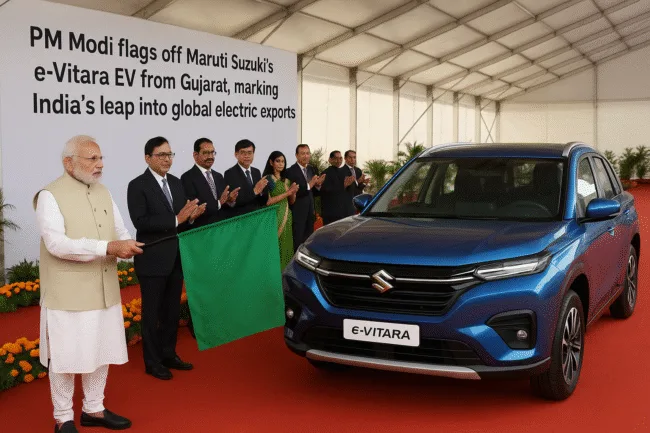
Prime Minister Modi, while flagging off the launch, emphasized that future EVs carrying the “Made in India” tag would redefine the country’s place in the global automotive supply chain. He described the day as “special” for India’s green mobility journey, framing it as a pivotal chapter in the government’s efforts to combine self-reliance with climate-focused innovation.
Why is battery electrode manufacturing in Gujarat seen as a critical factor in the EV supply chain?
Alongside the e-Vitara rollout, Modi inaugurated a new hybrid battery electrode manufacturing facility at the Hansalpur complex. The project, integrated within Maruti Suzuki’s vendor ecosystem, is designed to ensure that over 80% of the e-Vitara’s battery value chain remains domestic.
This announcement directly addresses one of India’s historical weaknesses in EV production—dependence on imported battery cells and materials. By investing in local electrode production, India aims to capture more of the value chain while reducing exposure to global supply disruptions.
Industry observers note that while China still dominates the EV battery supply chain, India’s pivot toward localized production reflects a gradual but significant industrial shift. With Gujarat already established as a hub for both petrochemicals and renewable energy, the integration of EV battery infrastructure reinforces its role as India’s leading manufacturing state.
What does the launch of the e-Vitara mean for Maruti Suzuki’s global growth and competitive positioning?
Maruti Suzuki, a subsidiary of Japan’s Suzuki Motor Corporation, has historically focused on compact and affordable cars in emerging markets. The introduction of a global electric model represents a calculated shift in strategy, as the automaker seeks to align itself with parent Suzuki’s electrification plans and global emissions mandates.
For advanced markets like Europe and Japan, compliance with stricter emissions standards makes EVs non-negotiable. By making the e-Vitara an export-first vehicle, Maruti Suzuki is not only diversifying its portfolio but also protecting its market access in geographies where internal combustion models face regulatory headwinds.
Analysts suggest that the e-Vitara could give Maruti Suzuki a differentiated advantage in markets seeking affordable yet reliable EVs—a segment where premium Western and Chinese automakers have left gaps. However, execution risks remain tied to global EV demand cycles, competition, and charging infrastructure adoption in recipient markets.
How are institutional investors and policy analysts interpreting India’s EV export milestone?
Institutional sentiment toward India’s EV strategy has turned more constructive following the e-Vitara’s debut. Auto-sector investors see this as evidence that Indian manufacturers are not just lagging followers but are entering global EV markets with export-ready models.
Policy analysts highlight that India’s EV momentum aligns with the government’s broader goals of reducing oil import dependency and positioning the country as a climate-conscious industrial power. The Gujarat launch also builds on prior incentives under the Production-Linked Incentive (PLI) scheme for advanced chemistry cells, which have already attracted commitments from global battery makers.
Still, caution remains. Some investors note that global EV sales growth has shown signs of slowing in 2025, particularly in Europe, raising questions about export volumes in the initial phase. That said, the narrative of India as a low-cost, large-scale EV producer remains attractive for long-term capital.
What is the historical context behind Maruti Suzuki’s EV strategy and its alignment with India’s green mobility push?
Maruti Suzuki has faced repeated criticism in the past for being slow to adopt electric mobility compared to rivals such as Tata Motors and Mahindra & Mahindra in the domestic market. Tata Motors’ Nexon EV, for instance, captured significant early market share in India.
However, Maruti Suzuki had long argued that the Indian market was not yet ready for mass-scale EV adoption, citing infrastructure gaps and affordability constraints. Instead, the automaker focused on hybrids and compressed natural gas (CNG) models.
The e-Vitara, therefore, represents both a strategic catch-up and a statement of intent. By making the model export-oriented, Maruti Suzuki is demonstrating that its electrification strategy is not limited by India’s infrastructure readiness but rather aligned with global demand cycles.
This aligns neatly with Prime Minister Modi’s vision of India as both a domestic green mobility leader and a global supplier. Historically, Indian automotive exports have thrived on low-cost engineering and scale economics, and the e-Vitara represents an attempt to apply the same formula to the EV era.
What is the future outlook for India’s EV exports and Maruti Suzuki’s role in shaping this transition?
Looking forward, analysts expect India’s EV export ambitions to grow as more manufacturers adopt localized battery production and global auto companies integrate India into their supply chains.
For Maruti Suzuki, the success of the e-Vitara will be closely watched in Europe, Japan, and other advanced markets where brand acceptance, safety certifications, and consumer trust will determine adoption. Domestically, while Maruti may continue to push hybrids in the short term, the export success of the e-Vitara could accelerate its timeline for Indian EV launches.
Policy experts also point to the potential knock-on effect for India’s broader manufacturing ecosystem. If India can establish itself as a reliable exporter of EVs and battery components, it could attract additional foreign direct investment in clean technology sectors, including battery recycling and advanced materials.
In the medium term, Gujarat’s role as the nucleus of India’s EV ecosystem appears set, with its combination of political support, industrial infrastructure, and geographic advantages for export logistics.
Discover more from Business-News-Today.com
Subscribe to get the latest posts sent to your email.