




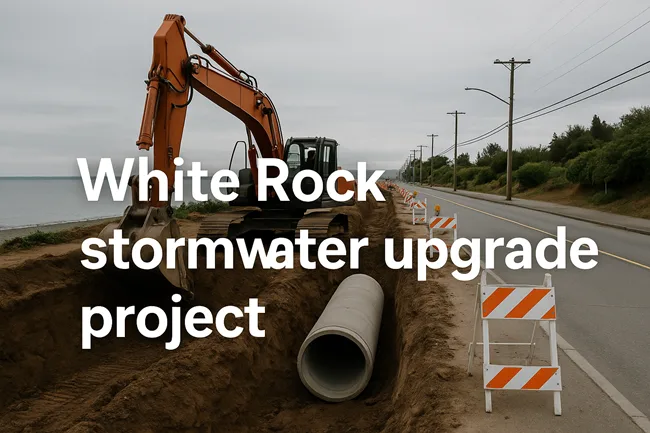
A joint investment of more than CAD 9.86 million from the federal, provincial, and municipal levels of government has been announced to fund major stormwater management upgrades along Marine Drive in White Rock, British Columbia. The project, formally called the Marine Drive Stormwater Improvements, is designed to reduce flooding risks, improve water quality in Semiahmoo Bay, and replace aging infrastructure that has long posed reliability challenges to the city’s drainage systems.
The initiative was unveiled in White Rock on August 22, 2025, in the presence of Ernie Klassen, Parliamentary Secretary to the Minister of Fisheries and Member of Parliament for South Surrey—White Rock, along with Jagrup Brar, British Columbia’s Minister of Mining and Critical Minerals; White Rock Mayor Megan Knight; and Chief Harley Chappell of the Semiahmoo First Nation. Each of the leaders framed the project as a climate-resilience measure that not only addresses pressing infrastructure concerns but also contributes to ecological protection and long-term community sustainability.
How will the Marine Drive stormwater project address flooding, biodiversity, and infrastructure reliability challenges?
The stormwater plan calls for the installation of roughly two kilometres of new underground stormwater pipes stretching along Marine Drive between Stayte Road and Finlay Street, a new pump station to replace outdated equipment, and targeted removal of deteriorating drainage assets that have been operating beyond their intended lifecycle. Upgrades will also include improvements at the outfall to enhance water quality before stormwater flows into Semiahmoo Bay.
These steps are designed not only to reduce flooding along one of White Rock’s busiest transportation corridors but also to protect the bay’s marine biodiversity. Local ecosystems around Semiahmoo Bay have long been under stress due to runoff, and city officials have stressed that the project will limit pollutants entering the water, helping to preserve biodiversity and improve conditions for fish and shellfish habitats.
By modernizing drainage capacity, the project aims to improve reliability during high rainfall events, many of which have become more frequent due to climate change. Municipal authorities and federal representatives alike described the initiative as a “once-in-a-generation upgrade” that balances urban resilience with environmental stewardship.
What role do federal, provincial, and municipal contributions play in the financing structure of this project?
The total investment of CAD 9.86 million has been structured across three tiers of government. The federal government, through the Green Infrastructure Stream of the Investing in Canada Infrastructure Program, is contributing CAD 3.95 million. The Government of British Columbia is providing CAD 3.29 million, while the City of White Rock itself is funding CAD 2.63 million.
The Green Infrastructure Stream has become a significant vehicle for financing municipal climate preparedness initiatives across the province. With over 160 projects already supported in British Columbia, totaling CAD 765 million in federal contributions and CAD 429 million from the provincial level, this program has emerged as a cornerstone of Canada’s adaptation strategy. The White Rock project continues this pattern, signaling Ottawa’s emphasis on aligning local infrastructure with national-level climate resiliency goals.
Funding remains contingent on the fulfillment of environmental and Indigenous consultation requirements, reflecting Canada’s regulatory approach to major municipal infrastructure upgrades.
How does this investment align with climate resilience strategies across Canada and globally?
In recent years, flooding events across Canada have highlighted the growing vulnerability of urban drainage systems. For coastal municipalities like White Rock, located on the shore of Semiahmoo Bay and vulnerable to rising sea levels, the risk is particularly acute. Analysts have pointed out that small cities often lack the financial capacity to independently modernize critical infrastructure, making federal and provincial partnerships essential.
The White Rock project fits into a wider national effort to integrate climate resilience into infrastructure planning. Ottawa’s federal climate adaptation strategies emphasize investments that both safeguard communities and reduce systemic risks. Internationally, institutions such as the World Bank and the United Nations have also called for climate adaptation funding to be treated on equal footing with mitigation. By positioning stormwater upgrades as both an ecological and economic measure, Canada’s approach mirrors these global frameworks.
What is the sentiment among policymakers, city officials, and Indigenous leaders about the project’s impact?
Policymakers presented the investment as a safeguard for White Rock residents, businesses, and natural ecosystems. Ernie Klassen stated that investments in stormwater management were essential for safe, healthy communities, noting that collaborative action was the best way to prepare for the intensifying effects of climate change. Christine Boyle, Minister of Housing and Municipal Affairs, emphasized that the upgrades would bring “peace of mind” to families while protecting vital roadways and local commerce during extreme weather events.
Mayor Megan Knight positioned the project as a direct response to community needs, underscoring White Rock’s municipal commitment to sustainability and climate resilience. Meanwhile, Chief Harley Chappell of the Semiahmoo First Nation framed the investment as a meaningful step in protecting the bay and its waters—resources that have sustained Indigenous communities for generations. His comments reinforced the cultural and ecological dimensions of infrastructure planning in coastal areas.
The combined messaging suggests a strong political consensus around the project, with institutions viewing it as both a climate adaptation measure and a long-term economic safeguard.
How are institutional and investor circles viewing municipal-level climate adaptation projects such as this one?
While White Rock itself is not a publicly traded entity, municipal climate resilience projects have increasingly become part of the risk assessments institutional investors apply when considering regional economic stability. Projects like this are viewed as reducing systemic risks, thereby protecting commercial assets, residential values, and insurance markets.
In analyst circles, Canada’s infrastructure investments under the Green Infrastructure Stream have been interpreted as a proactive measure to avoid the much higher costs of disaster recovery. For insurers, such projects can reduce claims exposure, while for businesses, improved resilience ensures continuity of operations in the face of extreme weather.
Investor sentiment across sustainability-focused funds remains aligned with these types of projects, which strengthen the long-term viability of municipalities and reduce uncertainty linked to climate change.
What future impact could the White Rock stormwater improvements have on local development, property values, and community resilience?
Looking ahead, the Marine Drive project is expected to deliver multifaceted benefits. Improved drainage reliability is likely to protect property values in White Rock’s waterfront neighborhoods, while businesses along Marine Drive could benefit from reduced disruption during heavy storms.
The ecological benefits—particularly for Semiahmoo Bay—could also enhance the city’s broader reputation as a sustainable coastal community, potentially supporting tourism and local economic diversification.
For the long-term, city officials suggest that White Rock will need to continue embedding climate adaptation measures into planning, with this stormwater project representing an important but not final step in its climate resilience roadmap.
Discover more from Business-News-Today.com
Subscribe to get the latest posts sent to your email.