




How significant is Strike Energy’s reserves downgrade at Walyering and what does it mean for investors holding ASX: STX shares?
Strike Energy Limited (ASX: STX) has faced a sharp market setback after disclosing a downgrade in reserves at its Walyering gas field in Western Australia, triggering an estimated impairment of between A$85 million and A$108 million on oil and gas assets, alongside a further A$19 million hit to deferred tax assets. The announcement, lodged on 19 August 2025, followed an independent review by RISC Advisory Pty Ltd that revised down the Perth Basin explorer’s proven and probable reserves, placing the company under pressure to reconcile contracted gas obligations with diminished resource certainty.
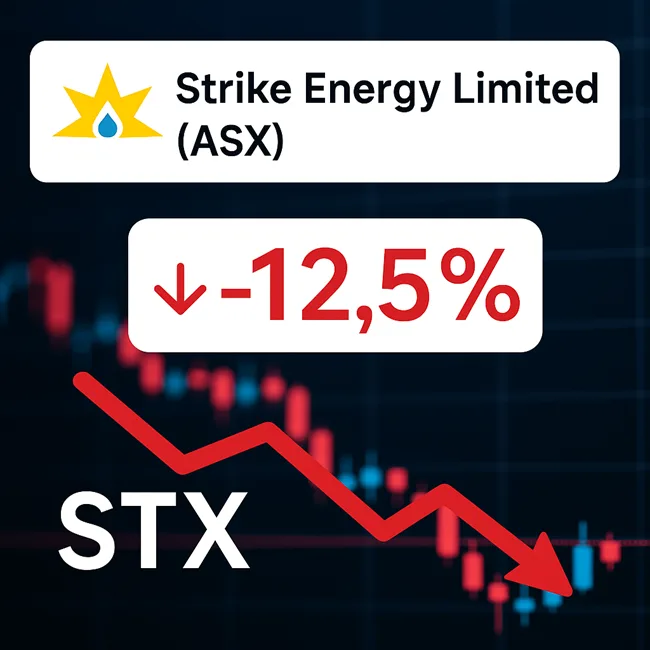
The disclosure came on a day when Strike Energy’s share price tumbled by 12.5% to A$0.105, leaving the Perth-based gas producer with a market capitalization of roughly A$346 million. Over the past year, the stock has lost more than 38% of its value, reflecting both operational challenges and broader investor caution around mid-cap energy names.
Why did Strike Energy’s gas reserves fall so sharply compared with earlier estimates in 2024?
The reserves downgrade stems from production performance at two key wells. At Walyering-5, longer-term output data suggested that connected gas volumes were closer to a conservative 1P interpretation, effectively reducing the field’s 2P and 3P reserve categories. Meanwhile, Walyering-7 failed to meet expectations, with results indicating poor productivity and limited connected volumes. The well is currently shut-in, pending the installation of compression facilities expected to be online in the first quarter of calendar 2026.
The revision saw Strike Energy’s 1P sales gas reserves drop to 11.2 petajoules (PJ) from 23.2 PJ a year earlier, while 2P reserves fell to 13.6 PJ from 38.5 PJ. On the condensate side, volumes were scaled back as well, with 2P estimates halved to 0.1 million barrels.
For FY25, Strike Energy produced 8.9 PJ of sales gas from Walyering, generating A$72.7 million in revenue. That performance aligned with expectations but was insufficient to offset the reserves downgrade that has now reduced the project’s long-term production outlook.
How is Strike Energy addressing the potential supply shortfall under its existing gas contracts?
Strike Energy currently has around 24 PJ of gas remaining under firm supply agreements. Based on the revised reserves profile, the company faces a potential shortfall of up to 9.5 PJ on a 2P basis or approximately 13 PJ on a 1P basis. To mitigate this gap, management is planning to drill the Walyering West-1 near-field exploration well in the first half of calendar 2026, subject to rig procurement, financier consents, and independent peer review.
The Walyering West prospect, located within Strike’s 100% owned L23 permit, carries estimated prospective resources of 13 PJ (low estimate), 46 PJ (best estimate), and 137 PJ (high estimate). Internal mapping has identified the Cattamarra Coal Measures as a likely analogue to productive zones at Walyering-5, suggesting near-field upside potential.
In addition, Strike Energy noted that it may purchase gas on the open market to meet delivery obligations if exploration results fail to close the gap.
How do institutional investors view the impairment charges and potential financial write-downs?
Initial assessments indicate asset impairments of A$85 million to A$108 million, with a separate A$19 million hit to deferred tax assets. These charges are expected to be finalized and reflected in Strike Energy’s audited FY25 financial results, scheduled for release on or around 26 September 2025.
Institutional sentiment appears cautious. While some investors may view the impairment as a non-cash adjustment, the underlying issue is the reserve downgrade, which directly affects Strike Energy’s ability to service contracts and sustain future revenue streams. Analysts have highlighted that impairments of this scale reduce balance sheet flexibility, potentially raising questions about financing options and capital allocation for near-field exploration.
What are the broader sector implications for mid-cap Australian gas producers?
Strike Energy’s challenges highlight a recurring theme for Australian mid-cap gas producers: reserve reclassifications can sharply alter valuations and sentiment. For companies reliant on a handful of core fields, well performance carries outsized weight in financial modeling. A downgrade not only triggers impairment charges but also undermines contract security, forcing management to accelerate exploration drilling or engage in opportunistic market purchases.
The Perth Basin has been a hotbed of exploration and development over the past decade, attracting attention from both domestic utilities and global energy players. However, the Strike Energy case underscores that basin geology can still surprise operators negatively, with compartmentalized reservoirs and uneven well productivity translating into volatile reserve outcomes.
What is the future outlook for Strike Energy and how might FY26 reshape its trajectory?
Looking ahead, Strike Energy’s near-term outlook hinges on three critical factors: the restart of Walyering-7 after compression in early 2026, the results of the Walyering West-1 well, and the company’s ability to bridge contracted delivery obligations with external supply if required. Management’s strategy to push ahead with drilling reflects a recognition that investor confidence depends on tangible reserve replacement.
Institutional investors will also closely track the September 2025 financials for clarity on impairment recognition, cash flow trajectory, and funding pathways. Given its market capitalization of around A$346 million and share price volatility, Strike Energy sits in a risk-sensitive segment where both positive drilling results and negative reserve surprises can swing valuations dramatically.
While some long-term investors may see upside if the Walyering West drilling program delivers new resources, the prevailing sentiment around Strike Energy Limited (ASX: STX) remains defensive. The company’s one-year share price decline of 38.24% and the steep 12.5% fall on the day of the reserves downgrade announcement highlight how fragile investor confidence has become. For many institutional holders, the concern is less about near-term impairments and more about whether Strike Energy can convincingly demonstrate operational execution and reliable reserve growth in a competitive Australian gas market.
Retail investors on ASX forums have pointed to the company’s relatively low share price as a potential entry point, but market history suggests that sustained re-rating only occurs once management shows consistent delivery against contracted gas sales. The Walyering West-1 well, scheduled for drilling in the first half of calendar 2026, will likely serve as the defining catalyst. If Strike Energy proves commercial volumes that can offset its contractual shortfall, the narrative could quickly shift from impairment-driven weakness to resource replacement and growth.
Until then, the stock’s trajectory is likely to be shaped by broader sector sentiment toward mid-cap Australian gas producers, where operational risks often outweigh commodity price tailwinds. For analysts tracking the sector, Strike Energy represents a classic case of a basin-focused gas developer under pressure: reserves downgrades erode confidence, impairments drag on balance sheet strength, and market valuations remain subdued until clear forward momentum is re-established. Investors seeking exposure to the Perth Basin are therefore watching closely to see if Strike Energy can deliver a turnaround that aligns with Australia’s growing domestic gas demand and broader energy transition dynamics.
Discover more from Business-News-Today.com
Subscribe to get the latest posts sent to your email.

