





Empire Petroleum Corporation (NYSE American: EP) has secured a unanimous victory from the New Mexico Oil Conservation Commission (NMOCD), cementing its rights to develop the Residual Oil Zone (ROZ) in the Eunice Monument South Unit (EMSU) and greenlighting a three-year CO₂ enhanced oil recovery (EOR) pilot. The ruling is a turning point for the company after four years of legal challenges and adds fresh momentum to a broader industry shift toward carbon-based recovery methods across the Permian Basin.
The Commission’s decision on August 14, 2025, denied five injection applications and suspended four wells tied to rival operator Goodnight Midstream, clearing regulatory space for Empire’s project. While the NMOCD did not identify immediate harm from competing injection activities, it found compelling evidence of potential waste or future impairment, siding with Empire’s arguments that third-party operations threatened the long-term viability of its reserves.
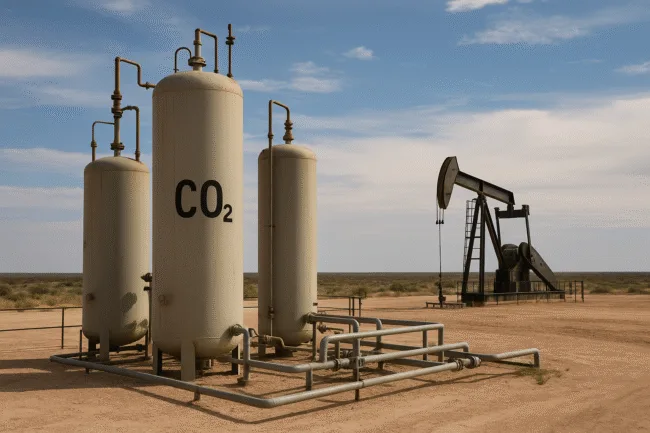
How is CO₂ enhanced oil recovery in the Permian Basin changing long-term production economics and financial incentives for operators?
Enhanced oil recovery using CO₂ has been tested in the Permian for decades, but the latest wave is different. Empire’s pilot arrives as federal tax incentives for carbon storage under the 45Q program are driving a resurgence of interest. With credits of up to $85 per ton of stored CO₂, EOR projects now carry an additional financial lever that can complement oil revenues.
Major players are already well ahead. Occidental Petroleum has integrated EOR into its low-carbon strategy, building a pipeline of carbon capture projects tied to its Permian assets. Denbury, acquired by ExxonMobil, has doubled down on CO₂ pipeline infrastructure designed to support both sequestration and recovery operations. Chevron has highlighted CO₂ injection in its broader Permian growth strategy.
For independents such as Empire, the economics of CO₂ injection provide both an opportunity and a challenge. Smaller firms lack the balance sheets of the majors but can leverage regulatory clarity and targeted pilots to demonstrate value. If successful, Empire’s EMSU project could materially expand recoverable reserves while also opening a path to new revenue through carbon credits.
How are major oil companies like Occidental and ExxonMobil scaling CO₂ recovery projects in the Permian compared to smaller independents such as Empire Petroleum?
Empire’s ruling highlights the divide between independents and majors. While large-cap companies have the capital to build regional CO₂ supply chains, smaller operators must rely on pilot-scale efforts to prove economic potential. Occidental’s Permian projects, for example, integrate with its large-scale carbon capture investments, while ExxonMobil, through Denbury, controls critical pipeline networks that serve both oil recovery and sequestration customers.
Empire’s strategy rests on regulatory leverage and asset-specific execution. By winning exclusive rights to its ROZ, the company gains a competitive edge despite limited resources. For investors, this contrast underscores how regulatory clarity can serve as a growth catalyst for independents even in a basin dominated by multinationals.
Why did Empire Petroleum’s stock react positively after the NMOCD ruling and what does it signal for investor sentiment in the CO₂ recovery sector?
Empire enters the pilot at a time when financials remain pressured. In Q2 2025, the company posted $8.75 million in product revenue, down 32% from the prior year, as realized prices per Boe fell sharply. Net loss widened to $5.06 million, while adjusted EBITDA turned negative at –$1.18 million. Yet production volumes rose 15% quarter-on-quarter to 2,357 Boe/d, underscoring operational momentum despite market headwinds.
The NMOCD ruling triggered a modest rebound in Empire’s stock, with shares climbing into the $5.20 range from recent lows near $4.70. Analysts view the decision as a de-risking event, giving Empire a clearer development pathway and reducing uncertainty that had constrained investor appetite. ESG-minded funds are also more likely to take notice, given the alignment of CO₂ projects with decarbonization goals.
At the basin level, the case signals a regulatory willingness to prioritize long-term recovery and carbon-linked projects over saltwater disposal capacity. Water disposal has become one of the most contentious issues in the Permian, with seismicity risks forcing regulators to rein in injection volumes. In contrast, CO₂ injection offers a route to maintain production while reducing emissions—a balance regulators are increasingly favoring.
What are the next operational milestones for Empire Petroleum’s CO₂ EOR pilot in New Mexico following the NMOCD decision?
Empire’s roadmap includes sourcing CO₂ supply, finalizing injection design, and initiating the EMSU pilot over the next three years. The company is also pursuing motions to revoke permits for other disposal operators and will continue litigation tied to trespass and damages. Parallel development is advancing in North Dakota and East Texas, but the New Mexico decision gives the clearest line of sight to near-term value creation.
The real test will come from pilot results. If Empire demonstrates improved recovery rates and operational efficiency, it could reposition itself among peers, justify a higher valuation multiple, and prove that independents can compete in the CO₂ EOR space dominated by larger players. For the Permian as a whole, the decision adds weight to a broader momentum shift where enhanced oil recovery is being re-framed as both an economic and environmental strategy.
Discover more from Business-News-Today.com
Subscribe to get the latest posts sent to your email.