How did Prime Minister Modi frame Operation Sindoor, the Indus water shift, and next-generation reforms as the building blocks of Viksit Bharat?
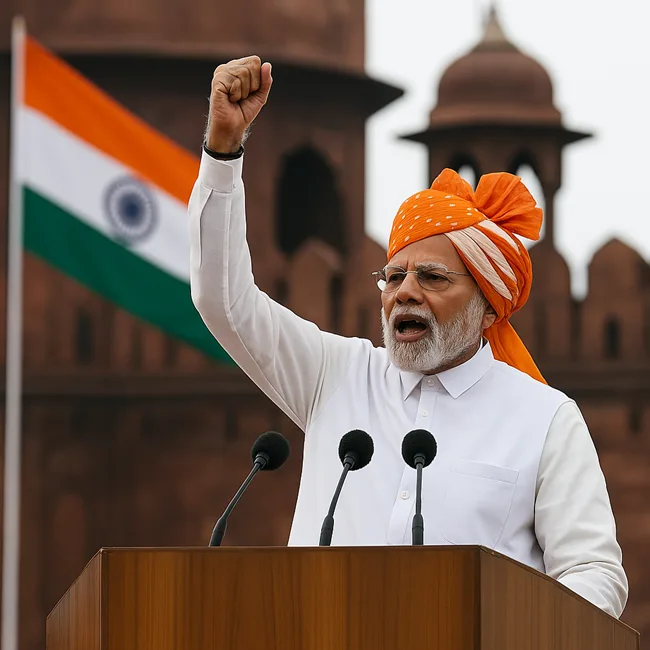
Prime Minister Narendra Modi marked India’s 79th Independence Day with one of his most forceful addresses yet from the ramparts of the Red Fort, combining tributes to history with sharp policy pivots on defence, energy, water, agriculture, and governance reforms. His speech emphasized that the journey to a “Viksit Bharat” by 2047 depends squarely on self-reliance across every sector, from semiconductors to space.
The tone was both celebratory and uncompromising. Modi hailed Operation Sindoor as proof of India’s military self-sufficiency, signaled a decisive rethink on the Indus Waters Treaty, announced a Rs 1 lakh crore youth employment scheme, and promised next-generation reforms in tax, GST, and governance. For analysts, this speech underscored both continuity and escalation—continuity in his decade-long emphasis on self-reliance, and escalation in the hardening of India’s security doctrine and economic autonomy narrative.
Why was Operation Sindoor presented as a turning point in India’s defence self-reliance and deterrence doctrine?
Modi saluted the “brave warriors of Operation Sindoor” as a symbol of India’s capacity to respond decisively to terrorism without reliance on foreign powers. He described how, following a massacre in Pahalgam in April, the armed forces were given “complete freedom” to strike back. The campaign penetrated deep into Pakistani territory, destroying terror infrastructure with indigenous weapons.
The Prime Minister framed the operation as a demonstration of India’s new “normal”—that those who fund, shelter, or arm terrorists are equally culpable and will be treated as enemies of humanity. Importantly, he tied the military success to “Made in India” defence capabilities, noting that without domestic production, the rapid and precise response would not have been possible.
Defence experts have interpreted this as both deterrence and doctrine. By naming Pakistan directly and dismissing “nuclear blackmail,” Modi signaled that India is no longer willing to treat nuclear rhetoric as a shield for cross-border terrorism. The subsequent launch of the Sudarshan Chakra Mission—a futuristic defence program drawing from mythological symbolism—was positioned as the next leap in precision deterrence, aiming for full nationwide coverage by 2035.
How did Modi link water security and agriculture to national sovereignty in his address?
The Prime Minister’s bluntest remarks came on the Indus Waters Treaty. He declared, “Blood and water will not flow together,” calling the arrangement “unjust” for having allowed rivers from India to irrigate enemy lands while Indian farmers remained parched. He pledged to ensure that India’s share of water would be retained “solely for Bharat, solely for its farmers.”
This sharp framing was paired with praise for India’s agricultural achievements, including record grain production, global leadership in milk, pulses, and jute, and second-place rankings in rice, wheat, and fish. Agricultural exports had crossed ₹4 lakh crore, reinforcing farmers’ contribution to the global market.
Institutional voices have noted that this merging of sovereignty, food security, and export competitiveness is designed to position farmers as central to both national pride and global trade strategy. Modi underscored this further by launching the PM Dhan-Dhanya Krishi Yojana for 100 lagging districts, alongside reminders of cattle vaccination programs and irrigation initiatives.
What role did economic reforms, tax changes, and employment schemes play in shaping the speech’s economic narrative?
Modi positioned economic reforms as the second pillar of Viksit Bharat. He highlighted the abolition of over 1,500 outdated laws and 40,000 compliances, while announcing the removal of 280 income tax provisions. Income up to Rs 12 lakh was exempted from taxation, a move the Prime Minister said brought “joy to middle-class families eager to contribute to nation-building.”
The headline-grabber was the promise of next-generation GST reforms by Diwali. Modi said taxes on daily essentials would be reduced, boosting MSMEs, local vendors, and consumer demand. Analysts see this as both populist and pragmatic—lightening the load on households while unlocking growth for small enterprises.
On employment, Modi launched the Pradhan Mantri Viksit Bharat Rozgar Yojana, a ₹1 lakh crore scheme aimed at creating 3.5 crore new jobs. Youth entering the private sector would receive ₹15,000 support, while companies expanding hiring would earn incentives. This was presented as a bridge from “Swatantra Bharat to Samriddha Bharat.”
Institutional sentiment has been broadly positive. With India on the cusp of becoming the world’s third-largest economy, reforms aimed at broadening consumer demand and reducing compliance burdens were seen as timely confidence-builders for investors.
Why was self-reliance in technology, semiconductors, and space a recurring theme throughout the speech?
Modi acknowledged that India “lost 50–60 years” when early plans for semiconductor manufacturing were stalled, allowing other nations to dominate. Now, he declared, India is on “mission mode” with six semiconductor units under development and four more approved. By year-end, he said, a Made-in-India chip will enter the global market.
He expanded the same narrative to energy and space. Solar energy had increased thirtyfold in 11 years, India had met its 2030 clean energy target five years early, and 10 nuclear reactors were advancing towards a tenfold capacity boost by 2047. A National Deepwater Exploration Mission for offshore oil and gas and a Critical Minerals Mission were also launched.
In space, Modi hailed Group Captain Shubhanshu Shukla’s return from the space station and announced plans for a domestically built space station and the Aatmanirbhar Gaganyaan mission. Over 300 startups were already innovating in satellites and exploration, reflecting what the Prime Minister described as the “strength and trust in the youth of Bharat.”
For institutions, the consistency of messaging—from chips to rockets to reactors—underscored India’s ambition to climb higher in global supply chains.
How did Modi frame women, youth, and social schemes as engines of inclusive growth?
Women’s empowerment was spotlighted through the rapid rise of self-help groups, the “Drone Didis” initiative, and the milestone of two crore “Lakhpati Didis,” with a pledge to reach three crore ahead of schedule. Modi said their entrepreneurship was now contributing “lakhs and crores” to the economy, from exports to local markets.
Youth entrepreneurship, he noted, was flourishing in Tier-2 and Tier-3 cities, powered by loans under the Mudra Yojana and supported by startup policies. Modi urged innovators not to let ideas die, calling today’s ideas the “future of generations to come.”
On social welfare, he reiterated a “saturation” approach—ensuring every eligible citizen directly receives government benefits through schemes such as Jan Dhan accounts, Ayushman Bharat, PM Awas, and PM SVANidhi. He claimed over 25 crore people had moved out of poverty in the past decade, forming a “neo-middle class” alongside the existing middle class.
Institutional sentiment sees this focus on inclusivity as a way to reinforce social stability while maintaining momentum toward higher growth.
What signals did Modi send on governance reforms and India’s long-term outlook to 2047?
Beyond specific schemes, the Prime Minister presented reforms as structural shifts. He cited the replacement of the penal code with the Bharatiya Nyaya Sanhita as a move rooted in “trust and sensitivity.” He announced a Next-Generation Reform Task Force, with a mandate to re-draft laws, rules, and procedures to suit 21st-century realities.
He also issued sharp warnings on demographic challenges, pledging a High-Power Demography Mission to tackle illegal infiltration and protect border security. By tying this to national unity, Modi argued that social and demographic stability was as vital as economic progress.
Looking ahead to 2047, Modi invoked his earlier “Panch Prana” pledge, reminding citizens that building a developed India would require pride in heritage, vigilance against dependency, and unwavering unity. His conclusion—“the one who has broken the steel rocks is the one who has bent the time”—framed the centenary of independence as a test of national willpower.
Is the Independence Day address a roadmap for continuity or escalation?
For observers, this year’s Red Fort address was more muscular than ceremonial. Modi used the symbolism of Independence Day to harden India’s red lines—on terrorism, nuclear threats, water sharing, and demographic security—while also positioning self-reliance in defence, technology, and energy as central to the next two decades.
Institutional sentiment suggests that while the tone was nationalist, the substance was reformist: a combination of populist tax relief, structural reforms, and innovation bets designed to keep India’s growth story intact. The consistent thread was that sovereignty, whether in security, water, or technology, is inseparable from economic prosperity.
Discover more from Business-News-Today.com
Subscribe to get the latest posts sent to your email.