How did Sempra’s Q2 2025 earnings and revenue performance compare with last year’s results?
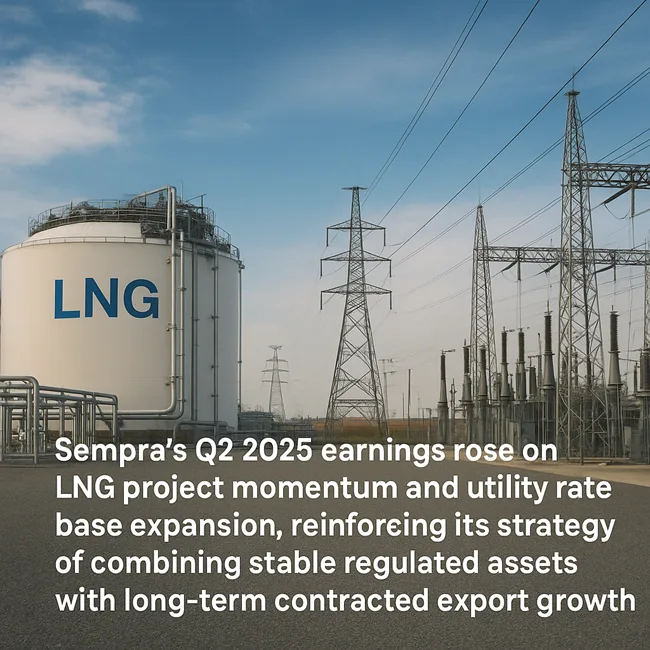
Sempra (NYSE: SRE) reported a strong second-quarter 2025 performance, with earnings and revenue both exceeding market expectations despite weather-related softness in retail gas sales. GAAP earnings for the quarter reached $828 million, or $2.57 per diluted share, compared with $722 million, or $2.23 per share, in Q2 2024. On an adjusted basis, which strips out non-recurring items, earnings rose to $847 million, or $2.63 per share, up from $743 million, or $2.29 per share, a year earlier.
Revenue for the quarter was $3.51 billion, representing a 4% increase from the prior-year period. This growth was supported by higher infrastructure returns and contributions from the company’s U.S. LNG portfolio, which helped counterbalance reduced retail gas demand caused by milder weather conditions in California and Texas.
The performance surpassed consensus analyst estimates for both earnings and revenue, underscoring the combined strength of Sempra’s regulated utilities and long-term contracted energy infrastructure assets.
What specific factors drove Sempra’s earnings growth during the second quarter of 2025?
The quarter’s growth was underpinned by a combination of LNG expansion progress, utility rate base growth, and operational efficiency.
One major contributor was the advancement of the Cameron LNG Phase 2 project in Louisiana, which reached a final investment decision in May 2025. The expansion, backed by long-term offtake agreements with investment-grade buyers, is expected to add substantial export capacity in the coming years and deliver stable, multi-decade cash flows.
Utility rate base expansion was another key driver. Both San Diego Gas & Electric (SDG&E) and Oncor Electric Delivery in Texas continued to see benefits from ongoing grid modernization, transmission upgrades, and renewable integration efforts. These investments not only enhanced regulated earnings but also strengthened long-term resilience and service quality.
Additionally, disciplined cost management supported margin improvement. Corporate overheads and interest expenses came in lower than expected, adding further lift to the bottom line. Chief Executive Officer Jeffrey Martin said the quarter reflected the resilience of Sempra’s “dual-platform” business model, combining the reliability of regulated earnings with the upside potential of LNG exports.
How are Sempra’s LNG export projects positioned to influence earnings growth over the next decade?
Sempra has established itself as one of the most ambitious LNG developers in the U.S., with several large-scale projects either under construction or in advanced planning stages.
Cameron LNG Phase 2 in Louisiana will add two liquefaction trains, increasing export capacity by 9.97 million tonnes per annum (MTPA). All of this capacity is contracted under long-term agreements, shielding the company from short-term market fluctuations.
Port Arthur LNG Phase 1 in Texas, now under construction, will deliver 13.5 MTPA of new export capacity and has already secured full long-term capacity commitments.
Vista Pacifico LNG in Mexico is targeted for a final investment decision in 2026 and is strategically aimed at serving Pacific Basin markets.
These developments are expected to generate predictable, take-or-pay revenue streams for decades, significantly expanding Sempra’s earnings base while diversifying geographic exposure.
What contribution did regulated utilities make to Sempra’s second-quarter earnings growth?
The regulated utility segment generated $536 million in net income for Q2 2025, an increase from $498 million in the prior year. This growth reflected substantial capital investment and load growth across Sempra’s service territories.
At SDG&E, investment in wildfire mitigation and renewable integration continued in line with California’s clean energy mandates. Grid hardening measures and modernization programs further enhanced reliability.
In Texas, Oncor Electric Delivery saw continued strong load growth from both industrial and residential customers, driven by regional population growth and industrial expansion. Transmission upgrades to support ERCOT grid reliability contributed to earnings momentum.
Sempra’s total regulated rate base grew 8% year-over-year, supported by more than $2.3 billion in capital expenditures during the first half of 2025.
How is Sempra addressing weather-related demand fluctuations and regulatory risk?
While mild weather reduced gas sales volumes in some territories, particularly at SDG&E, electricity demand growth in Texas helped balance the equation. Management pointed to the company’s diversified earnings mix as a key buffer against weather-driven volatility.
The company also leverages regulatory mechanisms such as decoupling and fuel cost pass-throughs to protect revenue streams. By maintaining constructive relationships with regulators in California, Texas, and Mexico, Sempra ensures timely recovery of capital expenditures while aligning with policy goals for grid reliability and decarbonization.
What guidance has Sempra maintained for 2025, and what assumptions underpin its forecast?
Sempra reaffirmed its full-year 2025 adjusted EPS guidance range of $9.15 to $9.45. This projection is based on continued execution of its utility capital programs, on-schedule LNG construction milestones, and stable political and regulatory environments in its key markets.
Planned capital spending for 2025 remains between $7.5 billion and $8.0 billion, with roughly 70% earmarked for regulated utility infrastructure and the balance for LNG export projects. This balanced allocation reflects the company’s commitment to sustaining steady utility growth while advancing high-return LNG initiatives.
How are institutional investors and analysts viewing Sempra’s performance and strategic positioning?
Institutional sentiment toward Sempra remains broadly positive. Analysts have highlighted the company’s ability to combine low-risk utility cash flows with long-term contracted LNG export growth. Some note that this dual growth profile offers investors both stability and upside potential, differentiating Sempra from pure-play utilities and LNG exporters.
Investor focus in the near term will be on execution of Port Arthur LNG Phase 1 and Cameron LNG Phase 2, as delays or cost overruns could impact the expected earnings ramp from the late 2020s onward. Nonetheless, the fully contracted nature of these projects provides strong earnings visibility once operational.
How does Sempra’s Q2 performance compare to other U.S. energy infrastructure players in 2025?
In the same reporting cycle, other LNG-focused companies such as Cheniere Energy and NextDecade also posted robust results on the back of strong global LNG demand and long-term contracting. On the utility side, peers including Duke Energy and Southern Company saw steady regulated earnings growth but lacked the LNG-driven expansion opportunities that underpin Sempra’s growth trajectory.
This combination of regulated stability and LNG upside gives Sempra a differentiated profile in the U.S. energy infrastructure landscape, making it an attractive option for investors seeking balanced exposure.
What are the key risks and growth drivers investors should monitor in the coming years?
Looking ahead, the primary risks include regulatory changes in California, potential construction delays for LNG projects, and shifts in global LNG demand dynamics. However, the company’s diversified portfolio, fully contracted LNG capacity, and large-scale utility investments provide a strong foundation for long-term growth.
Institutional investors will also be watching for progress on new project approvals, cost containment during construction, and the integration of renewable energy into its utility networks.
Why Sempra’s mix of regulated utility growth and LNG export expansion positions it for long-term earnings stability
Sempra’s Q2 2025 results reaffirm its strategic advantage in blending regulated utility stability with LNG export expansion. With multi-billion-dollar projects on track, strong regulatory frameworks, and disciplined financial management, the company is positioned for steady earnings growth through the next decade.
Share this:
Discover more from Business-News-Today.com
Subscribe to get the latest posts sent to your email.