




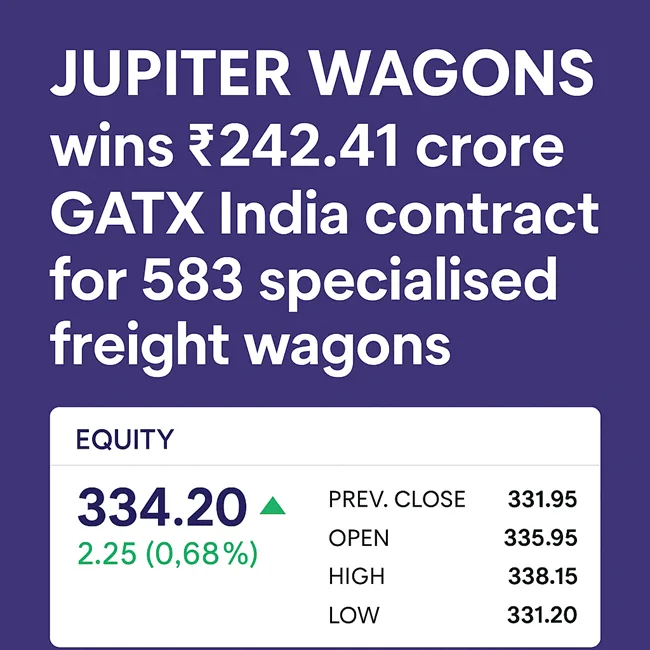
Jupiter Wagons Limited (NSE: JWL, BSE: 533272) has announced the award of a ₹242.41 crore contract from GATX India Private Limited, the country’s largest private railcar lessor, for the manufacturing and supply of 583 specialised freight wagons. The order reinforces Jupiter Wagons’ role in India’s ongoing freight infrastructure modernisation and adds to an already strong order book that is supporting steady investor interest in the counter.
By mid-morning trade, Jupiter Wagons’ shares were changing hands at ₹334.20 on the NSE, up 0.68% from the previous close of ₹331.95. Intraday trading had seen a high of ₹338.15 and a low of ₹331.20, with 4.45 lakh shares traded and a total traded value of ₹14.90 crore. The market capitalisation stood at ₹14,186.72 crore, and the stock’s price-to-earnings ratio was 35.93. The counter remains between its 52-week low of ₹270.05 on 3 March 2025 and high of ₹588.00 on 12 December 2024, with its current price closer to the lower end of the range, suggesting room for re-rating if execution and earnings momentum continue.
What wagon types are included in the GATX India contract and how do they address India’s shifting freight needs?
The contract encompasses a variety of purpose-built wagons, each designed to address specific cargo requirements. BLSS container carrier wagons are engineered for ISO container movement, featuring a high axle load capacity and improved payload-to-tare ratio for more efficient intermodal freight operations. ACT2 bi-level SUV carriers are designed to transport up to 10 sport utility vehicles per wagon, offering minimal handling, improved protection, and faster turnaround, aligning with the strong domestic demand for SUVs. BOXNHL high-capacity open wagons, capable of carrying over 70 tonnes, are optimised for bulk commodities like coal and iron ore, with open-top designs and tippler unloading compatibility for heavy-haul freight corridors. BVCM wagons expand the portfolio’s versatility by enabling carriage of multiple commodity types, supporting operators’ flexibility.
These high-specification designs are targeted at India’s evolving freight corridors, where higher axle loads, faster loading and unloading, and port-to-hinterland efficiency are increasingly in demand. The operational efficiencies embedded in these wagons are expected to bolster cargo handling capacity for GATX India and its clients.
How does this order strengthen Jupiter Wagons’ financial visibility and market positioning?
Jupiter Wagons enters FY2026 with a robust operating base. The company closed FY25 with consolidated revenue of over ₹4,000 crore, marking a 9.3% year-on-year increase. EBITDA rose 18% to ₹578 crore, with margin expansion to 14.6%, while net profit climbed 14.9% to ₹380 crore, delivering earnings per share of ₹9.1. The fourth quarter added ₹1,070 crore in new orders, including ₹600 crore in rake wagons from Ambuja Cement and ACC, ₹255 crore in wheelsets from Braithwaite & Co., ₹150 crore in passenger brake systems, and ₹65 crore in brake discs. As of 31 March 2025, the order book stood at ₹6,303.6 crore.
While Q4 FY25 revenue dipped slightly to ₹1,057 crore from ₹1,127 crore in Q4 FY24, profitability improved, with PAT at ₹103 crore versus ₹105 crore a year earlier but at a higher profit margin of 9.7%. This indicates operational efficiency gains even in the face of modest revenue pressure.
Institutional investors point to the growing order book and improving margins as evidence of execution discipline. At the same time, they note that converting large orders into sustained cash flows will require continued control of raw material costs, streamlined production, and adherence to delivery timelines.
How does Jupiter Wagons leverage vertical integration and global collaborations for competitive advantage?
Over more than four decades, Jupiter Wagons has developed a fully integrated manufacturing ecosystem with facilities in Kolkata, Jamshedpur, Indore, Jabalpur, Aurangabad, and Bangalore. The company’s capabilities extend beyond freight wagons to locomotives, passenger coach accessories, braking systems, ISO marine containers, commercial vehicles, electric light commercial vehicles (e-LCVs), battery energy storage systems (BESS), lithium batteries, couplers, bogies, brake discs, wheels, axles, and wheelsets. Maximum backward integration to its foundry operations allows greater quality control and cost efficiency.
Jupiter Wagons has also cultivated strategic partnerships with leading rolling stock manufacturers such as Tatravagonka (Slovakia), Kovis (Slovenia), Talleres Alegría (Spain), and DAKO-CZ (Czech Republic). These alliances support technology transfer, design innovation, and global best practices in production, enabling the company to meet both domestic and export-market requirements.
Beyond core rail products, Jupiter Electric Mobility—its EV arm—has launched the JEM TEZ and EV Star CC models and built a new Indore plant while acquiring battery assets from Log9 to deepen its position in electric transport and energy storage.
Why is the GATX order strategically important for Jupiter Wagons’ diversification and growth?
Historically, Jupiter Wagons has maintained a strong relationship base with government entities, including Indian Railways, metro rail operators, and defence procurement agencies, as well as corporate clients like Tata Motors, Adani Group, and GE. The GATX India order represents an opportunity to diversify further into the private leasing segment, a growing market in India’s freight ecosystem as operators seek flexible, asset-light logistics models.
Engagements with private lessors such as GATX can lead to repeat contracts and higher-margin customised solutions, particularly as India’s freight operators demand wagons tailored to their cargo profiles and operational patterns.
How does India’s rail freight modernisation create a demand runway for specialised wagons?
India’s logistics sector is in the midst of a structural shift, with the Dedicated Freight Corridor (DFC) project, increased port capacity, and incentives for containerisation reshaping cargo flows. The automobile industry’s expansion, especially in SUV manufacturing, has created a need for secure, high-capacity vehicle carriers, while bulk commodities remain central to power generation and steelmaking supply chains.
Specialised wagons like those in the GATX contract address these niches, enabling faster throughput, reduced damage risk, and compliance with modern safety and performance standards. For Jupiter Wagons, such contracts not only add revenue but also reinforce engineering credentials that can support bids in other domestic and overseas markets.
What is the outlook for Jupiter Wagons over the next financial year?
Analysts tracking the sector expect Jupiter Wagons to benefit from a confluence of factors: government and private sector investment in freight corridors, continued urbanisation and industrial growth, and global demand for rail freight equipment. The ₹6,300-plus crore order book offers visibility into FY2026, but execution will remain the determinant of margin realisation.
The company’s strategy appears focused on maintaining a balanced portfolio of government and private contracts, expanding its EV and sustainable mobility offerings, and leveraging joint ventures to penetrate new markets. If these initiatives progress as planned, Jupiter Wagons could consolidate its position as one of India’s most diversified and technologically advanced rolling stock manufacturers.
Discover more from Business-News-Today.com
Subscribe to get the latest posts sent to your email.
