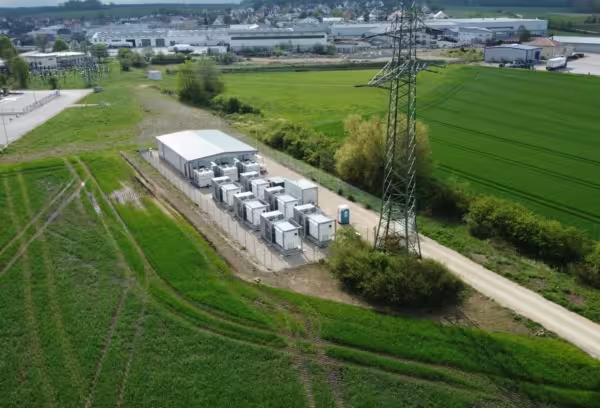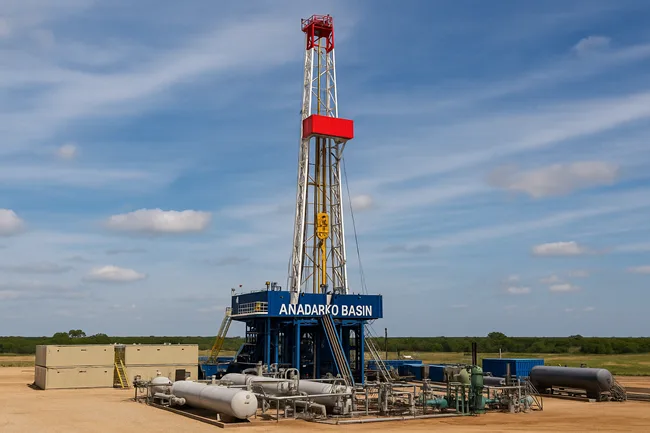
ConocoPhillips (NYSE: COP) has agreed to sell its Anadarko Basin assets in Oklahoma to Stone Ridge Energy Partners in a $1.3 billion cash deal, marking a major step in the Houston-based producer’s ongoing portfolio high-grading strategy. The transaction is designed to redirect capital toward lower-cost, higher-return projects such as its Lower 48 shale developments, Alaska operations, and its fast-expanding liquefied natural gas (LNG) portfolio.
The divested assets span approximately 650,000 net acres with net production of about 95,000 barrels of oil equivalent per day (BOE/d), comprising 55% natural gas, 30% oil, and 15% natural gas liquids. The package includes more than 1,200 operated wells, extensive gathering infrastructure, and proven reserves estimated at 410 million BOE.
ConocoPhillips chief executive Ryan Lance said the sale reflects the company’s commitment to capital discipline and returns-focused growth. He indicated that proceeds will be used to accelerate share repurchases and fund strategic LNG investments. By exiting these gas-heavy properties, the company reduces exposure to mature assets with breakeven prices above its most competitive shale plays, some of which can deliver returns at $30 per BOE.
Why is Stone Ridge expanding in the Midcontinent, and what does it gain from these assets?
Privately held Stone Ridge Energy Partners, backed by EnCap Investments, has been building its Midcontinent position through a series of acquisitions. The ConocoPhillips deal significantly scales its operations, boosting total production above 140,000 BOE/d and increasing operated acreage by more than 70%.
Stone Ridge chief executive Mike Urban called the transaction “transformational,” noting that the acquired assets offer multi-year drilling inventory across liquids-rich and gas-prone windows. The package also includes midstream assets — gathering systems and compression capacity — that provide control over product marketing and transportation costs, a key advantage in the region’s competitive price environment.
The integration of these assets is expected to deliver operational synergies, streamline field development, and allow the company to phase drilling activity in response to commodity price movements.
How does the deal reflect broader trends in oil and gas M&A activity?
The sale highlights an active U.S. upstream M&A market, where strategic divestments by supermajors are creating opportunities for private operators to gain scale.
In the first six months of 2025, the U.S. upstream oil and gas sector recorded more than $75 billion in announced mergers and acquisitions, reflecting one of the most active deal-making periods in recent years. A significant portion of this activity has been driven by public company consolidation in strategic shale basins, with headline transactions such as ExxonMobil’s expansion in the Permian Basin and Chesapeake Energy’s merger to strengthen its position in the Haynesville Shale.
At the same time, private equity-backed operators have been pursuing aggressive roll-up strategies, combining smaller acreage portfolios to build operational scale, reduce per-unit costs, and improve their leverage in marketing negotiations. Another notable trend has been the divestment of non-core assets by supermajors including Chevron, BP, and ConocoPhillips, all of which are channeling proceeds into high-return projects in lower-cost shale plays, LNG developments, and select international ventures. Together, these trends underscore a broader industry shift toward capital discipline, operational efficiency, and targeted resource allocation in a competitive global energy market.
Analysts say the Anadarko Basin continues to attract private operators due to lower entry costs versus the Permian and established infrastructure. Advances in horizontal drilling and completion techniques have improved well economics, particularly in liquids-rich zones.
What is the production and reserves profile of the Anadarko Basin assets?
The portfolio covers multiple counties in western Oklahoma and the Texas Panhandle, with production primarily from the STACK, SCOOP, and Merge plays. Proven reserves total roughly 410 million BOE, with about 55% weighted toward natural gas. Annual decline rates average 18–20%, supporting a steady base of cash flow.
Midstream infrastructure includes more than 1,000 miles of gathering lines and 200 MMcf/d of compression, enabling efficient operations and third-party service opportunities. This infrastructure footprint could enhance Stone Ridge’s ability to market natural gas into premium demand hubs.
How will the transaction be financed, and what are the near-term operational plans?
Stone Ridge will fund the acquisition with equity from EnCap and debt financing arranged by a group of commercial banks. Closing is expected in the fourth quarter of 2025, subject to regulatory approval.
Once the transaction is complete, Stone Ridge plans to operate five drilling rigs on the acquired acreage in 2026. The company will target both oil and gas zones, balancing growth with free cash flow generation to reduce leverage and potentially initiate investor distributions.
What is the institutional and analyst reaction to the deal?
Analysts view ConocoPhillips’ decision as a disciplined move that simplifies its portfolio and bolsters funding capacity for LNG expansion without increasing debt. From Stone Ridge’s perspective, the transaction’s timing could prove advantageous. While U.S. natural gas prices are currently under pressure, expanding LNG export capacity from 2026 onward could improve market conditions for gassy assets.
EnCap’s role as the primary backer adds weight to market confidence, given its history of building private operators into IPO or sale candidates. Several industry observers suggest that Stone Ridge’s growing scale could make it an eventual public market contender.
How could this transaction influence regional dynamics in the Midcontinent?
The deal reshapes the operator landscape in the Anadarko Basin by removing one of its largest public players and consolidating acreage under a private operator. This could result in more coordinated development and optimized infrastructure use, potentially lowering per-BOE operating costs.
In the short term, Stone Ridge’s control over key gathering and compression systems may improve basis differentials for its production. Over the longer term, the transaction could encourage additional private equity-backed consolidation in the basin as operators seek operational scale and marketing leverage.
What does the $1.3 billion Anadarko Basin deal reveal about shifting strategies in U.S. upstream oil and gas?
The $1.3 billion transfer of Anadarko Basin assets from ConocoPhillips to Stone Ridge Energy Partners is more than a straightforward property sale — it is a clear reflection of the evolving strategic priorities across the U.S. upstream sector. For ConocoPhillips, the divestment fits into a deliberate pivot toward projects with lower breakeven costs, faster payback periods, and higher margins, particularly in LNG and top-tier shale plays like the Permian and Eagle Ford. By exiting mature, gas-heavy acreage, the company not only streamlines its asset base but also frees up capital for high-growth developments in Alaska and long-term LNG export ventures, where global demand signals remain robust.
For Stone Ridge Energy Partners, the acquisition represents a rare scale leap in the competitive Midcontinent landscape. Backed by EnCap Investments, the private operator gains immediate production growth, a multi-year drilling runway, and control over valuable midstream infrastructure. This integration not only strengthens its position among the largest private producers in the Anadarko Basin but also enhances its ability to manage costs, optimize infrastructure use, and market gas and liquids more effectively amid volatile regional price differentials.
From a broader industry perspective, the transaction illustrates how well-capitalized private equity-backed firms are increasingly stepping into opportunities created by major oil companies’ portfolio reshuffling. With LNG expansion expected to drive higher demand for U.S. natural gas from 2026 onwards, and with shale producers under pressure to maintain capital discipline, such asset transfers could set the tone for a new wave of targeted, returns-focused M&A activity in North America’s upstream oil and gas market.
Discover more from Business-News-Today.com
Subscribe to get the latest posts sent to your email.