




Why is TotalEnergies reshaping its Vaca Muerta portfolio with the pending Rincon La Ceniza and La Escalonada sale to YPF?
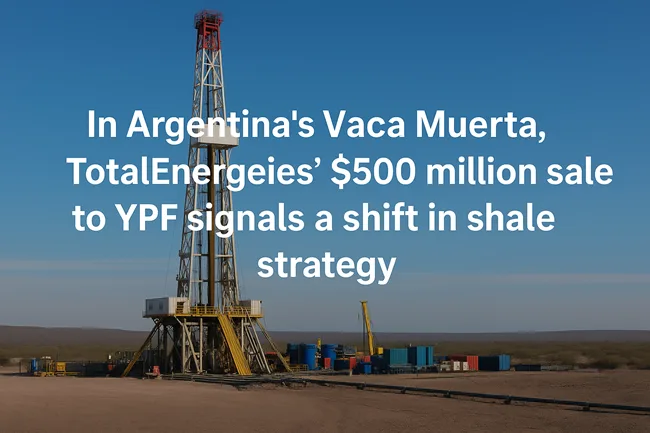
In the wide, wind-swept expanse of Argentina’s Neuquén Basin, a pending transaction could redraw the boundaries of one of the world’s most promising shale plays. Earlier this week, TotalEnergies SE (Euronext Paris, NYSE: TTE) said it had agreed to sell its 45 percent operated interests in the Rincon La Ceniza and La Escalonada blocks to state-controlled YPF SA for US $500 million. The assets, covering roughly 51,000 net acres in the heart of the Vaca Muerta, are currently in the pilot development phase — a stage where drilling activity is limited, data is gathered, and full-scale production plans are yet to be approved.
While the agreement remains subject to customary closing conditions, its implications are already being weighed by the industry. For TotalEnergies, the sale is less about retreat and more about recalibration — a strategic pruning of its Argentine portfolio to free up capital for more advanced projects. For YPF, it is an opportunity to add scale and operatorship in areas that could be developed faster under domestic stewardship.
How does this pending transaction reflect TotalEnergies’ evolving priorities in Argentina’s oil and gas sector?
TotalEnergies has been a fixture in Argentina since 1978, building its position into that of the country’s largest international gas producer. Its local arm, Total Austral, operates a mix of conventional and unconventional fields, with standout assets such as Aguada Pichana Este and San Roque producing about 50,000 barrels of oil equivalent per day in 2024. Before the announced sale, the company’s Vaca Muerta position spanned some 183,000 net acres.
By agreeing to divest Rincon La Ceniza and La Escalonada, the French energy major would reduce that footprint by around 20 percent. But the remaining acreage is more mature and better connected to infrastructure, offering stronger short- to medium-term cash flows. Company executives have underscored that proceeds from the sale would be channelled into assets aligned with its global growth pillars — notably natural gas and LNG — while maintaining a meaningful Argentine presence.
What makes Rincon La Ceniza and La Escalonada attractive targets for YPF’s shale development ambitions?
YPF has long sought to consolidate its control over key Vaca Muerta acreage, both to accelerate development timelines and to coordinate infrastructure investments. By acquiring operatorship of Rincon La Ceniza and La Escalonada, it would gain direct authority over drilling schedules, well designs, and service contracting, removing the need to align decisions with a foreign partner’s portfolio priorities.
The two blocks’ pilot status also offers YPF a degree of flexibility. While early-stage development can be capital-intensive, it also provides a clean slate for integrating cost efficiencies, local supply chain advantages, and new drilling techniques from the outset. If the deal closes, the concessions could be slotted into YPF’s broader development plan, potentially allowing them to move more quickly toward commercial-scale production.
Why are international oil majors recalibrating their stakes in the Vaca Muerta despite its vast resource potential?
The Vaca Muerta formation has drawn comparisons to the United States’ Permian Basin for its high-quality shale reservoirs and multi-decade production potential. International majors like Shell, Chevron, and ExxonMobil have committed billions of dollars to the region. Yet, beneath the geological promise lie persistent operational and economic headwinds.
Infrastructure bottlenecks — from gathering pipelines to processing plants — remain a constraint on production growth. Domestic price controls on oil and gas can limit returns, and regulatory changes can shift export economics overnight. Against this backdrop, many foreign players have adopted a “core concentration” strategy: retaining their most productive acreage while monetising holdings that are earlier in the development curve.
TotalEnergies’ pending sale mirrors similar moves by Chevron and Equinor, both of which have sold stakes in certain blocks to Argentine buyers in recent years.
How does this deal align with TotalEnergies’ broader portfolio management and energy transition agenda?
Globally, TotalEnergies has been positioning itself as both an oil and gas major and a leader in the energy transition. That balance is reflected in its capital allocation: funding LNG expansion, scaling renewables, and high-grading oil and gas portfolios to focus on assets with strong margins and manageable carbon footprints.
Senior Vice President Javier Rielo framed the Vaca Muerta divestment as a textbook case of unlocking value from part of the portfolio while sharpening focus on Neuquén Basin assets like Aguada Pichana Este and San Roque, and offshore projects in Tierra del Fuego. By exiting earlier-stage acreage at an attractive valuation, the company can reallocate capital to developments that promise both stronger returns and a closer alignment with its low-carbon ambitions.
How might investors interpret this pending transaction in the context of TotalEnergies’ 2025 performance?
TotalEnergies’ stock has been supported this year by high LNG prices and strong refining margins, giving the group more room to manoeuvre in portfolio decisions. Investors generally welcome moves that improve capital efficiency, especially when they involve monetising assets without impairing near-term production.
The Rincon La Ceniza and La Escalonada stakes are small in the context of TotalEnergies’ global upstream portfolio, but the US $500 million price tag and roughly US $10,000 per acre valuation stand out in a market where unconventional asset sales can be challenging. For shareholders, the pending sale reinforces management’s narrative of disciplined growth and strategic focus.
Could YPF’s acquisition, if completed, alter the development pace and competitive dynamics in Vaca Muerta?
If the transaction clears its closing conditions, YPF’s expanded operatorship could lead to more agile decision-making in the blocks’ development. The state-controlled firm has both the incentive and the domestic leverage to accelerate drilling, particularly if it can integrate the concessions into existing midstream infrastructure.
That said, speed will depend on broader factors, including Argentina’s macroeconomic environment, the availability of capital, and the pace of infrastructure build-out. Vaca Muerta’s growth potential is substantial, but without parallel investment in pipelines, processing facilities, and export capacity, even prime acreage can face delays.
The deal also hints at a subtle shift in the competitive balance. As international companies selectively step back from certain blocks, domestic operators are stepping up — potentially leading to more locally tailored operational strategies.
What does this agreement suggest about the future of foreign–domestic partnerships in Argentina’s energy sector?
Partnerships between Argentine companies and international majors have long been a feature of the country’s upstream sector, combining local knowledge with global technical expertise. The Rincon La Ceniza and La Escalonada sale, if finalised, would mark a rebalancing of that relationship in favour of domestic control in certain areas.
For TotalEnergies, the move keeps the door open to future collaboration while freeing resources for assets that better match its global roadmap. For YPF, it is a statement of confidence in its ability to manage and develop shale resources without ceding operational leadership to foreign partners.
What does the pending $500 million TotalEnergies–YPF deal reveal about the shifting balance in Argentina’s shale sector?
The pending US $500 million sale of Rincon La Ceniza and La Escalonada from TotalEnergies to YPF is more than a simple asset transfer — it is a reflection of shifting strategies in one of the world’s top shale plays. For TotalEnergies, it is about high-grading its portfolio and focusing on assets with stronger returns and strategic alignment. For YPF, it is about consolidating control and building momentum in the Vaca Muerta. If the deal closes, it will be another marker of how Argentina’s unconventional oil and gas sector is evolving, with domestic players taking a more prominent role in shaping its future.
Discover more from Business-News-Today.com
Subscribe to get the latest posts sent to your email.
