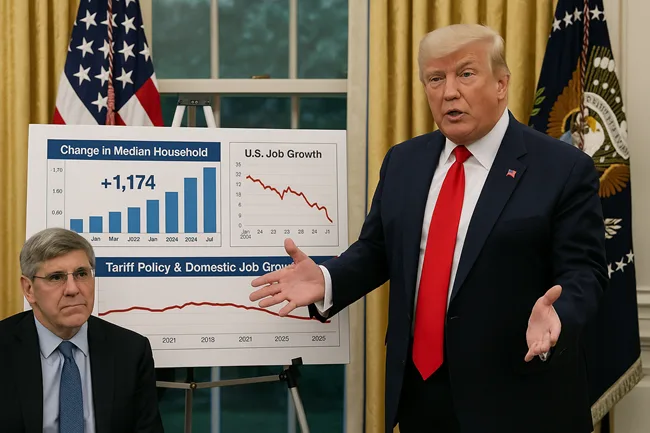
President Donald Trump sought to recast a faltering labor market as a sign of continued economic resilience in an unscheduled Oval Office briefing that blended political theatre with selective data presentation. The event, held days after the July 2025 jobs report revealed just 73,000 new positions added alongside sharp downward revisions to earlier months, featured Trump and economist Stephen Moore showcasing oversized, glossy charts that framed his economic record as superior to that of former President Joe Biden. The visual-heavy performance was aimed at controlling the narrative, but the numbers underneath suggest a more fragile outlook.
The July employment report, published by the Bureau of Labor Statistics (BLS), indicated that employers created a total of 597,000 jobs in the first seven months of 2025—a figure down roughly 44 percent from the same period in 2024. Compounding the weakness, the BLS revised May and June payrolls down by 258,000 jobs. The unemployment rate held near 4.2 percent, but economists warned that slowing hiring momentum, coupled with inflationary pressure from ongoing tariffs, could leave the Federal Reserve reluctant to cut interest rates this year. Within hours of the press conference, Trump dismissed BLS Commissioner Erika McEntarfer, a Senate-confirmed statistician, a move that drew swift criticism from former agency heads, data experts, and market analysts over concerns of political interference in economic measurement.
Why did Trump call an unplanned press conference after the disappointing jobs report?
The abrupt press event was widely seen as a damage-control exercise following a report that challenged Trump’s repeated claims of delivering an economic boom. Moore, a co-author of Trumponomics and long-time Trump economic adviser, stood beside the president flipping through charts mounted on an easel. These visual aids highlighted a series of metrics, including a claimed $1,174 rise in inflation-adjusted median household income during the first five months of Trump’s term, based on unpublished Census Bureau data. That figure has not been independently verified and is not part of the regular public statistical releases.
Trump used the opportunity to argue that the BLS had overstated job creation during Biden’s presidency while downplaying the slowdown in his own tenure. He also defended his tariff strategy, insisting that higher import costs would encourage domestic production and lead to future job gains—despite the immediate drag tariffs have placed on sectors such as manufacturing and construction.
The press conference also served a political function: by framing the data visually and comparing his record directly with Biden’s, Trump sought to shift public focus from the monthly payroll miss toward a narrative of long-term improvement. Political strategists noted that this approach mirrors campaign-style messaging, where perception often outweighs statistical consensus.
What do the underlying economic indicators reveal about the health of the U.S. economy?
While the Oval Office presentation emphasised selected positive trends, the broader data paints a more complex picture. Non-farm payroll growth in July was less than half the average monthly pace recorded in 2024. Revisions to prior months are often overlooked in headline reporting but can materially change the trendline; in this case, they confirmed a more pronounced slowdown than initially reported. Wage growth, measured on a year-over-year basis, has been hovering near 3.5 percent, but price increases—driven in part by import tariffs—have kept real wage gains modest.
Independent analyses from institutions such as the Brookings Institution and Moody’s Analytics suggest that while household incomes may have risen slightly since early 2025, they remain below pre-pandemic levels when adjusted for inflation. Consumer sentiment surveys conducted by the University of Michigan continue to show a gap between reported personal financial improvement and perceptions of broader economic health, indicating that confidence is not keeping pace with headline wage data.
Tariffs, a central plank of Trump’s trade agenda, have had a mixed impact. They have provided some insulation for domestic producers in certain sectors but at the cost of higher prices for consumers and input costs for manufacturers. Economists warn that if tariffs remain elevated without corresponding productivity gains, inflationary pressures could persist even if job growth stabilises.
How could the dismissal of the Bureau of Labor Statistics chief impact market confidence and policymaking?
The removal of BLS Commissioner Erika McEntarfer—reportedly after she refused to delay or amend the release of the July jobs data—has been met with rare bipartisan concern. Former commissioners have publicly stated that it is “not easy to manipulate data” within the BLS due to its decentralised collection processes and multiple internal verification layers. However, they also cautioned that leadership changes driven by political disagreements can erode the perception of independence, which is essential for market trust.
Institutional investors closely monitor BLS releases as inputs for asset allocation and interest rate expectations. Any perception that data is being massaged for political gain could lead to greater market volatility, as traders discount the reliability of official reports. Analysts at JPMorgan and Barclays have noted that even the suspicion of compromised data could prompt the Federal Reserve to rely more heavily on private-sector surveys, which might diverge in methodology and coverage, complicating monetary policy decisions.
For global observers, U.S. statistical independence has long been a benchmark for transparency. If that standard slips, it could diminish the credibility of American economic data in international negotiations, debt issuance, and trade agreements.
What is the likely market and policy trajectory if job growth remains weak and inflation stays elevated?
If hiring remains tepid through the rest of 2025, the Federal Reserve will face a difficult balancing act. Cutting rates could stimulate investment but risks reigniting inflationary pressures if supply-side constraints from tariffs persist. Maintaining current rates may protect against price instability but could further dampen business expansion and consumer spending.
Equity markets have already shown divergent behaviour in response to the jobs report: while the Dow Jones Industrial Average fell on the day of release, technology-heavy indices such as the Nasdaq Composite held up better, reflecting investor rotation toward sectors less sensitive to domestic labour conditions. Bond yields initially dropped on weaker growth signals but rebounded as traders assessed the inflationary implications of Trump’s trade policies.
From a policy perspective, Trump’s administration is expected to double down on supply-chain reshoring incentives, infrastructure spending, and targeted tax relief to offset the drag from tariffs. However, economists caution that without productivity improvements or broader labour market recovery, these measures may not deliver sustained gains in real incomes.
Will chart-driven messaging outweigh the risks of politicising economic data?
The Oval Office display may succeed in reframing the July jobs report for partisan audiences, but for investors, policymakers, and independent economists, the underlying metrics tell a less optimistic story. Slowing job creation, downward revisions, and tariff-linked inflationary pressures suggest the U.S. economy is navigating a more fragile phase than the administration portrays. The decision to remove the BLS chief compounds the uncertainty by raising doubts about the integrity of future data releases.
While political messaging can influence short-term sentiment, sustained economic strength is ultimately judged by verifiable outcomes. If the credibility of statistical agencies is eroded, the consequences could extend beyond one month’s jobs report, potentially affecting investment flows, monetary policy, and the U.S.’s standing as a global economic bellwether.
Discover more from Business-News-Today.com
Subscribe to get the latest posts sent to your email.