


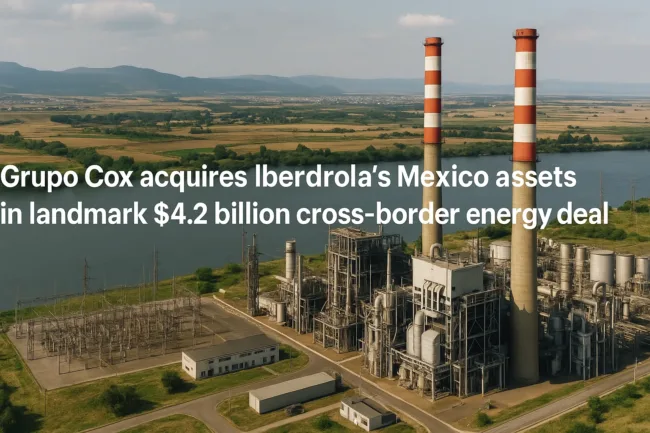
In one of the largest cross-border energy transactions of the year, Grupo Cox, a Spanish multinational specializing in water and energy infrastructure, has completed its acquisition of Iberdrola’s Mexican assets for a total consideration of USD 4.2 billion. The deal marks a strategic pivot for both companies and reinforces Grupo Cox’s ambitions to become a key regional energy player across Latin America.
The transaction, which was legally advised by DLA Piper, positions Grupo Cox as a dominant utility operator in Mexico’s evolving power sector. The asset transfer includes a combination of gas-fired generation assets and related energy infrastructure—consolidating Grupo Cox’s growing footprint outside of its Iberian base.
What makes the $4.2 billion acquisition of Iberdrola Mexico assets significant for Latin America’s energy future?
The acquisition reflects broader realignments in Latin American energy markets, where governments and private players are increasingly focused on localization, sustainability, and strategic asset control. Iberdrola’s decision to divest its Mexican assets is consistent with its capital reallocation strategy, shifting emphasis toward renewable-heavy portfolios in core European markets.
For Grupo Cox, however, the deal marks a decisive entry into Mexico’s large but politically sensitive power generation market. While energy reforms in Mexico have created uncertainty for international firms, local and regional operators like Grupo Cox appear better positioned to navigate the regulatory and economic landscape.
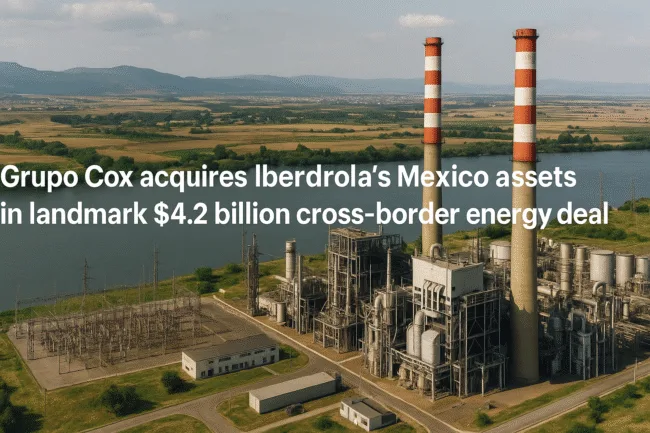
Institutional observers view the move as a calculated play to acquire established, revenue-generating power assets at scale. With rising demand for electricity in Mexico’s industrial corridors and major cities, control over base-load and flexible generation infrastructure provides long-term visibility for utility-focused investors. Analysts believe Grupo Cox is taking a medium-term view, betting that regulatory headwinds may ease as domestic power shortages prompt broader policy adjustments.
How does the acquisition align with Grupo Cox’s regional growth and diversification strategy?
Grupo Cox, which operates in multiple countries across Europe and Latin America, has long sought to diversify its asset base across water management and energy segments. The company’s strategic roadmap includes increased exposure to stable-yield utility assets with long operating histories and strategic location advantages.
The Iberdrola Mexico deal gives Grupo Cox a sizable operating footprint in one of Latin America’s most important energy markets, second only to Brazil in terms of scale. The company is expected to leverage its operational expertise in grid infrastructure and water-energy nexus management to optimize these assets further.
From a geopolitical standpoint, the acquisition allows Grupo Cox to deepen its ties in a NAFTA-aligned market while avoiding some of the capital-intensive risks associated with greenfield expansion. Legal and financial advisors close to the deal indicated that the transaction structure was designed to meet both compliance requirements in Mexico and European ESG transparency frameworks.
Who advised Grupo Cox on this transaction and what does it say about cross-border legal structuring?
DLA Piper acted as legal counsel to Grupo Cox, assembling a cross-border team of more than 40 lawyers across Miami, Mexico City, Madrid, and New York. The team was co-led by Francisco J. Cerezo, Chair of the firm’s US-Latin America and Ibero-American practices, and Partner Mauricio Valdespino in Mexico City.
In remarks released alongside the announcement, Antonio Medina Cuadros, Chief Legal Officer of Grupo Cox, commended the DLA Piper team for their professionalism and execution under complex regulatory conditions. He highlighted the importance of local legal insight combined with global transactional experience—a hallmark of firms like DLA Piper that maintain multi-jurisdictional practices.
This legal structuring success is emblematic of a broader trend in large M&A transactions in Latin America: legal compliance, ESG alignment, and multi-party coordination are becoming essential factors in deal execution, especially in regulated sectors like energy.
How are institutional investors reacting to Grupo Cox’s expansion in Mexico’s energy market?
Although Grupo Cox is privately held, institutional sentiment around the Mexican energy market has shown renewed interest in recent quarters, driven by resilient demand and ongoing grid modernization. Analysts note that infrastructure assets with stable cash flows and defensible economics—like the ones acquired in this transaction—remain attractive to sovereign wealth funds, pension managers, and private capital firms.
While Mexico’s regulatory uncertainty has led some large international energy firms to pare back operations, regional investors with longer-term outlooks are stepping in. Grupo Cox’s acquisition is being seen as a signal that experienced operators with the right local engagement strategy can still extract long-term value from these markets.
Moreover, energy security and climate resilience are creating new value propositions in markets that were previously viewed as politically risky. Institutions tracking emerging market infrastructure have flagged this deal as a bellwether for similar asset reshuffles across Latin America.
What does the future hold for Grupo Cox’s energy ambitions following the Iberdrola deal?
With the Iberdrola Mexico portfolio now under its operational control, Grupo Cox is expected to focus on asset integration, regulatory harmonization, and operational optimization over the next 12 to 24 months. The Spanish utility operator has not yet disclosed detailed plans regarding potential renewable retrofits or technology upgrades across the acquired assets, but industry experts expect some degree of modernization to align with ESG metrics and efficiency benchmarks.
Going forward, Grupo Cox may leverage the Mexican portfolio to support regional cross-border energy interconnection initiatives or to pilot hybrid water-energy infrastructure models. These models, increasingly popular among utility firms with water expertise, seek to improve efficiency and reduce emissions by co-optimizing water use and energy generation.
Institutional observers believe that Grupo Cox is likely to explore additional acquisitions across Latin America, especially in markets where power demand is rising and public-private partnerships are being encouraged to close infrastructure gaps.
Grupo Cox’s USD 4.2 billion acquisition of Iberdrola’s Mexican assets underscores the strategic rebalancing underway in Latin America’s energy sector. While global utilities like Iberdrola recalibrate toward renewables and capital-light models, regional players like Grupo Cox are stepping up to take control of mission-critical infrastructure with long-term value.
For investors, policymakers, and market watchers alike, the deal signals that energy infrastructure in emerging markets remains a battleground for capital deployment, geopolitical influence, and ESG-driven transformation.
Discover more from Business-News-Today.com
Subscribe to get the latest posts sent to your email.