


Offshore oil and gas operators are investing heavily in advanced corrosion protection technologies as platform lifespans stretch and inspection costs mount. In 2025, the global offshore corrosion protection market is projected to exceed USD 12 billion, fueled by aging steel infrastructure, more extreme weather cycles, and a shift toward condition-based monitoring across both fossil and renewable energy sectors.
With over 4,000 offshore platforms exposed to salt spray, temperature swings, and biofouling, extending structural life through coatings, cathodic systems, and smart materials has become a critical industry priority. Leading technologies like thermally sprayed aluminium (TSA), zinc-rich epoxies, and closed-loop cathodic protection systems are now being combined with self-healing polymers and volatile corrosion inhibitors (VCIs) to create multi-layered protection strategies.
What are the leading corrosion protection technologies used on offshore oil and gas platforms in 2025, and how are they improving asset longevity?
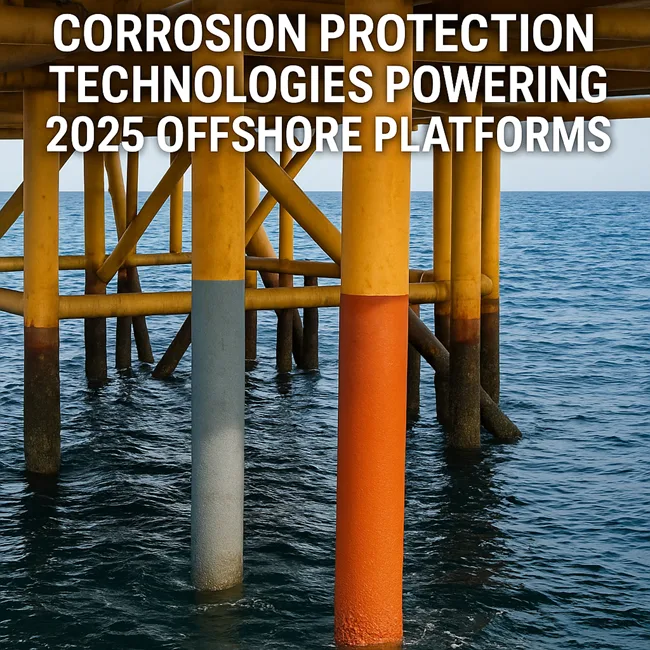
At the top of the list is thermally sprayed aluminium (TSA)—a proven coating applied to steel structures through arc or plasma spray. TSA forms a sacrificial barrier, shielding platform legs, decks, and risers from immersion and splash zone corrosion. In high-salinity conditions, it can extend asset life by 20 years or more with minimal rework.
Closely following are organic zinc-rich epoxy coatings, which offer galvanic protection through sacrificial electron transfer. These coatings have evolved significantly in 2025, with better adhesion, higher resistance to underfilm corrosion, and improved performance under UV exposure. Used together, TSA and zinc-epoxy systems form a dual-barrier solution frequently seen on jacketed rigs and subsea modules.
The third key advancement is closed-loop cathodic protection (CP). Unlike traditional sacrificial anode systems, closed-loop CP uses smart sensors and impressed current systems that self-adjust in real time. Operators can remotely monitor corrosion rates, adjust voltage, and even predict where future material loss is most likely to occur. Pilot deployments on subsea pipelines have shown up to 90% reduction in localized corrosion versus passive CP systems, especially in variable-current environments.
A fourth category gaining traction is self-healing polymeric coatings. In 2025, several manufacturers, including DragX and NanoSteel, have released cold spray formulations that repair microcracks and minor abrasions automatically. These are especially useful for hard-to-reach structural elements like riser clamps, splash zone piping, and FPSO hull plating. Field data indicates that platforms using these coatings have reduced maintenance frequency by 40% over three-year periods.
Finally, volatile corrosion inhibitors (VCIs), often deployed as wraps or inserts in flanges and enclosed joints, are becoming standard on deepwater platforms and floating production units. Products like Zerust VCI flange protectors prevent galvanic corrosion in crevices and are often rated for 3–5 years of passive protection.
Offshore platform operators are increasingly integrating these technologies into a layered defense model. A typical configuration might involve TSA as a primary coating, zinc epoxy in areas of high abrasion, closed-loop CP on subsea elements, and VCIs around modular joints.
Research institutions such as Deakin University (Australia) and NTNU (Norway) have validated the performance of hybrid protection systems, especially in assets exposed to both chemical and microbiologically influenced corrosion.
Floating wind operators are also adopting these technologies to protect turbine support structures. TSA and CP combinations are now standard for concrete-spar and semi-submersible floating wind platforms, which face similar challenges to oil and gas assets in terms of saltwater ingress and biogrowth.
The cost argument is also gaining traction. According to multiple market analysts, advanced offshore coatings and CP systems can reduce total lifecycle maintenance costs by up to 30%, especially when paired with digital inspection regimes and AI-based structural integrity models.
Why corrosion protection is becoming a strategic differentiator in offshore operations
As ESG compliance and downtime minimization become strategic priorities, corrosion protection is no longer viewed as a maintenance line item—it’s a performance differentiator.
Operators deploying smart cathodic systems and self-repairing coatings are reporting fewer inspection interventions, extended asset life, and higher platform availability. In a market where decommissioning costs are rising and platform life extensions are more common, investing in proactive corrosion management makes strong financial sense.
For new offshore projects—including floating LNG and hybrid wind–hydrogen assets—designers are now specifying dual-layer corrosion strategies during FEED stages.
In 2025, the offshore corrosion protection space is no longer just about resisting rust—it’s about protecting uptime, avoiding unplanned shutdowns, and supporting carbon-responsible operations through extended infrastructure lifespans.
Discover more from Business-News-Today.com
Subscribe to get the latest posts sent to your email.