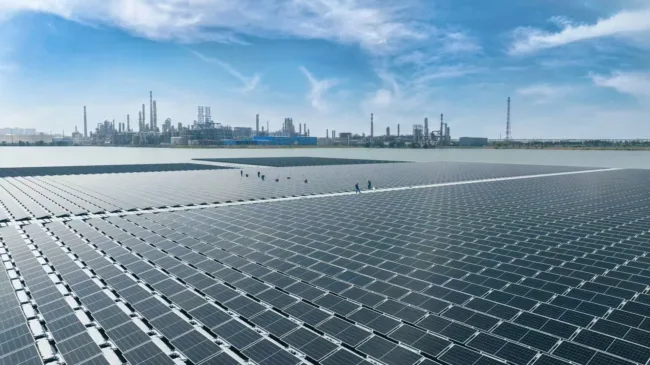
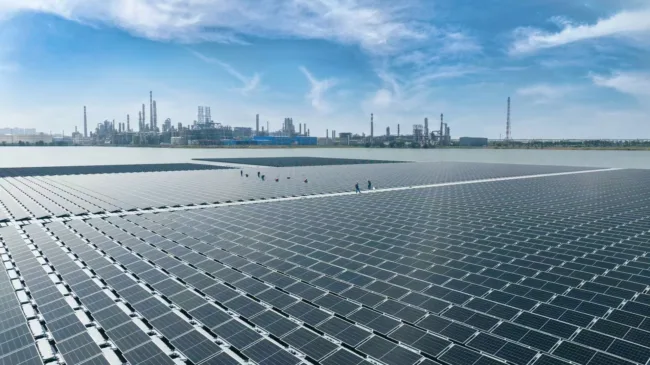
China Petroleum & Chemical Corporation (HKG: 0386), widely known as Sinopec, has officially launched operations at the country’s first commercial floating offshore photovoltaic (PV) project in a full-seawater environment. Developed in collaboration with Shandong Province and Qingdao Municipality, the 7.5-megawatt floating solar installation is expected to generate 16.7 million kilowatt-hours of electricity per year and cut carbon emissions by nearly 14,000 tons annually.
This marks the most ambitious milestone in the electric utility developer’s broader transition toward integrated green hydrogen production. Industry experts suggest this pilot-scale deployment could be a cornerstone in building renewable-to-hydrogen ecosystems along China’s industrial coastline.
What technical challenges did Sinopec overcome to deploy PV technology in seawater environments and how were they addressed?
The offshore floating PV system occupies roughly 60,000 square meters and introduces multiple innovations tailored for harsh marine conditions. Unlike traditional pile-based solar farms, the system uses buoyant platforms that track tidal elevations, minimizing the vertical gap between panels and seawater. This unique seawater-cooling design enhances generation efficiency by an estimated 5–8%.
To mitigate salt corrosion and marine fouling, Sinopec integrated specially engineered floats and panel supports resistant to barnacle accumulation and salt-mist degradation. The project also features a customized underwater anchoring system built to endure wind speeds of up to level 13 and tidal ranges of up to 3.5 meters. This novel anchoring approach reportedly reduced capital expenditure by about 10% compared to pile-based equivalents.
In addition, the low-profile structure facilitates safer and more cost-effective maintenance. Cables and panels are mounted close to the waterline, allowing easier inspection and reducing operational overheads.
How does this floating PV project align with Sinopec’s broader green hydrogen strategy?
Sinopec has made considerable headway in its push toward clean hydrogen production. The Chinese energy major previously opened the country’s first “carbon-neutral” hydrogen refueling station and launched an industrial-scale seawater electrolysis project. These form part of its blueprint for a vertically integrated hydrogen supply chain powered by renewable electricity.
With the floating PV system now generating clean energy offshore, institutional observers believe Sinopec has achieved a critical link in that supply chain. The company’s goal is to use PV-powered electricity for water electrolysis, thereby producing green hydrogen at scale without burdening inland energy grids or competing for land use.
Analysts note that improving solar conversion efficiency—even by single-digit percentages—can significantly reduce the levelized cost of green hydrogen. In this context, Sinopec’s investment in offshore solar is seen as both a technological and economic hedge.
What are the environmental and economic benefits of the project with regard to coasts and shallow sea utilisation?
By tapping into marine surfaces rather than land, Sinopec is solving one of the critical spatial challenges of large-scale solar deployment. China’s eastern coastal provinces—home to dense populations and industrial hubs—have limited available land for renewable installations. Offshore floating PV solves this by activating underutilized sea-connected areas.
Furthermore, the design lowers operational costs through passive seawater cooling, while the materials and anchoring innovations extend system durability. According to Sinopec, the project’s reduced reliance on traditional structural reinforcements and the streamlined maintenance process could cut installation and lifecycle costs significantly. This positions the model as an economically viable option for other densely populated coastal economies with shallow waters and tidal variation.
What is Sinopec’s projected roadmap for scaling floating offshore PV capacity beyond the pilot?
Following the successful launch of the 7.5-megawatt plant, Sinopec has announced plans to scale the project to 23 megawatts. This larger phase, likely to begin development by 2026, will serve as a test case for replicability in deeper waters or alternative marine geographies.
Institutional investors and energy analysts anticipate that similar floating solar arrays could soon be rolled out across other Chinese coastal provinces, especially in the Yangtze River Delta and the Greater Bay Area. These regions collectively account for more than 40% of China’s GDP and nearly 60% of its energy consumption—making them prime candidates for green hydrogen and renewable energy integration.
Industry observers are also closely tracking whether Sinopec will begin exporting the technology or licensing its modular design to other energy developers in Asia, Southeast Asia, or Africa, where similar geographic constraints exist.
What is the market and policy context surrounding Sinopec’s offshore PV project?
The floating PV milestone aligns with China’s larger energy and industrial goals. The country surpassed 1 terawatt of installed solar capacity in May 2025, including nearly 200 gigawatts added in just the first five months of the year. Offshore and floating PV technologies are expected to play an outsized role in helping China meet its target of deriving at least 20% of primary energy consumption from non-fossil sources by 2025.
Sinopec’s venture also complements the government’s growing emphasis on hydrogen infrastructure, with estimated state and private sector investments of US$50 billion expected by 2030. By linking floating solar power to hydrogen electrolysis, the company is effectively positioning itself as a first-mover in China’s offshore renewable-to-hydrogen transition—potentially securing policy incentives and regulatory support.
What sentiment are analysts and investors expressing regarding Sinopec’s transition into new energy markets?
Institutional sentiment around Sinopec’s floating PV project has been broadly positive. While traditional oil and gas assets remain the firm’s revenue backbone, investors are increasingly focused on how legacy energy players will adapt to a carbon-constrained world.
Analysts suggest that Sinopec’s floating solar initiative represents a “capital-efficient proof of concept” for integrating renewable energy with industrial-scale hydrogen production. Some investors are also watching the project’s cost trajectory closely, as reductions in the levelized cost of electricity (LCOE) could materially influence the feasibility of widespread green hydrogen adoption.
The project’s strategic location, combined with its potential for scaling, is viewed as a positive signal for Sinopec’s energy transition roadmap. If replicated successfully, the floating PV model could create a parallel growth engine alongside the company’s fossil fuel legacy operations.
What future developments can be expected from Sinopec and its floating PV strategy?
With the floating solar pilot now operational and early indicators pointing toward efficiency and durability, Sinopec is expected to move quickly toward broader deployment. The upcoming 23-megawatt expansion could serve as a real-world test for performance across seasons, tidal variations, and storm events.
Additionally, Sinopec’s growing hydrogen infrastructure network—including refueling stations and industrial offtake partners—could help internalize demand and reduce the project’s dependency on external buyers or subsidies.
Looking ahead, the integration of AI-based grid management, predictive maintenance for marine PV systems, and potential offshore battery storage are all areas under institutional watch. Regulatory frameworks governing marine energy use, environmental permitting, and interconnection approvals will likely be the decisive factors in the speed and scale of future deployments.
If execution continues to align with policy support and performance expectations, Sinopec may emerge as a global reference case for industrial-scale offshore renewable integration—turning China’s shallow seas into a frontier for climate infrastructure.
Discover more from Business-News-Today.com
Subscribe to get the latest posts sent to your email.