



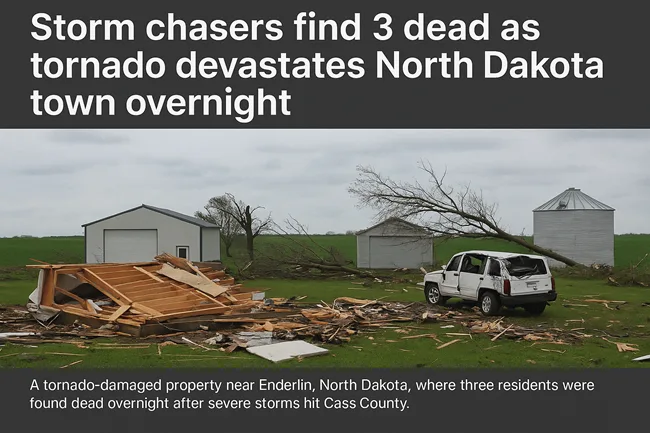
At least three people were killed in North Dakota late Friday night after a tornado tore through rural Cass County, leaving widespread destruction and prompting an overnight multi-agency emergency response. The fatalities occurred near the small town of Enderlin, where law enforcement and storm chasers found the victims amid heavy structural damage.
According to the Cass County Sheriff’s Office, deputies were dispatched at approximately 11:40 p.m. local time to a tornado-hit residence near Enderlin. Upon arrival, fire officials informed them that two deceased individuals had already been located by storm chasers tracking the tornado’s path. Soon afterward, a third deceased person was discovered at another nearby location.
In an official statement, the Cass County Sheriff’s Office confirmed, “Deputies found extensive damage to the area and began conducting well-being checks on people with several partner agencies. Law enforcement, the Enderlin Fire Department, and other first responders continue searching the area and checking on residents now.”
Sheriff Jesse Jahner announced that a press conference would be held at 7:30 a.m. Saturday to provide updates on the response effort, including the scope of fatalities, damage assessments, and ongoing rescue operations. The identities of the deceased have not yet been released, and the full extent of the destruction is still under evaluation.
What makes this North Dakota tornado significant in the state’s history of deadly storm events?
Although North Dakota is no stranger to tornadoes, Friday night’s event has become one of the state’s deadliest in recent years. Historically, the region’s most devastating tornado occurred in 1957 when an F5 twister hit Fargo, killing 12 and injuring over 100. That event helped shape the U.S. approach to tornado classification and early warning systems.
Friday’s storm reaffirms that the Upper Midwest remains vulnerable to violent weather, particularly in late spring and early summer. North Dakota’s tornado season typically peaks in June, and this recent event fits a familiar pattern—isolated rural strikes with fatal consequences due to limited visibility, sparse populations, and fast-moving systems.
Institutionally, North Dakota has upgraded its emergency response capabilities over the decades. Volunteer storm chasers, advanced weather radar, and drone-assisted search and rescue now form part of the multi-layered system triggered during overnight storm events such as this one.
How are North Dakota’s emergency responders coordinating efforts in Cass County and Enderlin?
Emergency services in Cass County responded swiftly with support from surrounding jurisdictions. According to local reports, the Cass County Sheriff’s Office, Enderlin Fire Department, Alice Fire Department, Casselton Ambulance, Lisbon Ambulance, the North Dakota Highway Patrol, and the Red River Valley UAS team were all deployed to the impact zone.
Search operations began as soon as first responders confirmed the presence of deceased individuals. Drones and ground units worked in tandem to identify survivors, conduct wellness checks, and assess building damage. Road blockages, downed trees, and power line hazards complicated access in several areas, especially near remote farms.
The sheriff’s office indicated that aerial and on-foot assessments will continue throughout Saturday. No additional injuries have been confirmed so far, though utility disruptions and property damage have been reported across several rural sections of Cass County.
What kind of wind speeds and structural damage were associated with this tornado event?
The National Weather Service has confirmed the occurrence of a tornado in the area but has not yet issued an EF-rating. Preliminary data suggest wind speeds could have exceeded 110 mph. In nearby Luverne, North Dakota, local equipment recorded gusts up to 111 mph, while in Bemidji, Minnesota, winds peaked at 106 mph.
The storm overturned vehicles, destroyed homes, and flattened multiple outbuildings. Drone footage captured by regional storm chasers and UAS teams show twisted metal, leveled structures, and debris strewn across open fields. Officials reported power outages in more than 24,000 homes in North Dakota and 34,000 across Minnesota.
These initial figures could rise as utility companies complete their site inspections. Emergency managers said power restoration could take several days in more severely impacted areas.
How does this event compare with other recent tornadoes in North Dakota and the Upper Midwest?
North Dakota’s last high-profile tornado occurred in July 2021 when a twister hit the Watford City area, damaging dozens of structures but causing no fatalities. However, this week’s tornado is being compared to more deadly outbreaks in 1992 and 1953, which caused widespread destruction and killed several residents in the state.
Cass County has remained vulnerable due to its geographic location along frequently active storm paths. The 2024 tornado season was already forecast to bring above-average activity, with NOAA warning of more frequent supercells forming in the Upper Plains due to warming conditions and jet stream variability.
While Friday’s tornado was isolated in impact, the broader system is part of a larger line of storms that affected several states across the Midwest, including Minnesota and South Dakota, resulting in additional property losses and travel advisories.
How are weather authorities and institutional agencies assessing and communicating risk post-event?
The National Weather Service’s Grand Forks office is deploying survey teams to classify the tornado, estimate path length and width, and determine the EF-rating. The service relies on both radar data and physical damage surveys, often conducted on foot and using drones, to assess wind speeds and identify tornado behavior.
Forecasters continue to issue advisories and recommend residents in surrounding counties remain weather-aware due to lingering instability in the region’s atmosphere. Local authorities praised the role of spotter networks and storm chasers, who were first on the scene in some locations and helped guide responders.
Institutionally, Cass County has asked residents to contact emergency services if they are in need of temporary shelter or medical assistance. No mandatory evacuations were ordered, but assistance is being offered to anyone displaced by the storm.
What is the current sentiment among local communities and emergency leadership?
Community sentiment in Enderlin and surrounding areas remains one of grief but also of strong institutional support. Sheriff Jesse Jahner stated that his department and all partner agencies are committed to “working through the specifics” and continuing their door-to-door efforts to ensure every resident is accounted for.
Public messages on local social media pages reflect a mixture of condolences and praise for first responders. Residents are also sharing photos of damage, which in many cases show the complete destruction of homes and farming structures.
State and county officials have not yet issued a formal disaster declaration, but coordination with federal partners is ongoing should the threshold for FEMA assistance be met in coming days.
What should affected residents do next and how long could recovery take?
Residents are being urged to remain indoors, avoid downed power lines, and check in on neighbors. Law enforcement is continuing welfare checks and assessing blocked roadways for debris removal. Several utility crews are already working to restore power in phases.
Weather forecasters caution that additional storms could develop later in the weekend. Local emergency services will continue offering real-time alerts through radio, social media, and mobile emergency apps.
Sheriff Jahner’s morning press conference is expected to provide new details on the number of properties destroyed, road closures, and support available for impacted families. Federal weather authorities will also release a final tornado rating after completing the survey.
Discover more from Business-News-Today.com
Subscribe to get the latest posts sent to your email.