



Why are private label brands growing rapidly while national FMCG leaders struggle to retain volume?
Private labels are no longer second-tier substitutes. In the inflation-defined marketplace of 2025, store-brand products have become strategic growth drivers for retailers and a formidable challenge for legacy consumer goods giants like The Procter & Gamble Company (NYSE: PG), Unilever (LSE: ULVR), and Colgate-Palmolive (NYSE: CL). As price-sensitive consumers trade down and perception gaps narrow, private labels are gaining share across food, household essentials, and personal care categories.
According to market analytics firm Circana, private label sales in the United States surged to a record $271 billion in 2024, up 4% from the previous year. Simultaneously, national brands saw unit sales decline by nearly 7%. The trend is not just driven by inflation—consumer perception is shifting too. A 2024 survey by PLMA found that 75% of shoppers consider store brands to be “a better value,” and over 72% now view them as quality-equivalent to national labels.
This evolution in buyer behavior is especially strong among younger demographics. Data from IRI shows that 44% of Gen Z and 39% of younger millennials purchased private label products for the first time in the past year. For these consumers, the appeal goes beyond price—private brands are increasingly seen as modern, minimalist, and aligned with values like sustainability and simplicity.
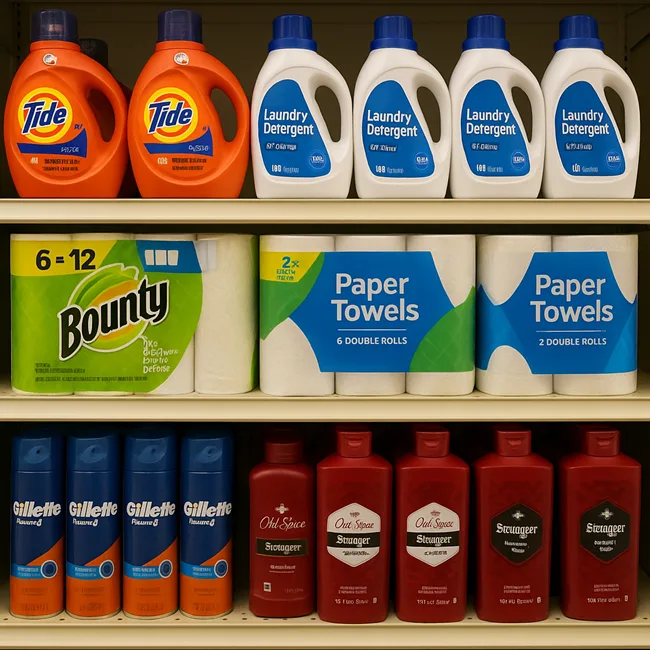
How large are store brands becoming—and could they rival national household names?
Retailers like Costco Wholesale Corporation (NASDAQ: COST), Walmart Inc. (NYSE: WMT), and Target Corporation (NYSE: TGT) are building billion-dollar brand portfolios under their own roofs. Costco’s Kirkland Signature, for example, generated nearly $86 billion in sales last year—more than household names like Colgate or Pampers. Analysts estimate Kirkland’s standalone brand value to be around $17–$18 billion, contributing up to one-third of Costco’s total revenue.
Walmart’s Great Value and Sam’s Choice, Target’s up & up and Good & Gather, and Aldi’s entire store assortment—80% of which is private label—underscore the structural advantages of retailer-owned brands. In Europe, where private labels account for nearly 40% of FMCG value share in the top six markets, retailers like Lidl, Tesco, and Carrefour are expanding their in-house lines across frozen, ambient, and personal care segments.
While few private labels have the global reach of Procter & Gamble’s Tide or Gillette, their growth trajectory is clear: the more constrained consumers become, the more private labels expand.
What impact is inflation having on P&G’s volume performance and brand loyalty?
Procter & Gamble, a bellwether for consumer sentiment and pricing power, has acknowledged softening volume in key categories despite modest organic sales growth. In its April 2024 earnings update, the company flagged that consumers—especially in North America, which now contributes over half of its total revenue—are beginning to show resistance to pricing actions in the face of high inflation.
While CFO Andre Schulten reaffirmed the strength of core brands like Tide, Pampers, and Always, he noted that the company is “seeing some consumers begin to experiment with lower-priced alternatives.” In categories such as dish care, laundry additives, and grooming, value-tier private labels have started gaining traction, particularly among younger and middle-income households.
P&G’s 7,000-person white-collar workforce reduction announced in June 2025 is partly a cost-control measure in response to these margin pressures. Although its core franchises remain strong, the firm is exiting less competitive segments and intensifying digital spend on hero brands to defend market share.
How are other FMCG giants like Unilever and Colgate responding to the store-brand threat?
The private label threat is systemic. Unilever has reported volume flatness in Europe and North America across household and personal care categories, even as it shifts focus to its top 30 “power brands.” The company recently announced it would spin off its entire ice cream division and divest €1 billion worth of lower-margin food brands—an effort to double down on high-loyalty segments as private brands undercut price-sensitive SKUs.
Colgate-Palmolive, meanwhile, is consolidating marketing spend on its oral care and pet nutrition divisions, two of its highest-margin verticals. However, its mid-tier personal care brands continue to face competitive pressure from well-executed private label competitors on drugstore and discount retail shelves.
Across the industry, there’s a growing consensus: unless national brands can clearly differentiate through innovation, formulation, or sustainability, they will continue to lose volume share to increasingly sophisticated private-label offerings.
What are retailers doing to accelerate the rise of private label brands in 2025?
Retailers are no longer just shelf curators—they are becoming brand builders. Walmart, Target, Kroger, Costco, and even Amazon are investing heavily in design, marketing, and supply chain integration for their own brands. In many cases, they’re building premium and organic product tiers that directly challenge the “better for you” and clean-label strategies of big FMCG players.
Interactive in-store activations, QR code engagement, and social-first digital campaigns are all being deployed to drive awareness and loyalty. At Walmart, the 2025 launch of its “Bettergoods” line combines value pricing with plant-based and allergen-free claims, targeting the same wellness-conscious shoppers P&G once dominated with brands like Native or Herbal Essences.
Retailers are also leveraging first-party data from loyalty programs to tailor promotions for their private labels—something even dominant CPG brands can’t replicate without retailer alignment. According to a 2025 survey by Relex, over 60% of North American grocery retailers have plans to expand private-label assortment by 10% or more in the next 12 months.
Are investors worried that private label expansion could erode CPG profit pools?
Yes, sentiment is shifting. Institutional investors are beginning to scrutinize the long-term structural headwinds posed by private-label growth. While Procter & Gamble and Colgate-Palmolive remain defensive stocks in volatile environments, analysts are flagging that volume erosion in mid-tier brands could pressure gross margins unless offset by significant innovation or price/mix benefits.
Fund flow data from Q2 2025 shows institutional rotation out of broad CPG ETFs and into retail-exposed equities like Costco and Walmart, whose private label dominance has become a margin tailwind. Norges Bank, BlackRock, and other long-term holders continue to maintain overweight positions in P&G, but with more selectivity toward segments showing premium-tier resilience.
From a valuation standpoint, the risk is that legacy FMCG firms are being priced for margin durability that may no longer be guaranteed. Store brands, once viewed as cyclical threats, are now seen as secular disruptors—particularly in the post-pandemic value economy.
What should brand-led companies do to defend against the private label surge?
To remain competitive, legacy FMCG companies must innovate at the intersection of price, performance, and purpose. This means investing in product formats that justify a price premium, embedding transparency into sourcing, and launching tiered SKUs that span value to premium segments without cannibalizing core.
For Procter & Gamble, that could mean faster rollout of regional variants, smaller pack sizes for cost-conscious markets, or digital bundles via DTC. For Unilever, it may involve portfolio pruning, faster innovation cycles, and co-branding with influencers. Across the board, closer collaboration with retailers on shopper data, assortment strategy, and shelf velocity metrics will be critical.
The days of assuming consumer loyalty as a given are over. In 2025, brand strength is not static—it’s earned every quarter, every channel, every SKU.
Discover more from Business-News-Today.com
Subscribe to get the latest posts sent to your email.

