


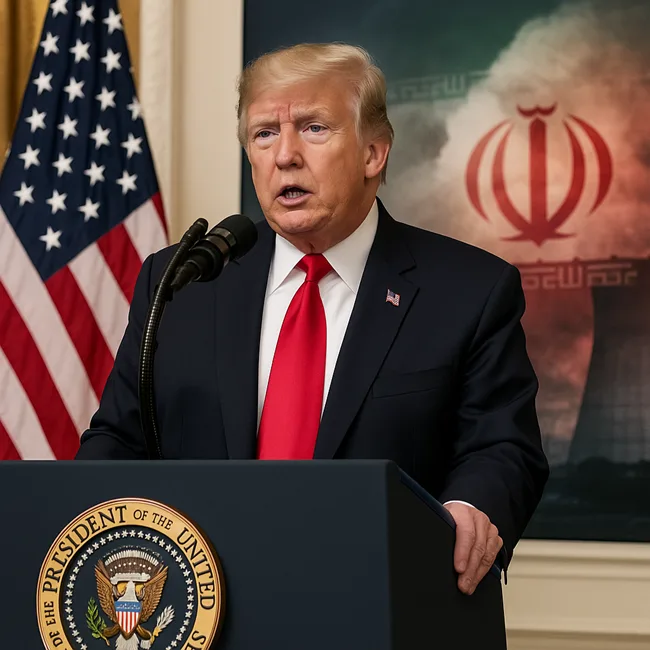
President Donald Trump is grappling with rising dissent from within his own MAGA coalition over the possibility of U.S. military action against Iran. Key America First figures are urging restraint to avoid what they fear could be a repeat of past Middle Eastern interventions that fractured U.S. politics and drained public trust.
Core members of the Make America Great Again movement—including influential voices like Steve Bannon, Marjorie Taylor Greene, and Tucker Carlson—have begun distancing themselves from a potential escalation. Their concern follows reports that the Trump administration is weighing whether to support Israel’s military operations with bunker-busting airstrikes on Iranian nuclear sites.
What new signals suggest Trump is seriously weighing military action against Iran?
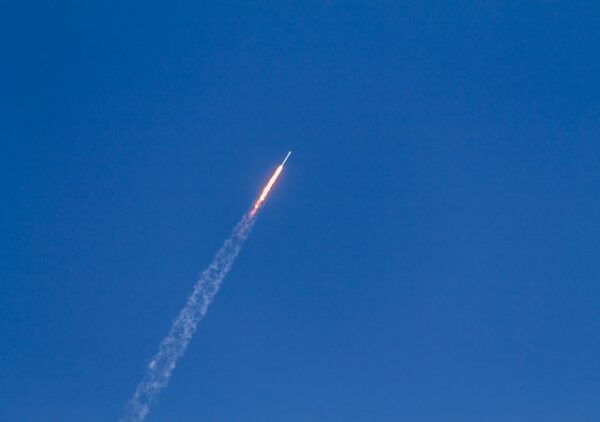
According to reports this week, President Trump is considering deploying B-2 stealth bombers equipped with 30,000-pound bunker-buster bombs in a potential strike on Iran’s Fordō nuclear facility. The Wall Street Journal and ABC News indicated that military options have been finalized for presidential review. Trump, when questioned, said he had “some ideas” but had not made a final decision.
The strike plans come amid Israel’s continued aerial assault on Iranian military and nuclear assets, raising the specter of a broader regional conflict. Trump’s public rhetoric—emphasizing that “Iran cannot have a nuclear weapon”—has reinforced speculation that the U.S. may provide military support to Israel beyond intelligence and logistics.
How are MAGA leaders reacting to Trump’s potential shift from diplomacy to military engagement?
The internal backlash has been swift. Steve Bannon, a former chief strategist and longtime Trump ally, urged the president to reconsider. Speaking in Washington, Bannon warned that intervention could “tear the country apart” and likened it to the Iraq War’s destabilizing effects. He stressed that any military move must be justified transparently to the American people.
Marjorie Taylor Greene echoed this sentiment on social media, asserting that those advocating full U.S. involvement are “not America First/MAGA.” She declared, “We are sick and tired of foreign wars. All of them.”
Tucker Carlson added further pressure with a combative interview featuring Senator Ted Cruz, where Carlson criticized Cruz’s push for regime change in Iran and accused him of “calling for the overthrow of the government.” The exchange quickly went viral and became a flashpoint in the MAGA movement’s internal debate.
What historical context explains this division within the Republican Party?
This isn’t the first time America First conservatives have rebelled against interventionism. Trump’s original 2016 campaign thrived on promises to end “forever wars” and rethink U.S. military commitments. That legacy still defines much of the MAGA movement’s ideological identity.
Trump’s 2018 withdrawal from the Iran nuclear deal, known as the Joint Comprehensive Plan of Action (JCPOA), and subsequent “maximum pressure” sanctions campaign already shifted the regional dynamic. However, he stopped short of full military confrontation, even after incidents like the downing of a U.S. drone and Iran-backed attacks on oil tankers.
Now, Trump’s consideration of direct strikes would mark a significant departure from his past caution and has reopened old fault lines among Republicans—particularly between non-interventionists and neoconservatives.
How does this divide reflect broader public and institutional sentiment on Iran?
Polling remains mixed. A Reuters/Ipsos survey from March 2025 showed that 48% of Republicans supported the idea of using U.S. military force to defend Israel regardless of threat origin. Only 28% disagreed. Among Democrats, just 25% favored such action, while 52% opposed it.
Inside Congress, sentiment is split. Lawmakers like Senator Lindsey Graham support aggressive backing of Israel and see strikes as a necessary deterrent. On the other hand, bipartisan figures such as Representatives Ro Khanna and Thomas Massie have introduced legislation requiring Congressional approval before any military action against Iran.
Vice President JD Vance attempted to bridge the divide, acknowledging public wariness while defending Trump’s credibility. “People are right to be worried about foreign entanglement after the last 25 years,” Vance said, “but I believe the president has earned some trust on this issue.”
What role is Israel playing in influencing U.S. deliberations on Iran?
Israeli Prime Minister Benjamin Netanyahu has ramped up pressure on Tehran in recent months, launching what Israeli media dubbed “Operation Rising Lion” targeting suspected nuclear and ballistic missile facilities. Israel has long warned that Iran’s nuclear program is an existential threat.
Trump, who has previously celebrated U.S.-Israel ties as a cornerstone of his foreign policy, praised Netanyahu’s resolve but has not clarified how far U.S. support would extend. Israel is reportedly lobbying Washington for more direct involvement, particularly in intelligence coordination and logistics support for precision strikes.
This has placed the U.S. in a complex geopolitical position—balancing alliance commitments with rising domestic resistance to a new conflict.
How would a military strike impact Trump’s foreign policy legacy and the 2026 midterms?
A direct U.S. military operation could create serious political consequences. Trump’s record—built on ending wars, not starting them—would face scrutiny. Military engagement might help consolidate support among traditional hawks, but risks alienating isolationist MAGA conservatives and younger voters fatigued by years of conflict.
Strategically, a strike could destabilize the administration’s efforts to maintain Gulf alliances and weaken Trump’s diplomatic push for ending the Ukraine war. It could also complicate pending trade deals with nations hesitant to support war-time partners.
Republican strategists worry that MAGA disillusionment could translate into reduced turnout or primary challenges in the 2026 midterms, particularly in swing districts.
How are international stakeholders reacting to the growing U.S.–Iran tensions?
The European Union has urged de-escalation, calling for a return to diplomacy and compliance with nuclear safeguards. The United Nations Security Council held a closed-door meeting earlier this week to assess the risk of escalation following reports of Israeli drone activity over central Iran.
In the Gulf, countries such as the United Arab Emirates and Saudi Arabia have remained largely silent but are reportedly nervous about retaliatory attacks that could target oil infrastructure, shipping lanes, or proxy positions in Yemen and Iraq.
NATO allies have yet to take a public stance but are preparing contingency plans in the event that a broader regional conflict disrupts global energy supplies.
What’s next in Trump’s decision-making timeline and how is the base responding?
On Wednesday, Trump told reporters that he had not reached a final decision. “I’m not looking to fight,” he said, “but if it’s a choice between them fighting or having a nuclear weapon, you have to do what you have to do.”
Trump’s statement has done little to unify his political base. While some MAGA-aligned voters support decisive action to prevent nuclear proliferation, others demand a clearer explanation before endorsing another foreign operation. Analysts suggest that Trump may attempt to strike a middle path—emphasizing deterrence while stopping short of a full-scale intervention.
The coming days could determine not just the trajectory of U.S. policy on Iran, but also the ideological cohesion of the MAGA movement heading into a high-stakes election cycle.
Will Trump’s Iran decision permanently divide the MAGA base or reshape its foreign policy stance?
President Trump stands at a critical junction: authorizing a strike on Iran may affirm his resolve against nuclear threats, but it also risks alienating the very movement that powered his political ascent. MAGA’s internal divide—between America First isolationists and national defense hardliners—could shape not only the legacy of Trump’s presidency but also the direction of the Republican Party in the post-2024 era.
Whether the movement fractures or realigns may depend on what Trump does next—and whether he brings his base along with him.
Discover more from Business-News-Today.com
Subscribe to get the latest posts sent to your email.