



Who is Iran’s supreme leader and how has Ayatollah Khamenei responded to Israeli attacks on nuclear facilities?
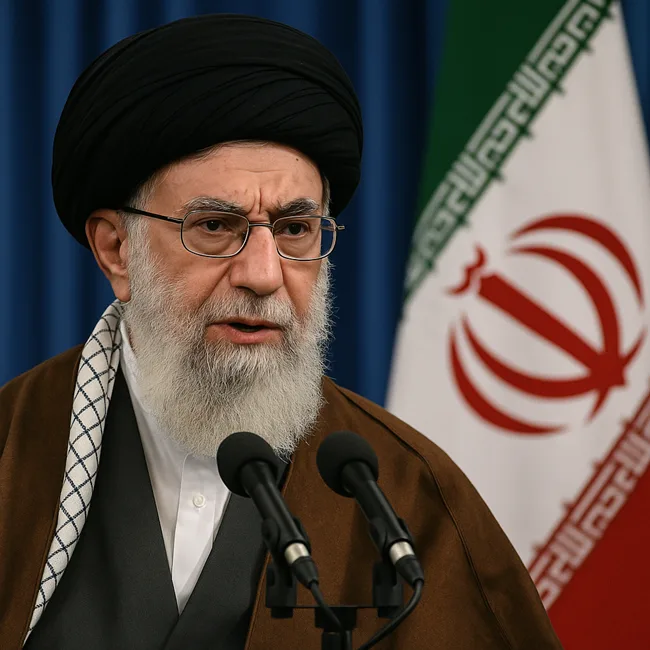
Ayatollah Ali Khamenei, Iran’s supreme leader since 1989, has pledged that the country will not surrender to pressure following an unprecedented Israeli air assault on key nuclear and military assets. The 86-year-old leader issued a defiant public message on June 18, 2025, nearly a week after Israel’s surprise strikes targeted top officials and infrastructure, declaring: “War will be met with war, bombing with bombing, and strike with strike.”
Khamenei’s comments, broadcast via the semi-official Tasnim News Agency, came amid reports that he had temporarily gone into hiding. U.S. President Donald Trump had previously called on Iran to surrender, while Israeli Prime Minister Benjamin Netanyahu has hinted that eliminating Khamenei could bring a swift end to the ongoing conflict. Israel and Iran have now exchanged aerial bombardments daily, as regional and international alarm grows.
What historical and institutional authority does Khamenei hold as Iran’s supreme leader?
Khamenei rose to power after the 1989 death of Ayatollah Ruhollah Khomeini, the Islamic Republic’s founder. Khomeini bypassed his designated successor, Hossein-Ali Montazeri, and the Assembly of Experts ultimately selected Khamenei, who had served as president from 1981 to 1989.
The Iranian constitution enshrines the role of the supreme leader as both religious and political head of state. As outlined by the Council on Foreign Relations, the office has sweeping powers: setting national policy, supervising its implementation, commanding the armed forces, and appointing key positions across Iran’s military and judiciary, including the Islamic Revolutionary Guard Corps (IRGC).
For over three decades, Khamenei has overseen Iran’s expansion of influence across the Middle East, bolstering proxy groups and confronting the U.S.-led order. His leadership has been marked by ideological rigidity, internal suppression, and a deepening military-industrial complex around the IRGC.
How have Israeli strikes affected Iran’s leadership structure and succession plans?
On June 13, 2025, Israel launched Operation Rising Lion, targeting nuclear and command facilities across Iran. Among those killed were IRGC Commander-in-Chief Hossein Salami, aerospace division head Amir Ali Hajizadeh, and multiple nuclear scientists. These high-profile casualties have sharply weakened Iran’s strategic command, leaving Khamenei increasingly reliant on his son, Mojtaba Khamenei—whose growing role has prompted speculation about succession.
While no official successor has been named, Mojtaba is now seen as a power center within the regime. Institutional observers warn that any leadership vacuum could trigger infighting. Ray Takeyh, a senior fellow at the Council on Foreign Relations, said Iran could face “much more chaotic” decision-making if Khamenei is killed or incapacitated. “Other centers of power will have their own prerogatives,” he noted in a press briefing.
The Iranian regime’s succession mechanism remains opaque, controlled by clerical elites and the IRGC. But the elimination of senior commanders is already reshaping internal balances—and external actors are closely watching for signs of fragmentation or elite defection.
What latest military escalations have intensified Iran–Israel tensions and raised regional risk?
Israel’s air campaign included precision missile strikes on the Natanz enrichment site, missile development centers, and drone hangars in central Iran. Iran responded with over 150 ballistic missiles and more than 100 drones aimed at Israeli targets, most of which were intercepted by Israel’s air defense systems with assistance from U.S. forces.
The exchange has left hundreds dead in Iran and more than two dozen civilian casualties in Israel, according to initial media reports. The Iranian foreign ministry warned that any American involvement would escalate the conflict into “all-out war,” while shipping disruptions in the Strait of Hormuz and targeting of U.S. bases in Iraq remain on the table.
Though President Trump has not publicly committed U.S. troops, he has greenlit aerial support for Israel and warned Tehran of consequences if escalation continues. The situation remains fluid, with global oil markets, trade flows, and regional energy security on edge.
How have global and regional actors responded to Khamenei’s defiant posture and the broader escalation?
Israeli domestic sentiment has rallied around Netanyahu, with broad bipartisan support for the strikes. Former opposition leaders such as Avigdor Lieberman and Benny Gantz have aligned with the Prime Minister on national security. Public polling shows that over 80% of Jewish Israelis support military retaliation, even amid criticism of parallel operations in Gaza.
In contrast, international reactions have leaned toward de-escalation. Russia, while affirming Iran’s sovereignty, urged restraint. China has called for direct negotiations and has warned against a regional spillover. European nations including Germany, France, and the United Kingdom are reportedly exploring backchannel diplomacy to reopen nuclear talks, possibly through Oman or Qatar.
The United Nations has held emergency sessions, with Secretary-General António Guterres expressing concern about destabilization across the Middle East. Energy-importing nations such as India and Japan have urged both sides to exercise caution, citing volatility in crude oil prices.
What is the public sentiment inside Iran amid leadership strikes, regime uncertainty, and mass displacement?
While official state media has framed the strikes as an act of war and emphasized Khamenei’s resistance, underground and social channels report a different narrative. Large crowds in Tehran and other cities have protested in recent days, chanting slogans such as “Death to the Dictator” and calling for regime change. Over 100,000 civilians are believed to have fled the capital toward northern provinces like Gilan and Mazandaran.
The Iranian Red Crescent has deployed mobile medical units to manage the humanitarian fallout, while internet disruptions have intensified as authorities seek to limit coverage of dissent. Despite government crackdowns, leaked videos have shown IRGC defections and low morale within military ranks—adding to speculation that the regime may be facing its deepest legitimacy crisis since the 2009 Green Movement.
What are Iranian opposition leaders saying about regime change, and how are they positioning themselves?
Maryam Rajavi, the exiled leader of the National Council of Resistance of Iran, told European lawmakers that Israel’s attack marked “the beginning of a critical new chapter.” She argued that lasting peace is only possible through “regime change by the people of Iran and the organized resisters.”
Reza Pahlavi, the exiled crown prince and son of the last Shah, has also taken a prominent role in calling for public uprising. In an interview with ABC News Live, Pahlavi claimed, “We are sensing almost a state of collapse by the regime.” He pointed to defectors, fleeing officials, and Khamenei’s underground retreat as signs of a tipping point.
Pahlavi said plans were in place for a post-regime transition, including a 100-day roadmap to establish a democratic interim government. “We are prepared for the first hundred days after the fall,” he wrote on X, “and for the establishment of a national and democratic government—by the Iranian people and for the Iranian people.”
What future scenarios are being considered if Khamenei is removed or dies, and how could this reshape Iran’s regime?
Despite Iran’s constitutional mechanisms, the absence of a named successor introduces volatility. If Khamenei dies, power struggles may emerge between Mojtaba Khamenei, the IRGC, and clerical leaders within the Assembly of Experts. A fractured power base could lead to weakened cohesion, institutional paralysis, or even civil unrest.
Institutional watchers believe the regime is already showing cracks. The mass death of IRGC leadership, economic fallout, internal protests, and elite defections point toward a regime under pressure. Whether Iran maintains its theocratic model or is pushed toward military or secular alternatives remains uncertain, but the next few weeks may define the Islamic Republic’s trajectory for decades.
What are the global implications of this leadership crisis for the Middle East and international diplomacy?
The Khamenei succession question is now more than a domestic issue. It is a geopolitical fault line. If Iran’s leadership collapses or descends into chaos, repercussions will be felt across Iraq, Syria, Lebanon, and even the Gulf states. Tehran’s proxies, including Hezbollah, have already hinted at retaliation, while Saudi Arabia and the UAE have raised alert levels.
Meanwhile, U.S., European, and Asian diplomatic teams are preparing for a dual-track response: managing military escalation while exploring pathways to a post-Khamenei Iran. For the Biden–Trump rivalry playing out in Washington, the crisis could reshape foreign policy agendas, particularly around nuclear non-proliferation and defense strategy.
Discover more from Business-News-Today.com
Subscribe to get the latest posts sent to your email.