India’s Operation Sindoor represents one of the most significant cross-border counter-terrorism actions in recent years, executed in response to the Pahalgam massacre in Jammu and Kashmir. The massacre, which occurred on April 22, saw 26 civilians—25 Indian nationals and one Nepali tourist—brutally murdered by militants who separated victims by religion. The attack triggered a swift and calibrated military response by Indian forces, resulting in precision airstrikes across nine identified terror training and control centers located in Pakistan and Pakistan-occupied Kashmir (PoK).
The Ministry of Defence described Operation Sindoor as “focused, measured and non-escalatory,” explicitly designed to avoid Pakistani military installations or civilian casualties. The statement reiterated India’s intent to hold perpetrators accountable, while also underlining the restraint exercised in operational planning.
How did India signal the beginning of Operation Sindoor?
Just moments before the official announcement, at 1:28 AM on May 7, the Indian Army posted a video on social media captioned “Ready to strike, trained to win.” The video featured visuals of tanks, aircraft, and troops in action—signalling the onset of a military strike. At 1:44 AM, the Press Information Bureau released a formal statement declaring the launch of Operation Sindoor. By 1:51 AM, the Indian Army posted “Justice is served. Jai Hind!” on X (formerly Twitter), making it clear that the mission had achieved its initial objectives.
What were the targets of Operation Sindoor?
According to official briefings and defence intelligence, nine terror sites were struck. These included Lashkar-e-Taiba (LeT) training centers in Kotli and PoK, and Hizbul Mujahideen facilities in Sialkot. Specific targets included:
Abbas Terrorist Camp (Kotli) – A suicide bomber training facility linked to LeT, located 13 km from the LoC.
Gulpur Camp (Kotli) – A revival base for LeT, located 30 km from the LoC.
Mehmoona Joya Camp (Sialkot) – A Hizbul Mujahideen hub, situated 12 km from the International Border.
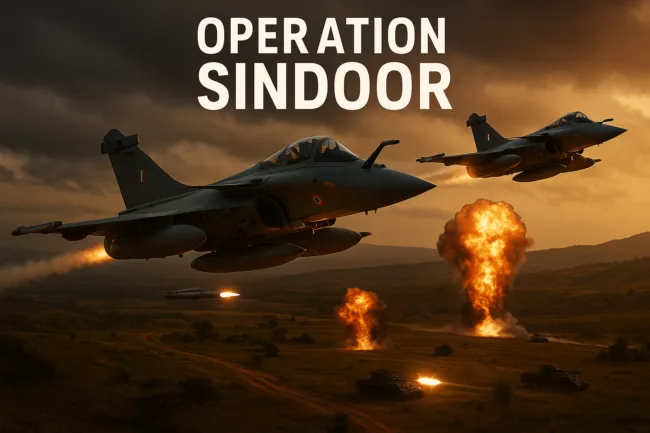
Each of these camps was reportedly destroyed by 1:11 AM using Rafale fighter jets equipped with French-origin SCALP cruise missiles and Hammer bombs.
What advanced weapons did India deploy during the strikes?
Operation Sindoor showcased India’s growing air combat capability. The Indian Air Force deployed Rafale fighter jets equipped with SCALP (Système de Croisière Autonome à Longue Portée) missiles, capable of hitting hardened targets with pinpoint accuracy. Alongside, Hammer (Highly Agile Modular Munition Extended Range) air-to-ground precision bombs were used for short-range strikes. The operation demonstrated the synergy of Indian air power with real-time intelligence and satellite surveillance.
How did Pakistan respond to Operation Sindoor?
Pakistan’s Prime Minister Shehbaz Sharif described the strikes as an “act of war” and vowed a “forceful” response. Cross-border shelling was reported from multiple sectors along the Line of Control and International Border shortly afterward. In one such incident, three Indian civilians were reported killed due to mortar fire in Bhimber Gali, Poonch.
Pakistan closed its airspace for 48 hours, resulting in major disruptions. Airlines including Emirates, Lufthansa, Swiss and British Airways rerouted flights to avoid Pakistani skies. Domestically, India shut down Srinagar Airport and cancelled or diverted over 200 flights, primarily in the northern and western regions.
How did India respond diplomatically?
India moved swiftly to inform key allies. National Security Advisor Ajit Doval briefed U.S. Secretary of State Marco Rubio about the “measured, non-escalatory” nature of the strikes. Foreign Secretary Vikram Misri emphasized India’s commitment to peace and proportionate action during briefings to the UN Security Council and diplomatic counterparts in Europe and Asia. The government stressed that no Pakistani civilian or military infrastructure was targeted, aligning the operation with international legal standards for counter-terrorism.
How did world leaders react to the strikes?
Reactions from global leaders were mixed. U.S. President Donald Trump called the strikes “a shame,” urging both nations to step back from the brink. United Nations Secretary-General António Guterres called for “maximum restraint” and warned that the international community could not afford a military confrontation between two nuclear-armed neighbours. The broader diplomatic response remained cautious, with international organisations monitoring the situation closely.
What was the domestic response in India?
Leaders across party lines supported the armed forces and backed Operation Sindoor. Defence Minister Rajnath Singh saluted the operation, stating, “Long live Mother India.” Home Minister Amit Shah described the strike as a “fitting response” to the Pahalgam atrocity. Opposition leaders including Mallikarjun Kharge, Rahul Gandhi, and Shashi Tharoor expressed solidarity, while J&K Chief Minister Omar Abdullah termed it a “necessary and targeted” strike.
A symbolic aspect of the operation’s name—“Sindoor,” a reference to the sacred red vermilion powder symbolizing marital status and dignity for Indian women—was acknowledged by victims’ families. Sangita Ganbote, whose husband was among those killed in the Pahalgam attack, noted that the naming served as a tribute to widows left behind by the tragedy.
Were there any casualties on the Pakistani side?
Although official confirmations are limited, reports suggested significant damage at targeted camps. A letter circulating in Pakistani media claimed that 14 members of Jaish-e-Mohammed chief Masood Azhar’s family were killed during the Bahawalpur strike. Azhar reportedly vowed retaliation. However, Indian authorities have not confirmed these specific claims.
What steps has the Indian government taken following the operation?
Prime Minister Narendra Modi has postponed his planned trips to Croatia, Norway, and the Netherlands to monitor the evolving situation. He held continuous communication with defence chiefs overnight. An emergency cabinet session was convened, followed by an all-party meeting scheduled for May 8. Home Minister Amit Shah also chaired a security review with chief ministers and top officials from all border states, stressing vigilance against misinformation and anti-national propaganda.
What is the outlook for regional stability?
While India has reiterated that Operation Sindoor was a non-escalatory response aimed solely at dismantling terror infrastructure, tensions remain high. Ceasefire violations have resumed, and both militaries are on high alert. The long-term stability of the region will likely depend on how diplomatically both sides navigate the aftermath. With India committed to a zero-tolerance policy towards terrorism and Pakistan indicating readiness to retaliate, the possibility of further conflict cannot be ruled out.
India’s calibrated use of force, advanced military capabilities, and strategic communications during and after Operation Sindoor may set a new precedent in the evolving doctrine of counter-terror strikes across hostile borders. However, the true measure of its success will be determined by both the disruption of terror networks and the avoidance of full-scale escalation.
Discover more from Business-News-Today.com
Subscribe to get the latest posts sent to your email.