


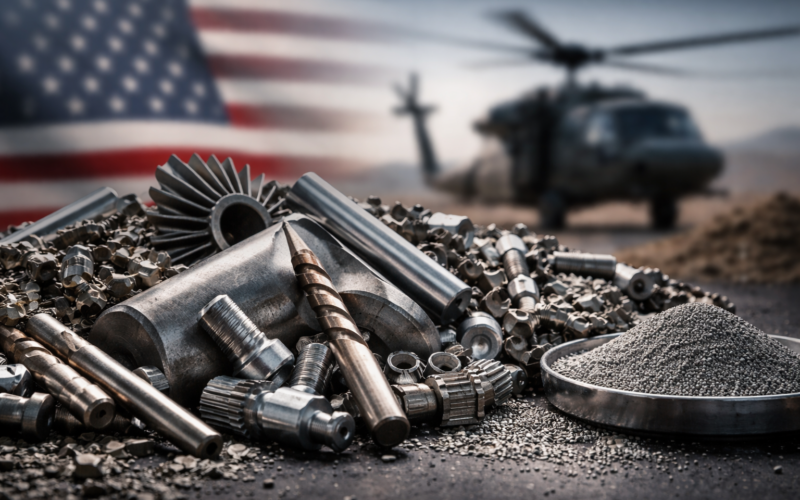
6K Additive, Inc. (ASX: 6KA) said on April 2 that it had secured a Phase II contract worth US$1.95 million over 18 months from the Defense Logistics Agency to help convert end-of-life military parts and scrap into high-value metal powders for additive manufacturing. The award is strategically significant because it pushes 6K Additive deeper into one of Washington’s most urgent industrial priorities: reducing US dependence on foreign sources of critical metals such as tungsten, niobium, and titanium. For a newly listed ASX materials stock still proving that its public-market story can match its technology narrative, the contract gives investors something more tangible than futuristic powder talk. It offers evidence that 6K Additive is moving into the category of defense-relevant supplier rather than merely interesting manufacturing platform.
Why does the 6K Additive Defense Logistics Agency award matter beyond the contract value alone?
On the surface, US$1.95 million is not a company-transforming sum. In small-cap defense and materials stories, though, the headline value is often the least interesting part. What matters more is what the contract is designed to prove. The award is aimed at establishing a domestic loop in which scrap from United States military depots can be identified, sorted, processed, and converted into reusable, high-specification powders for defense applications. That shifts the commercial proposition from selling metal powder into building a sovereign industrial capability around metal recovery, qualification, and reuse.
That distinction matters because governments do not just want raw material access anymore. They want trusted processing, resilient conversion capacity, and traceable domestic supply chains that can keep operating when geopolitics goes sideways. 6K Additive’s pitch fits that mood neatly. Instead of competing only on additive manufacturing quality, it is presenting itself as a circular-defense materials platform with national security relevance. In other words, it is not merely making powder. It is trying to become part refinery, part recycler, part industrial policy answer sheet.
The timing also works in the company’s favor. Washington has spent the past several years hardening its rhetoric around critical minerals, strategic materials, and supply chain vulnerabilities, especially where China’s dominance or geopolitical concentration creates leverage over Western defense production. Tungsten and niobium sit squarely in that conversation, and titanium remains strategically sensitive for aerospace and defense applications. 6K Additive’s contract lands right in the overlap between industrial policy, defense readiness, and advanced manufacturing.
How exposed is the United States defense supply chain to imported tungsten niobium and titanium?
The company’s own announcement points to the core vulnerability: China controls more than 80% of global tungsten production, while the United States relies entirely on imports for niobium, largely from Brazil and Canada, and titanium imports have also been flagged in national security discussions. Those are not niche concerns buried in some policy appendix. They go directly to the materials used in aerospace systems, defense platforms, high-temperature alloys, and mission-critical repair environments.
That is why the contract’s material mix is more revealing than the contract size. Nickel and titanium are already important in aerospace repair and defense manufacturing. Tungsten is tied to hardness, heat resistance, and strategic industrial applications. C103, a niobium alloy, points to high-performance defense and aerospace use cases where substitution is not always simple. If 6K Additive can demonstrate that recovered material can be transformed into powder with properties close enough to virgin standards for real applications, the commercial door swings much wider than this one award.
There is also an uncomfortable truth here for the broader market. The Western critical minerals conversation often focuses on mines, permitting, and upstream extraction. But real resilience is built in the middle of the chain: recovery, processing, refinement, qualification, and manufacturing integration. That is where many supply chains still wobble. 6K Additive is effectively betting that defense customers will pay for a domestic bridge between scrap and usable advanced feedstock.
Can 6K Additive turn military scrap recovery into a scalable defense manufacturing model?
The company says the program will include identifying and collecting scrap from Defense Logistics Agency depots, proving a robotic sorting system, converting nickel, titanium, tungsten, and C103 into high-value powder, and running cold spray trials for nickel and titanium powders as repair technology. That scope is important because it is broader than a simple recycling pilot. It touches sourcing, automation, materials conversion, and downstream application testing.
If it works, 6K Additive is not just selling powder batches. It is proving a workflow the Department of Defense could potentially replicate or expand across more depots, more alloys, and more maintenance programs. Aviation depots generating tens of thousands of pounds of mixed scrap weekly suggest there is enough feedstock to make the model industrially relevant, not just conceptually elegant.
The real attraction is circularity with strategic logic. Scrap is already domestic. The issue is whether it can be turned into something consistent, certifiable, and useful enough for high-performance applications. That is a much harder problem than it sounds. Mixed scrap is messy, defense qualification standards are unforgiving, and repeatability matters more than a flashy pilot batch. In advanced materials, one successful demo gets attention. Ten repeatable ones get contracts.
Cold spray testing is especially notable because it hints at a repair-and-maintenance angle, not only virgin-part production. If upcycled nickel and titanium powders can support military repair workflows, the value case strengthens. Repair technology can reduce downtime, extend asset life, and ease pressure on complex spare-part supply chains. That is a much easier sell in defense budgets than broad sustainability claims alone. Saving money and reducing dependence at the same time is the kind of bureaucratic poetry procurement teams actually fund.
What does this contract reveal about 6K Additive’s strategic position in the US defense industrial base?
The announcement notes that 6K Additive has received US$23.4 million under the Defense Production Act Title III, US$12.4 million in Defense Logistics Agency programs over recent years, and a US$27.4 million Export-Import Bank approved loan facility. Even allowing for the company’s natural incentive to present that support favorably, the pattern is clear: this is not a one-off government introduction. 6K Additive is being treated as an emerging node in a strategic industrial network.
That matters because government validation often functions as a proxy for commercial credibility in difficult manufacturing categories. Defense agencies do not eliminate execution risk, but they do impose technical filters that small-cap investors cannot easily assess on their own. A growing stack of government-backed programs suggests 6K Additive has cleared enough of those filters to stay in the room.
It also gives the company narrative coherence. Many small-cap industrial stocks suffer from what might politely be called strategic hobby-collecting: a little sustainability, a little advanced manufacturing, a little defense, a little policy alignment, and no clear center of gravity. 6K Additive’s center of gravity is becoming clearer. Its UniMelt platform, scrap-to-powder capability, and domestic-sourcing message all now point toward one theme: strategic materials independence for high-value industrial and defense end markets.
How is ASX: 6KA stock trading as investors weigh defense exposure and execution risk?
Market data suggests investors are still treating 6K Additive like an emerging story rather than a fully trusted execution vehicle. Yahoo Finance showed ASX:6KA at about A$0.80 on April 2, with a 52-week range of A$0.655 to A$1.09 and a market capitalization around A$213.8 million. ASX company data also showed a market cap around A$208.5 million and the same 52-week range, while TradingView indicated the stock was down about 10.6% year to date and about 9.1% over one month.
That pricing backdrop creates an interesting tension. On one hand, the company has assembled a credible defense-linked and industrial-policy-aligned growth narrative. On the other, the market has not rewarded it like a breakout strategic materials winner yet. That can be read two ways. Bulls will say the market is underappreciating the stickiness and optionality of government-backed materials programs. Skeptics will say investors are waiting for evidence that technical promise can turn into recurring, scalable, and margin-supportive revenue.
Both readings are fair. The stock’s current position below its 52-week high suggests enthusiasm exists, but conviction remains conditional. Investors appear willing to give 6K Additive credit for relevance, not yet for inevitability. Frankly, that is a sensible place for the market to be. Defense-adjacent materials stories can rerate sharply, but they also have a habit of turning “strategic” into “someday” if qualification, throughput, or commercialization slips.
What execution risks could still derail 6K Additive’s defense metals thesis from here?
The biggest risk is technical repeatability. Converting heterogeneous scrap into premium spherical powders at consistent quality is not trivial, and defense applications are not forgiving. The company must prove not only that it can produce acceptable material, but that it can do so reliably enough for qualification, procurement, and field-use confidence.
The second risk is scale economics. A pilot or Phase II contract can demonstrate capability, but scaling from program success to durable commercial economics is another challenge altogether. Investors will eventually want to know whether these contracts generate attractive margins, whether government-funded work leads to broader offtake, and whether the company can expand throughput without eroding the value proposition.
A third risk is customer concentration through policy dependence. Government support is useful, but overreliance on grant and program activity can become a crutch if it does not translate into repeat procurement demand or adjacent commercial adoption. The ideal outcome for 6K Additive is to use defense validation as a door-opener into aerospace, industrial repair, and premium materials applications where certification and pricing are more durable.
Then there is plain old small-cap risk, which never takes a holiday. Newly listed companies with complex technologies are often judged quarter by quarter, and the market’s patience can be shorter than the engineering timeline. This is why each contract matters less as isolated revenue and more as proof that the company is building a repeatable, defensible role in a strategic value chain.
What happens next if 6K Additive proves its scrap-to-powder model for the Pentagon?
If the program hits its milestones, 6K Additive could move from being a niche advanced materials name to a more serious defense-industrial enabler. The company’s announcement already frames a possible Phase III focus aligned with Defense Logistics Agency Disposition Services, the Navy, and the Air Force Life Cycle Management Center. That suggests management sees a pathway from pilot validation toward broader institutional embedding.
The upside case is not just more contracts. It is deeper integration into a US policy push to localise supply chains for hard-to-source strategic inputs. If 6K Additive can prove that recovered domestic scrap can be converted into certifiable powder for additive manufacturing and repair applications, the company may end up selling something more valuable than powder itself: resilience. That is a product category governments are increasingly happy to buy.
And that is really the heart of the story. Plenty of companies talk about circular economy benefits, advanced manufacturing, and critical minerals all in the same breath. 6K Additive is unusual because the Pentagon appears willing to fund the sentence, not just applaud it.
What are the key takeaways on what 6K Additive’s Pentagon award means for investors and the wider industry?
- 6K Additive’s US$1.95 million award matters more as a capability validation than as near-term revenue.
- The contract strengthens 6K Additive’s positioning inside the United States defense-industrial resilience narrative.
- Tungsten, niobium, titanium, and nickel are strategically relevant metals, making the award materially aligned with national security priorities.
- The company is attempting to solve a mid-chain bottleneck in critical minerals, not just a raw-material sourcing problem.
- Robotic sorting, scrap qualification, and cold spray testing suggest the program is aimed at workflow creation, not one-off recycling optics.
- Government backing across multiple programs indicates growing institutional trust, though not yet guaranteed commercial scale.
- ASX:6KA still trades like an emerging execution story, with investors appearing interested but not fully convinced.
- The biggest upside lies in turning defense validation into repeat procurement and broader industrial adoption.
- The biggest risk is whether technical success can be translated into consistent economics and certification-grade repeatability.
- If 6K Additive succeeds, it could become a meaningful example of how strategic metals policy shifts from mining rhetoric to manufacturing reality.
Discover more from Business-News-Today.com
Subscribe to get the latest posts sent to your email.