


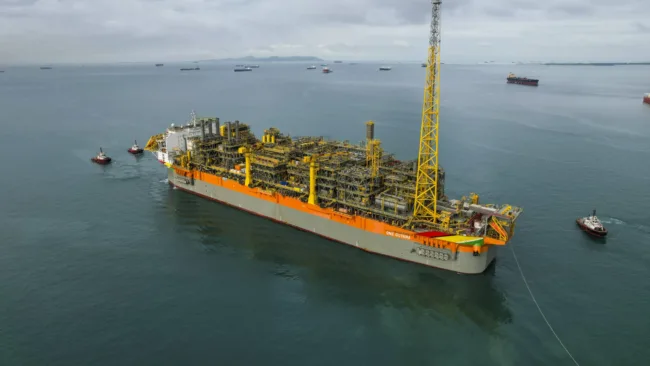
ExxonMobil Guyana Limited has started oil production at Yellowtail, the fourth deepwater development in the Stabroek Block, marking the largest single offshore project in Guyana’s history. The milestone, achieved four months ahead of schedule, lifts the country’s installed production capacity above 900,000 barrels of oil per day (bopd) and reinforces its position as one of the fastest-growing offshore producers globally.
The ONE GUYANA floating production storage and offloading (FPSO) vessel now joins the Destiny, Unity, and Prosperity FPSOs in operation. For ExxonMobil and its co-venturers Chevron and CNOOC Petroleum Guyana Limited, the early start underscores repeatable execution in one of the world’s most competitive deepwater basins.
How does Yellowtail’s ahead-of-schedule launch reshape Guyana’s production capacity and export outlook?
Yellowtail is designed for an initial annual average of 250,000 bopd, with oil marketed as Golden Arrowhead crude. The FPSO has a storage capacity of two million barrels and is the largest vessel deployed in the block to date. By integrating Yellowtail’s output with the three earlier FPSOs, Guyana’s total installed capacity has risen sharply, supporting a medium-term pathway toward ExxonMobil’s goal of 1.7 million oil-equivalent barrels per day by the end of the decade.
The project’s early start provides flexibility in export scheduling and strengthens Guyana’s capacity to capture favorable pricing windows in global crude markets. Analysts note that commissioning four large FPSOs in just five years — all ahead of schedule and under budget — is an uncommon feat in deepwater oil, positioning Guyana as a reliable growth source for Atlantic Basin refiners.
When was final investment decision taken and what are Yellowtail’s technical parameters?
ExxonMobil made its final investment decision (FID) for Yellowtail on April 4, 2022, after securing government and regulatory approvals. At sanction, the US$10 billion scope included six drill centres with up to 26 production wells and 25 injection wells, tied back to the ONE GUYANA FPSO. The development targets the Yellowtail and Redtail fields, estimated to hold more than 900 million barrels of recoverable oil.
The FPSO’s design incorporates gas treatment, water injection, and offloading systems optimised for sustained plateau production. Its two-million-barrel storage capacity allows operational flexibility during offloading, a key factor in managing logistics across multiple producing vessels in the block. Engineering standardisation from earlier projects has been leveraged to reduce costs and compress timelines.
Why is Yellowtail seen as proof of execution quality rather than a short-term share price catalyst for ExxonMobil?
Exxon Mobil Corporation (NYSE: XOM) was last trading at about US$106.13, up marginally on the day, with an intraday range of US$105.83 to US$107.27. The contained price move signals that markets had already factored in on-time first oil from Yellowtail. Investor reaction has been neutral-to-positive, with emphasis on execution consistency rather than a single-event re-rating.
For long-term shareholders, the startup strengthens cash flow visibility and supports ExxonMobil’s dividend and buyback programme. Growth-oriented investors, however, may look to macro drivers such as Brent crude trends, refining margins, and the timing of subsequent FPSO startups for upside triggers.
Institutional flows continue to favour operators with advantaged barrels, low break-even costs, and predictable ramp-ups. ExxonMobil’s ability to bring on four major projects in five years under budget fits that thesis, which in turn supports long-only fund allocations and moderates event-driven volatility.
How does Chevron’s acquisition of Hess reshape the Stabroek Block partnership and investor exposure?
The Stabroek Block is operated by ExxonMobil Guyana Limited with a 45 percent stake, alongside Hess Guyana Exploration Ltd. at 30 percent and CNOOC Petroleum Guyana Limited at 25 percent. In mid-2025, Chevron Corporation (NYSE: CVX) completed its acquisition of Hess Corporation after an arbitration ruling affirmed its rights to Hess’s 30 percent stake. This resolution removed a significant legal overhang and locked in Chevron’s access to one of the most attractive growth portfolios in the industry.
Chevron’s shares have been relatively steady, reflecting the long-term nature of the Guyana production ramp. The integration of Hess’s stake adds a high-margin growth driver to Chevron’s upstream portfolio, though near-term valuation momentum will remain linked to broader market conditions and synergy execution.
Hess shares, prior to delisting, had gained about 13 percent over six months on the strength of Guyana’s production growth profile, outperforming sector peers and the S&P 500. Analysts had maintained overweight or buy ratings, with 12-month price targets clustered between US$153 and US$184.
How is ExxonMobil embedding local content and supplier development into Yellowtail’s execution?
Guyanese nationals now make up more than 67 percent of the oil-and-gas workforce in the country, with over 3,500 citizens directly engaged in offshore activities — up more than 50 percent since 2019. More than 2,000 local businesses are involved in ExxonMobil’s Guyana supply chain.
Since 2015, ExxonMobil and its contractors have spent over US$600 million with more than 880 local suppliers. Additionally, over 3,000 Guyanese companies are registered with the Centre for Local Business Development, founded by ExxonMobil and its partners in 2017 to build capacity, enhance competitiveness, and expand local participation in global supply chains.
This focus on local content not only amplifies the economic multiplier from oil revenues but also develops technical skills and industrial capabilities that can serve the broader economy beyond the lifespan of current projects.
What does the long-term development pipeline for the Stabroek Block look like after Yellowtail?
The Stabroek Block holds more than 10 billion oil-equivalent barrels of recoverable resources, giving ExxonMobil and its partners a long runway for successive developments. Four additional projects are in planning or early execution stages, with potential for up to 10 FPSOs by the early 2030s.
If the current pace of execution continues, total installed capacity could reach 1.7 million oil-equivalent barrels per day by the end of the decade. Sustaining this trajectory will require careful management of operational reliability, infrastructure build-out, and regulatory compliance, alongside maintaining environmental standards and transparent fiscal governance.
How are investors positioning around ExxonMobil and Chevron after Yellowtail’s startup?
For ExxonMobil holders, Yellowtail is viewed as a “hold-and-compound” catalyst — reinforcing the reliability of future volumes without prompting aggressive buying at current valuations. Opportunistic entries are more likely to be driven by sector-wide pullbacks than individual project milestones.
For Chevron shareholders, the secured stake in Stabroek is a strategic win, but the timeline for material cash flow contributions spans multiple years. Analysts suggest the company’s 4.4 percent dividend yield and free cash flow profile remain its primary draw for income-focused investors.
Both ExxonMobil and Chevron benefit from substantial passive ownership through energy benchmarks, which can stabilise capital flows and dampen volatility around operational updates.
Discover more from Business-News-Today.com
Subscribe to get the latest posts sent to your email.