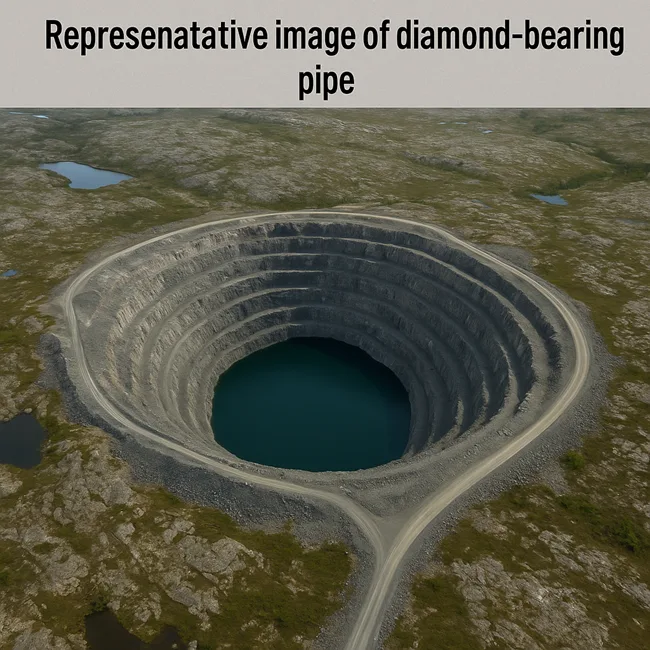
Arctic Blue Diamonds Ltd., a private Canadian diamond development company, has acquired an 89.7 percent controlling interest in the WO Diamond Project, which hosts the DO27 kimberlite—one of the largest and highest-grade undeveloped diamond-bearing pipes in Canada. The Yellowknife-based miner announced on July 9, 2025, that it had acquired a 72.1 percent stake from Peregrine Diamonds Ltd., a subsidiary of De Beers Canada Inc., and a further 17.6 percent from Archon Minerals Ltd.
This strategic acquisition positions Arctic Blue Diamonds Ltd. as the operator of the WO Joint Venture and grants it exclusive diamond marketing rights for any future production from the site. The WO Project covers 5,815 hectares across eight mining leases in Canada’s Northwest Territories, located approximately 23 kilometers from the Diavik Diamond Mine and 53 kilometers from the Ekati Diamond Mine—two of the country’s most productive diamond operations now entering late-stage mine life.
Arctic Blue Diamonds Ltd. is part of the Arctic Blue Group, which includes Arctic Blue LLC, an online retailer of Canadian fluorescent diamonds through its platform ArcticBlue.com. With this acquisition, the vertically integrated diamond group has signaled its intent to become a next-generation mining and retail force in Canada’s diamond sector.
What are the size, grade, and valuation assumptions underpinning the DO27 kimberlite resource?
The DO27 kimberlite has a surface area of approximately 9 hectares and lies beneath a shallow lake one kilometer in size with an average depth of 4 meters. For context, most kimberlites at the Diavik and Ekati diamond mines are under 3 hectares in size, highlighting the exceptional scale of DO27.
Drilling conducted prior to the acquisition included 114 core holes totaling 24,185 meters and 46 large-diameter reverse circulation holes totaling 8,840 meters. The deposit has been delineated to a depth of approximately 350 meters and remains open at greater depths. Based on data collected through August 7, 2008, the DO27 kimberlite contains an indicated mineral resource of 19.5 million tonnes grading 0.94 carats per tonne, for a total of 18.2 million carats.
This estimate, prepared by Qualified Persons Dr. Ted Eggleston and Ken Brisebois, was based on conservative economic assumptions: a diamond price of US$72 per carat, full metallurgical recovery, mining costs of US$2.05 per tonne (increasing by US$0.02 per 10 meters of depth), and operating costs of US$19.96 per tonne including ore transport and processing at an offsite facility. Importantly, the bottom cut-off was set at 1 millimeter, a common threshold for commercial diamond recovery.
Beneath the currently defined resource, Arctic Blue Diamonds Ltd. has identified an additional exploration target of 6.5 to 8.5 million tonnes of kimberlite, with an estimated grade ranging from 0.8 to 1.0 carats per tonne. While conceptual in nature, this target adds further upside potential, pending future infill drilling.
Institutional investors familiar with the resource have noted that independent valuations by WWW International Diamond Consultants in 2006 and 2007 placed the rough diamond value at US$72 per carat. A 2014 market analysis, using industry price indices, revised the estimated rough diamond price range to between US$90 and US$100 per carat—suggesting stronger economics if those values hold today.
How does the unique softness of the DO27 ore support cost-efficient and sustainable mining options?
One of the most compelling aspects of the DO27 kimberlite is its extremely soft and friable ore composition. Testing conducted by AMEC Americas Ltd. found that up to 90 percent of the ore in the top 60-meter zone consists of fines below 1 millimeter. This unique characteristic enables an Ore Concentrate Option, in which simple on-site washing removes most non-diamond-bearing fines and retains the coarse +1mm fraction, which can then be transported to an offsite diamond recovery facility.
This concentrated approach significantly reduces the volume of ore requiring long-distance hauling and full-scale processing—lowering both cost and environmental footprint. Arctic Blue Diamonds Ltd. has emphasized that this concentrate strategy could extend the useful life of nearby facilities, such as those at Diavik and Ekati, or justify construction of a new purpose-built plant in Yellowknife.
More importantly, the soft ore opens the door to one of the industry’s most disruptive technologies: Underwater Remote Mining (URM). URM technology is considered ideal for soft, low-density kimberlite pipes situated under shallow water, such as DO27. The approach uses remotely operated “crawler” systems equipped with drum cutters to excavate ore underwater and pump it to the surface using a vertical pipeline system.
Developed by Royal IHC’s mining division in the Netherlands, URM crawlers are capable of operating at depths of up to 400 meters. Their continuous mining method avoids the need for blasting, reducing surface disruption and minimizing environmental impact. Since 2018, Dominion Diamond Mines has collaborated with IHC to develop and trial URM systems at the Ekati mine, providing a model for potential deployment at DO27.
From an institutional sentiment perspective, sustainability-focused investors view URM technology as a catalyst for reducing diamond mining’s ecological footprint. While capital-intensive, the method offers lower lifetime costs and a cleaner permitting profile—advantages that could support Arctic Blue Diamonds Ltd.’s financing efforts in the future.
What is the current operational status of the WO Project and what steps will determine its development timeline?
Despite the acquisition, the WO Diamond Project remains on care and maintenance. Arctic Blue Diamonds Ltd. has announced that a new round of environmental, geological, and engineering studies will commence to evaluate the feasibility of developing DO27 using a URM-based model. These studies will assess lakebed sediment behavior, pipeline routing, dewatering strategies, and concentrate handling logistics—each a prerequisite for regulatory and investor approvals.
The electric utility developer will also need to consider infrastructure upgrades, particularly the seasonal road access, and whether to establish an all-season route to optimize ore transport or support workforce logistics. As the asset is located just 23 kilometers from Diavik, proximity to existing grid infrastructure and workforce camps could lower development costs, though detailed site assessments are pending.
Institutional observers anticipate that Arctic Blue Diamonds Ltd. will initially pursue strategic partnerships or offtake agreements with either regional miners or processing facility operators to manage capital expenditures and lower upfront investment risk. Given the size of the resource and the strength of historic valuations, analysts believe the asset could attract interest from global investors seeking exposure to a high-grade, long-life diamond project with strong ESG credentials.
What long-term strategic value could Arctic Blue unlock by vertically integrating diamond mining and online retail?
Arctic Blue Diamonds Ltd. is in a rare position among diamond developers: it already controls a retail distribution channel through Arctic Blue LLC, which sells certified Canadian fluorescent diamonds online. By pairing this channel with a secure, high-grade resource base and full marketing rights under the WO Joint Venture, the company could vertically integrate its supply chain from mine to market.
Analysts suggest that if successful, this model could insulate Arctic Blue Diamonds Ltd. from traditional supply chain volatility and allow for branding differentiation—particularly if it emphasizes ethical sourcing, carbon-neutral operations, and transparency across the value chain. This could be especially compelling for Gen Z and millennial consumers, who increasingly prioritize provenance and environmental stewardship in luxury purchases.
Looking forward, market participants expect Arctic Blue Diamonds Ltd. to focus on converting the DO27 conceptual target into an expanded measured resource. Success on this front, combined with progress on URM feasibility and concentrate logistics, could position the project as Canada’s next major diamond development initiative. If Arctic Blue chooses to pursue a public listing or raise institutional capital, the clarity of these development milestones will likely determine investor enthusiasm and valuation.
Discover more from Business-News-Today.com
Subscribe to get the latest posts sent to your email.