




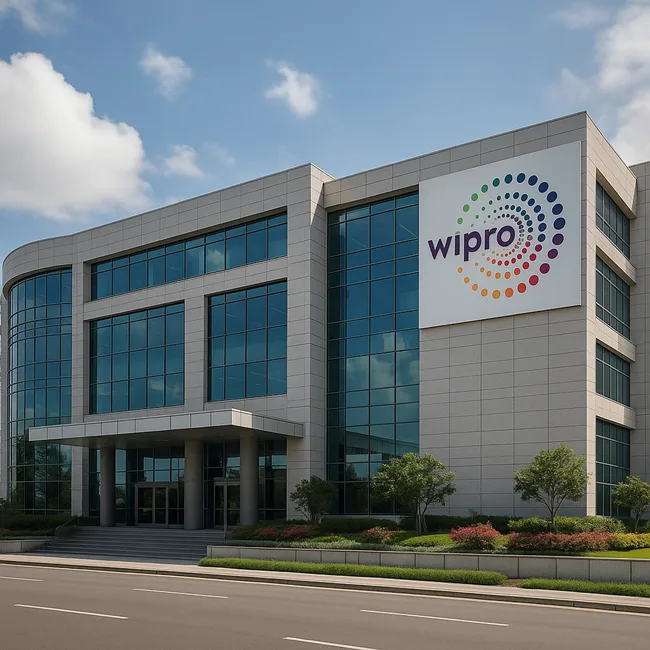
Wipro Limited (NSE: WIPRO, BSE: 507685, NYSE: WIT) closed at ₹253.70 on October 16, 2025, marking a gain of 1.39% or ₹3.49 from the previous close. The stock reacted positively to the company’s Q2 FY26 financial results, which showcased solid margin discipline and robust large deal wins despite tepid revenue guidance for the next quarter.
The trading session saw the stock open at ₹250.40, dip to a low of ₹248.80, and reach an intraday high of ₹254.07, before closing at ₹253.81. The volume-weighted average price (VWAP) was ₹252.33, suggesting healthy participation on both institutional and retail desks following the earnings announcement.
What key financials did Wipro report for Q2 FY26 and how do they compare year over year?
For the quarter ended September 30, 2025, Wipro Limited posted gross revenue of ₹227.0 billion ($2.56 billion), up 2.5% quarter-over-quarter and 1.8% year-over-year. Net income for the quarter stood at ₹32.5 billion ($365.6 million), marking a 1.2% YoY growth despite a sequential dip of 2.5%. The earnings per share rose to ₹3.10 from ₹3.07 in the year-ago period.
Operating cash flow came in at ₹33.9 billion ($381.5 million), amounting to 103.8% of net income. Free cash flow stood at ₹31.2 billion, which is 95.5% of net income, reinforcing the company’s strong liquidity and cash conversion profile.
IT services revenue came in at $2.604 billion, a sequential growth of 0.7%, but a year-over-year decline of 2.1% in reported terms and 2.6% in constant currency terms. The IT services operating margin for Q2 FY26 was 16.7% but adjusted upward to 17.2% after excluding a one-time customer bankruptcy provision of ₹1,165 million.
What does Wipro’s Q3 FY26 revenue guidance signal to investors and analysts?
Wipro has guided for Q3 FY26 revenue in the range of $2.591 billion to $2.644 billion, translating to sequential growth of -0.5% to +1.5% in constant currency terms. This outlook excludes any revenue contribution from the recently announced acquisition of Harman Digital Transformation Solutions. While the guidance implies a narrow range and limited near-term growth, the mid-point suggests a potential bottoming out of the revenue contraction trend.
Institutional sentiment appears cautiously optimistic, as analysts focus more on margin resilience and robust deal wins rather than near-term topline softness. However, the guidance underlines that demand recovery across key geographies remains uneven.
What insights are analysts drawing from Wipro’s deal wins and segment performance?
Wipro’s large deal bookings reached $2.9 billion, representing a 90.5% year-over-year surge, while total bookings for the quarter came in at $4.7 billion, up 30.9% YoY but down 6.1% sequentially. These figures reflect strong traction in renewals and multi-year transformation engagements across healthcare, financial services, and telecom sectors.
Among the key deal wins were an AI-led transformation with a UK-based financial group, a healthcare platform modernization deal in the U.S., and a digital overhaul for a merged rural banking entity in India. These engagements signal Wipro’s growing influence in AI-first, cloud-native transformations and enterprise modernization initiatives.
Regionally, Europe and APMEA returned to growth with sequential gains of 2.7% and 3.3% respectively, while Americas 2 declined by 2.0%. Sector-wise, Banking, Financial Services and Insurance (BFSI) remained the largest contributor at 34.3% of revenues, followed by consumer (18.2%), energy and resources (17.4%), technology and communications (15.6%), and healthcare (14.5%).
How are Wipro’s improving margins, stable cash conversion, and falling attrition shaping institutional confidence in FY26?
Wipro maintained steady margins despite a revenue base that remains pressured. The adjusted operating margin of 17.2% reflects strong cost control and operational efficiency. CFO Aparna Iyer noted that three of the four strategic market units (SMUs) showed sequential growth and reiterated the company’s intent to maintain margins within a narrow, sustainable range.
Voluntary attrition declined to 14.9% on a trailing 12-month basis, continuing a positive trend in talent retention. Utilization excluding trainees rose to 86.4%, up from 85.0% in the previous quarter, reinforcing execution discipline.
These operational metrics suggest that Wipro is managing its internal levers well, even as external demand cycles remain uncertain. Investors may read this as a sign that the company is laying the groundwork for a more meaningful growth rebound in the second half of FY26.
How are institutional investors reacting to Wipro’s strategic direction and outlook?
While the stock has been underperforming peers in terms of revenue acceleration, Wipro’s margin stability and large-deal conversion offer a narrative of resilience. The $2.9 billion in large deals for Q2 alone exceeds the value secured in some full-year periods in the past, raising investor confidence in future conversion to revenue.
Wipro CEO Srini Pallia emphasized an AI-first strategy through the launch of Wipro Intelligence™, aiming to help clients transition confidently into the next wave of digital transformation. This narrative, if executed well, could shift investor focus away from short-term topline volatility toward strategic positioning.
Institutional investors are likely to keep a close watch on the pace of deal ramp-ups, AI-led productivity gains, and cross-sectoral growth as indicators of whether Wipro can return to consistent mid-single-digit growth.
Can Wipro’s margin discipline and deal wins drive a turnaround in FY26?
Wipro Limited’s Q2 FY26 performance underscores a company in the thick of strategic recalibration—one that is actively balancing operational efficiency with a forward-facing transformation agenda. With gross margins holding steady despite lingering demand softness and large-deal TCV crossing the $2.9 billion mark, Wipro is showcasing its ability to execute in a structurally challenged global IT services environment.
The 1.4% post-earnings stock gain, while modest, is reflective of investor appreciation for disciplined cost management, strong cash generation, and the early signals of a shift toward higher-value, AI-led digital transformation engagements. Unlike in past quarters where execution was hampered by weak client spending and portfolio churn, the September 2025 quarter demonstrated meaningful traction in strategic verticals such as banking, healthcare, and telecommunications—driven by GenAI, cloud-native migration, and modular platform deals.
Yet, the company’s guidance for Q3 FY26 remains cautious, with projected revenue growth in the narrow band of -0.5% to +1.5% in constant currency. This conservative outlook is likely to temper near-term optimism and reinforce a ‘wait-and-watch’ sentiment among institutional investors and FIIs. However, with over $9.5 billion in total bookings for the first half of the fiscal year and a robust margin buffer at 17.2% (adjusted), Wipro may be better positioned than it appears to weather the ongoing macroeconomic uncertainty.
To convert its current pipeline into sustainable topline growth, Wipro will need to accelerate deal ramp-ups, deepen account mining across strategic clients, and ensure its AI-first platforms—like Wipro Intelligence—move beyond conceptual narratives into high-revenue implementations. Investors will also be closely watching execution timelines and client retention metrics in the U.S. and Europe, where digital transformation budgets have been more selective.
The second half of FY26 presents an opportunity—but not a guarantee—for Wipro to reclaim its growth credentials. If it succeeds in turning backlog into billings while maintaining or expanding margin performance, the stock may attract renewed institutional accumulation. Until then, the message from the market is clear: stability is good, but sustained growth is better.
What are the top 5 things investors should take away from Wipro’s Q2 FY26 earnings report?
Wipro’s Q2 FY26 performance, though mixed in terms of revenue growth, presents several notable trends that investors and market watchers should track closely. Here are the five key takeaways:
Large deal momentum accelerates: Wipro booked $2.9 billion in large deals during the quarter, a 90.5% year-over-year surge, contributing to $4.7 billion in total bookings—an encouraging sign of enterprise trust in Wipro’s transformation capabilities.
Margins hold steady despite pressures: Adjusted operating margin expanded 40 basis points YoY to 17.2%, showcasing strong internal cost control and a focus on high-value engagements, even amid a one-time client bankruptcy provision.
Revenue growth remains muted: IT services revenue grew just 0.3% sequentially in constant currency and declined 2.6% YoY, signaling that execution challenges and macro headwinds continue to weigh on top-line expansion.
Q3 guidance disappoints bulls: The company forecasted Q3 FY26 revenue growth of -0.5% to +1.5% in CC terms—below aggressive investor expectations and suggesting a gradual recovery path through H2.
AI-first strategy gains traction: Wipro’s push into modular AI frameworks and agentic automation, particularly through initiatives like Wipro Intelligence, is beginning to show up in key strategic wins—though full monetization is still in early stages.
Discover more from Business-News-Today.com
Subscribe to get the latest posts sent to your email.

