

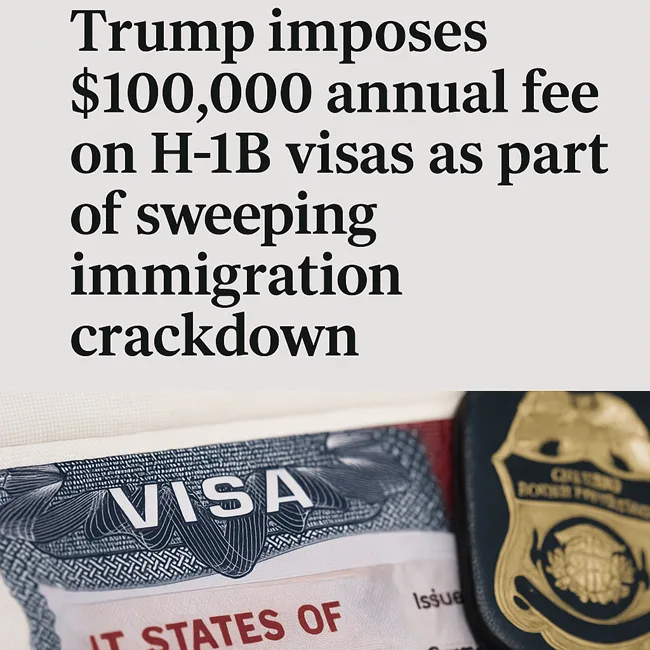
US President Donald Trump has formally unveiled one of the most consequential immigration measures of his second term: a new $100,000 annual fee per worker on all H-1B visa applications and renewals. The proclamation, signed in September 2025, is being described as a decisive move to curb what the administration views as decades of misuse of the program designed for highly skilled workers. With immediate enforcement, the decision is expected to significantly reshape U.S. corporate hiring practices, the flow of Indian and global STEM talent, and the competitiveness of the American economy in sectors ranging from technology to healthcare.
The policy marks the most aggressive change to the H-1B program in recent memory. It extends the Trump administration’s longstanding pledge to “hire American” into the very mechanics of the visa system, transforming what was once a relatively affordable pathway into a premium option available only to companies able and willing to absorb the six-figure price tag.
How will the $100,000 H-1B visa fee work and what are the rules for employers
Under the new proclamation, employers sponsoring foreign workers through the H-1B visa route must pay a fee of $100,000 per employee each year, in addition to existing application and legal costs. This fee also applies to renewals, meaning a company employing an H-1B worker over several years will face cumulative charges running into hundreds of thousands of dollars.
The Trump administration has argued that such a fee will serve as a filtering mechanism, ensuring only workers with specialized skills essential to the U.S. economy are brought in. Employers will have to demonstrate that paying the fee makes business sense, which implicitly raises the threshold for foreign hires. While exact rules around exemptions remain unclear, legal experts say universities, research institutions, and non-profits may face fewer obligations, though even they could be affected if implementing agencies adopt a broad interpretation.
Why does the Trump administration believe a high fee for H-1B visas is justified
The administration has consistently presented the policy as a protective measure for American workers. Officials maintain that many companies have historically used the H-1B system as a way to secure lower-cost labor rather than filling genuine skill gaps. By adding a $100,000 barrier, the government claims it is forcing firms to prioritize U.S. talent first, while still allowing the most critical foreign specialists to enter.
In addition to this workforce rationale, the fee is also politically symbolic. It reinforces Trump’s campaign narrative of standing up to corporate practices that undercut domestic workers. The White House insists the new rule will deter large outsourcing firms from filing thousands of applications annually and will restore the H-1B program to its original intent of supporting innovation rather than commoditized labor.
Which sectors and companies are most likely to be affected by the new H-1B visa fee
Technology companies, consulting firms, financial services institutions, and healthcare providers are expected to feel the sharpest impact. Large outsourcing companies that rely on bringing in thousands of Indian engineers through the H-1B route will face immediate and unsustainable costs, potentially forcing them to cut back sharply on U.S. hiring or shift operations offshore.
For smaller firms and startups that use H-1B visas sparingly but depend on specialized skills unavailable locally, the fee could prove devastating. Many simply lack the resources to allocate $100,000 per employee per year and may be compelled to abandon international recruitment altogether.
The implications are particularly stark for Indian professionals, who account for the majority of H-1B visa holders. With most employers expected to reduce filings, the pipeline for Indian engineers, doctors, and researchers will tighten dramatically, reducing opportunities for migration and advancement in the U.S. labor market.
What legal, political, and economic challenges could derail the H-1B visa fee
Immigration attorneys have raised fundamental questions about whether the executive branch has the legal authority to impose such a sweeping fee without congressional approval. Visa fees are typically set by Congress, and litigation is expected to emerge quickly. Courts may be asked to decide whether the president has exceeded his constitutional authority.
Politically, the fee is dividing stakeholders. Business associations, especially in Silicon Valley and Wall Street, have criticized the move as economically self-defeating. Advocacy groups warn it will harm America’s reputation as a global talent hub and could weaken its leadership in fields like artificial intelligence, biotechnology, and advanced engineering.
Economically, there is concern that the measure could accelerate offshoring. If U.S. companies cannot bring foreign workers in, they may move more jobs abroad. Rather than protecting American workers, critics argue, the policy may export opportunities to India, Eastern Europe, and Latin America.
How could the new H-1B visa rules impact global competitiveness and innovation in the U.S.
The long-term consequences for innovation are a major source of debate. Supporters of the fee believe U.S. companies will finally be compelled to invest in domestic training and workforce development, narrowing dependency on foreign workers. Skeptics counter that such training pipelines take years to establish and cannot easily replace the global talent pool currently available through H-1B visas.
If the fee discourages highly skilled workers from choosing the U.S., other destinations such as Canada, the United Kingdom, and Australia may benefit. These countries have already positioned themselves as friendlier alternatives with immigration frameworks designed to attract top STEM talent. Losing ground in this competition could set back U.S. ambitions in critical sectors at a time when artificial intelligence, semiconductor design, and biotech innovation are driving global economic advantage.
How are Indian applicants and outsourcing firms expected to react to the new H-1B visa fee
For Indian workers, who dominate H-1B issuance, the cost barrier represents a seismic shift. Many employers may choose to reserve sponsorship only for the most senior or strategically critical roles, drastically shrinking the number of junior and mid-level opportunities that have historically served as stepping stones for global careers.
Indian IT services giants that have traditionally sent thousands of employees annually to the U.S. could be forced to restructure their models. Instead of relying on on-site staff, they may expand remote delivery from India or increase hiring in third-country locations. For individual applicants, competition for the remaining H-1B slots is likely to intensify, creating higher thresholds for academic achievement, experience, and specialized expertise.
How has the stock market and investor sentiment reacted to the announcement
The announcement has already created ripples in financial markets. Shares of companies with significant dependence on H-1B employees, such as outsourcing firms and technology services providers, saw immediate downward pressure as investors factored in higher operating costs and the likelihood of reduced margins.
By contrast, some domestic staffing and recruitment companies recorded modest gains, reflecting speculation that they could benefit from increased demand for U.S. workers. Institutional sentiment remains cautious, with analysts noting that the uncertainty surrounding potential legal challenges makes it difficult to predict how durable the policy will be.
What is the implementation timeline and what comes next for the H-1B visa program
The proclamation was signed in mid-September 2025, with provisions taking effect immediately or within weeks. However, the Department of Homeland Security and U.S. Citizenship and Immigration Services still need to publish implementing guidance that clarifies whether renewals, cap-exempt entities, and dependents are fully covered under the rule.
Legal challenges are widely expected, and the courts may issue injunctions that temporarily suspend the policy. Until such clarity emerges, companies face significant uncertainty in workforce planning, particularly for fiscal year 2026 H-1B petitions.
What do expert opinions reveal about whether the $100,000 H-1B visa fee can achieve its intended goals or backfire on U.S. competitiveness
From an expert perspective, the $100,000 fee is both bold and risky. It may succeed in reducing perceived abuses of the H-1B system, but its breadth ensures that many legitimate, high-skilled professionals will also be caught in the net. Without parallel investment in U.S. education and training infrastructure, the policy risks creating skill shortages that undermine American competitiveness rather than strengthen it.
For now, companies and workers alike are bracing for a new reality where the H-1B visa, once seen as the gold standard of global mobility, becomes an elite and expensive pathway accessible only to a narrow group of candidates and their sponsors.
Discover more from Business-News-Today.com
Subscribe to get the latest posts sent to your email.