




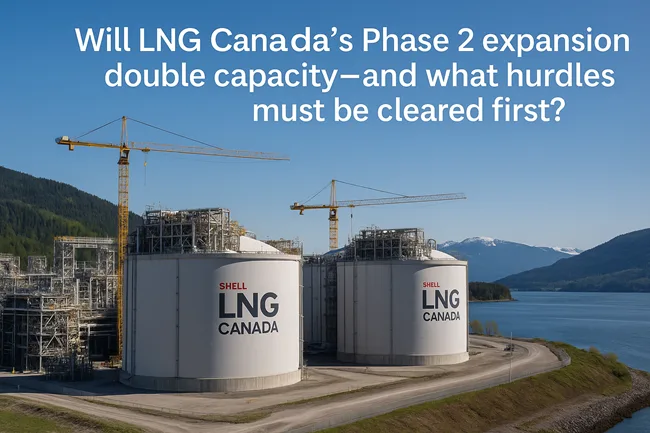
Shell plc and its joint venture partners are weighing the viability of a second-phase expansion at the LNG Canada terminal in Kitimat, British Columbia, which could double total export capacity from 14 million tonnes per annum (mtpa) to 28 mtpa. The final investment decision (FID) is not expected before 2026, but market watchers are already treating it as one of the most consequential LNG decisions of the decade.
With Train 1 of Phase 1 producing its first liquefied natural gas in June 2025 and the inaugural cargo departing on June 30, the facility has entered commercial operations. However, the ramp-up has been cautious, with Train 1 operating below nameplate capacity due to a mechanical fault reported during commissioning. Despite this, institutional investors remain optimistic that LNG Canada’s underlying economics, powered by AECO-indexed gas and proximity to Asian markets, could justify expansion—if regulatory, environmental, and capital hurdles can be resolved.
What strategic, environmental, and financial factors will shape the decision to proceed with LNG Canada phase 2?
Shell executives have publicly stated that any commitment to Phase 2 will depend on broader capital allocation priorities, global LNG market trends, and competitive positioning. The Phase 1 build—at approximately CAD 40 billion—has already made LNG Canada the most expensive private infrastructure project in Canadian history. A second phase would likely require another multibillion-dollar investment, subject to cost inflation in engineering and procurement and the availability of low-carbon power.
British Columbia’s CleanBC plan mandates that all new LNG facilities achieve net-zero emissions by 2030. For LNG Canada Phase 2, this implies a need for significant power from renewable sources, potentially exceeding 400 megawatts. That demand must be met by BC Hydro, whose grid capacity remains constrained in northern British Columbia. Without firm commitments for additional hydroelectric or transmission infrastructure, analysts believe Phase 2 may face delays or redesigns to meet carbon intensity thresholds.
Furthermore, investor concerns about rising EPC (engineering, procurement, and construction) costs have been amplified by the global inflationary environment, leading to questions about whether the project can maintain economic viability without significant government incentives or cost-sharing mechanisms.
What regulatory and Indigenous engagement challenges could delay phase 2 approval?
While Phase 1 benefited from early community engagement and strong partnership with the Haisla Nation, Phase 2 will require new environmental approvals, renewed Indigenous consultation, and likely, additional permits tied to the Coastal GasLink pipeline or new lateral infrastructure. Institutional observers have highlighted that British Columbia’s permitting regime remains among the most complex in North America, particularly for major energy projects.
Delays to BC Hydro transmission expansions, unresolved questions over emissions compliance frameworks, and evolving provincial labor policies may add to the development timeline. Indigenous groups beyond the Haisla may also assert rights and interests over any new pipeline corridors or construction activities tied to expansion. Analysts suggest that proactive engagement with First Nations—following the Cedar LNG model—could mitigate future litigation or project disruptions.
How will competition from U.S. and global LNG projects influence Shell’s calculus for LNG Canada Phase 2?
Shell’s LNG portfolio includes equity positions in major projects across Qatar, Nigeria, the United States, and Australia. Global LNG supply is expected to grow significantly between 2025 and 2030, with the U.S. Gulf Coast adding over 60 mtpa of new capacity and Qatar’s North Field expansion alone targeting 85 mtpa.
Compared to those markets, Canada presents a mixed value proposition. On one hand, AECO natural gas prices remain structurally discounted compared to Henry Hub, giving Canadian projects a potential feedstock advantage of US$1–2 per MMBtu. Additionally, Kitimat’s geographic position cuts shipping time to Northeast Asia by roughly 10 days versus U.S. Gulf terminals. On the other hand, Canada’s high construction costs, lengthy permitting, and stringent climate policies make it a comparatively high-friction environment.
Institutional investors believe Shell will evaluate whether Phase 2 offers sufficient return on capital compared to quicker-to-execute U.S. expansions or joint ventures in lower-cost jurisdictions like Mozambique, Oman, or Indonesia.
What market and supply dynamics support the case for doubling LNG Canada’s export capacity?
LNG Canada Phase 2 would add approximately 14 mtpa of new capacity, equivalent to 1.8 billion cubic feet per day (Bcf/d) of gas throughput. In total, the Kitimat site could reach 3.6 Bcf/d, firmly establishing Canada as one of the top five LNG exporters globally.
Market signals from Asia remain mixed but supportive. Long-term demand growth is projected in India, China, South Korea, and Southeast Asia, where coal-to-gas switching and industrial feedstock needs are expected to drive incremental consumption. Shell’s 2025 LNG Outlook projected annual LNG demand growth of 4–5 percent through 2040, much of it centered in the Pacific Basin.
On the supply side, Canadian producers continue to increase output from the Montney Formation, while AECO prices remain suppressed due to infrastructure bottlenecks. By absorbing excess Western Canadian Sedimentary Basin gas, Phase 2 could provide price support to domestic markets while increasing utilization on the Coastal GasLink pipeline.
What risks should investors and stakeholders monitor as Shell considers LNG Canada Phase 2?
As Shell plc and its joint venture partners evaluate whether to proceed with Phase 2 of the LNG Canada project, investors and institutional stakeholders are closely monitoring a combination of technical, regulatory, commercial, and geopolitical risk signals that could materially influence the final investment decision (FID).
A critical early factor is the ability of BC Hydro to confirm sufficient renewable electricity capacity for the expansion. British Columbia’s CleanBC framework mandates that all new industrial projects—including LNG expansions—meet net-zero carbon standards. For LNG Canada Phase 2, this likely means sourcing 400 to 500 megawatts of clean power to electrify key liquefaction and compression systems. Any delays in grid build-out, substation upgrades, or permitting for new transmission lines could jeopardize Shell’s ability to meet emissions compliance thresholds and delay the FID timeline.
Investors are also tracking the status of provincial and federal environmental approvals, which must be amended or reissued for Phase 2 construction. The permitting process will involve revised emissions models, marine shipping assessments, and public consultations with both Indigenous communities and environmental groups. Prolonged review periods or legal challenges—particularly related to greenhouse gas intensity or cumulative project impact—could increase execution risk and project uncertainty.
From an infrastructure perspective, any developments involving the Coastal GasLink pipeline system will be closely scrutinized. While the pipeline was originally designed to accommodate potential expansion, Shell may require additional compression or lateral infrastructure to support Phase 2 volumes. Public filings, right-of-way negotiations, or construction announcements related to new metering stations or interconnects would serve as early indicators that groundwork for expansion is advancing.
On the market side, stakeholders should monitor LNG demand trends in Northeast Asia—particularly China, South Korea, and Japan—where long-term offtake appetite will shape Shell’s commercial outlook. A slower-than-expected recovery in Chinese industrial gas demand, or increased LNG contract activity with U.S. or Qatari suppliers, could challenge the business case for doubling capacity at Kitimat.
Geopolitical and trade policy developments also introduce risk. If the European Union or Asia-Pacific nations implement carbon border adjustment mechanisms (CBAMs), LNG shipments with high lifecycle emissions could face tariffs or import restrictions. While LNG Canada Phase 1 was primarily gas-fired, a Phase 2 build that integrates electrification would likely yield a lower carbon intensity profile—putting it on par with projects like Cedar LNG and potentially qualifying it for green or ESG-labeled procurement.
Institutional sentiment toward Phase 2 will also depend on internal capital competition within Shell’s global portfolio. The company has LNG stakes in Qatar, Nigeria, the U.S., and Australia—all of which offer lower regulatory barriers and clearer development timelines. If LNG Canada Phase 2 is perceived as less agile or cost-competitive, Shell may prioritize projects elsewhere, especially in markets where feedstock and EPC costs are lower and execution risk is more predictable.
Ultimately, investors should view LNG Canada Phase 2 as a strategically important but high-complexity asset. Its fate will depend not only on feed gas economics or long-term demand curves, but also on whether Shell and its partners believe the Kitimat facility can serve as a low-emissions, high-integrity anchor point in a rapidly evolving global LNG system.
Discover more from Business-News-Today.com
Subscribe to get the latest posts sent to your email.
