



Can L&T’s engineering muscle and strategic partnerships position it as the top private player in India’s nuclear expansion?
India’s ambitious nuclear power programme is creating a new wave of opportunities for private-sector participation, and Larsen & Toubro (L&T) is emerging as one of the leading beneficiaries. With decades of experience in heavy engineering, strategic global partnerships, and a track record of delivering critical reactor components, the company appears well-positioned to capitalise on the country’s accelerated nuclear expansion plans.
How L&T is powering India’s nuclear infrastructure with critical components
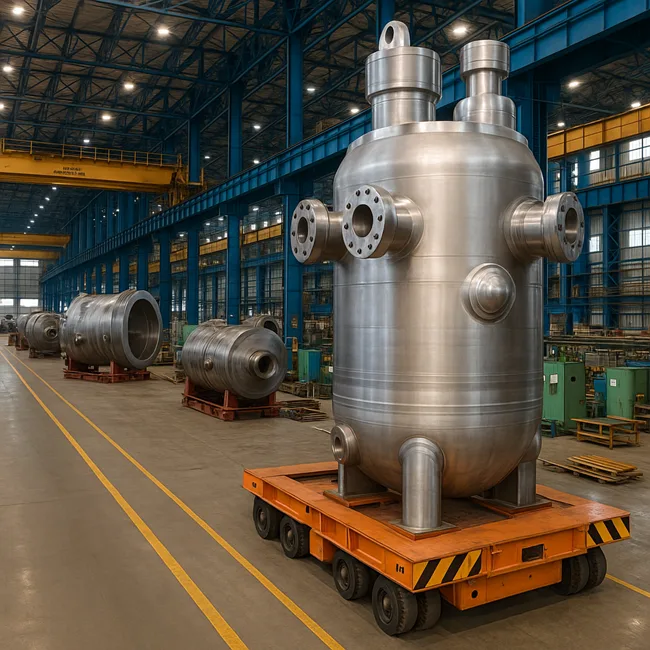
L&T’s role in India’s nuclear sector dates back to the 1970s, when it began supplying fabricated components for early-generation pressurised heavy water reactors (PHWRs). Over the decades, it has evolved into a key manufacturing partner for the Nuclear Power Corporation of India Limited (NPCIL), producing reactor vessels, steam generators, end shields, coolant channel assemblies, and heavy forgings. The company also supplied several critical systems for the Prototype Fast Breeder Reactor (PFBR) at Kalpakkam.
In recent years, L&T has been deeply involved in the 700 megawatt-electric (MWe) PHWR fleet-mode programme. In 2024, it delivered the first steam generator for the Kaiga Units 5 and 6 project a year ahead of schedule, and completed the full set of four generators in just 45 months—surpassing contractual expectations. Such delivery speed is crucial for NPCIL’s strategy to standardise designs and roll out multiple units simultaneously to reduce construction timelines and costs.
To strengthen its manufacturing base, L&T acquired the remaining 26% stake in L&T Special Steels and Heavy Forgings (LTSSHF) from NPCIL, making it a wholly owned subsidiary. This move gives L&T full control over one of India’s few facilities capable of producing large nuclear-grade forgings, a capability that positions it strongly for both domestic and export orders.
New frontiers: small modular reactors, advanced fuels, and global nuclear projects
As India’s nuclear programme pivots towards next-generation technologies, L&T is moving early to establish itself in emerging markets like small modular reactors (SMRs). At its 80th Annual General Meeting, the company confirmed it is among only three Indian firms cleared by the U.S. Department of Energy to receive SMR technology transfers, paving the way for domestic manufacturing and deployment.
L&T has also signed a memorandum of understanding with U.S.-based Clean Core Thorium Energy to collaborate on ANEEL (Advanced Nuclear Energy for Enriched Life) fuel technology. This advanced fuel blend, combining thorium with high-assay low-enriched uranium, promises higher burn-up rates and reduced waste volumes—aligning with India’s long-term thorium utilisation strategy.
Internationally, L&T secured a significant contract from the ITER Organisation in France to deploy advanced welding technology for the nuclear fusion project’s vacuum vessel. Valued between ₹1,000 crore and ₹2,500 crore, the order underscores L&T’s ability to compete in the highest tiers of global nuclear engineering.
How L&T compares with other private-sector players in India’s nuclear ecosystem
While L&T is often the first name associated with private-sector nuclear manufacturing, it is not alone. Bharat Forge supplies precision forgings for turbine and reactor assemblies, Godrej & Boyce manufactures critical components like calandrias and end shields, and Walchandnagar Industries produces specialised reactor equipment and missile system components.
However, L&T’s integrated capabilities—from heavy forgings to turnkey module fabrication—set it apart. Its ability to manage end-to-end manufacturing, combined with early entry into SMRs and advanced fuels, positions it as a more diversified and internationally competitive player.
Could L&T tap the global nuclear supply chain?
With nuclear energy seeing a global resurgence, especially in Asia, the Middle East, and parts of Europe, Indian manufacturers are eyeing export opportunities. L&T’s ASME-certified facilities, long-standing track record, and global partnerships make it a strong candidate for supplying reactor components, modules, and heavy forgings to overseas projects.
If India moves ahead with SMR manufacturing for export—as government policy discussions have suggested—L&T could find itself in a position similar to that of South Korea’s Doosan Enerbility or Japan’s Mitsubishi Heavy Industries, both of which have become global suppliers for nuclear builds.
Why L&T is uniquely positioned in India’s nuclear growth trajectory
The government’s plan to expand nuclear capacity to 100 gigawatts by 2047 includes reforms to attract private investment, accelerate PHWR fleet deployment, and develop new technologies like SMRs and advanced fuel cycles. L&T’s combination of domestic credibility and global exposure fits perfectly into this roadmap.
Its long manufacturing history, control over heavy forging capabilities, ability to meet or exceed delivery schedules, and early moves into high-growth segments like SMRs and thorium-based fuels make it a frontrunner to become the largest private-sector beneficiary of India’s nuclear build-out.
Discover more from Business-News-Today.com
Subscribe to get the latest posts sent to your email.