




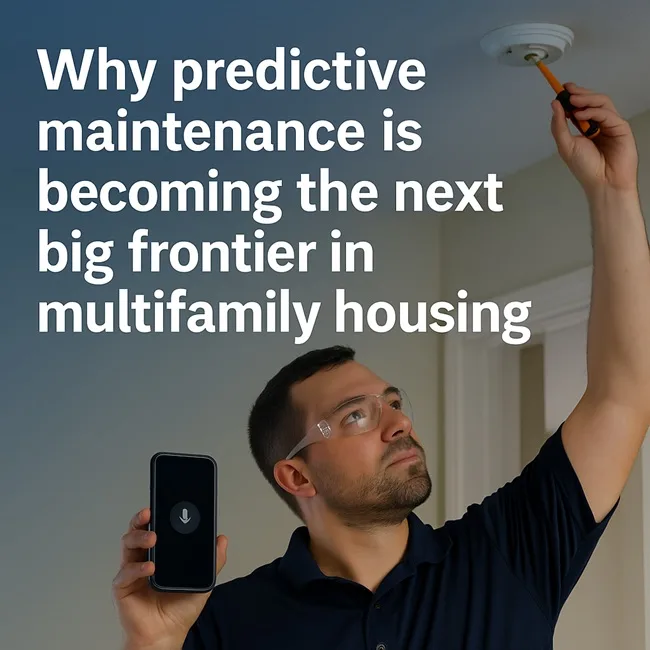
As operating costs continue to climb and technician shortages strain service delivery, multifamily housing operators are increasingly turning to artificial intelligence to help shift from reactive repair models to preventive, data-driven maintenance strategies. The next frontier in property operations is not just about speed or cost-cutting but it is about anticipating failures before they happen and planning capital spend with confidence.
At the center of this transformation is HappyCo, a United States-based property technology company serving over 5.5 million rental units. HappyCo has introduced Joy, a vertically trained artificial intelligence engine designed to convert everyday repair data and technician insights into predictive operational intelligence. Joy is embedded into the company’s maintenance suite and works in tandem with Voice Assist, a new AI-powered voice capture tool that lets technicians dictate repairs naturally and generate structured, searchable maintenance records on the fly.
By analyzing every work order, inspection, and field interaction, Joy enables operators to forecast where breakdowns are likely to occur, how much time and material resolution may require, and how to prioritize technician workloads more strategically. Analysts following the sector believe this kind of forward-looking field intelligence could reshape the economics of property maintenance across large portfolios, especially in a sector where margins are increasingly squeezed and efficiency is paramount.
How HappyCo’s Joy AI engine is trained to convert field data into predictive maintenance insights
Unlike general-purpose AI tools that rely on external language models, Joy is trained on a decade of domain-specific data. HappyCo’s platform has ingested more than one billion real-world maintenance interactions. These include detailed logs of repairs, inventory usage, technician time tracking, and task completion outcomes, all tied back to individual units across thousands of properties. This gives the AI engine a proprietary, high-context foundation that allows it to interpret technician speech and transform it into operationally relevant outputs.
With Voice Assist, technicians no longer need to type notes or check boxes after completing a repair. They can simply speak into the HappyCo mobile app, describing what was fixed and how, while Joy parses the input and categorizes it in real time. A simple phrase like “replaced leaking valve in 14B, took 20 minutes, used spare from inventory” becomes a structured data point that links technician performance with asset reliability, maintenance timing, and cost per task.
This level of automation solves one of the most under-discussed problems in property operations: the lack of consistent, high-fidelity maintenance documentation. Technicians often vary in how they record tasks, and that variation becomes an operational blind spot for managers trying to plan capital improvements or benchmark team performance. With Joy generating standardized records automatically, multifamily operators gain unprecedented visibility into the health of their properties and the effectiveness of their teams.
What results have operators like Blanton Turner and Mark-Taylor Residential seen from Joy?
Blanton Turner, a Seattle-based real estate firm managing multifamily properties, has already reported strong results from integrating Joy and Voice Assist into its daily operations. By standardizing maintenance data capture and improving technician coordination, the company reduced average unit turnover time from nearly two weeks to just under six days. Each technician is now able to manage between 150 and 175 units, compared to pre-AI deployment benchmarks that hovered significantly lower. These productivity gains are helping Blanton Turner avoid third-party contractor costs while improving resident satisfaction and minimizing vacancy loss.
Mark-Taylor Residential, another early adopter, emphasized the importance of consistent documentation for performance evaluation and service quality. Dan Regan, Director of Integrated Operations at Mark-Taylor Residential, said that completion notes allow his team to isolate the root cause of repeat issues. The data enables managers to distinguish between technician training gaps and underlying equipment flaws. These insights feed directly into capital planning decisions, giving operations leaders more confidence when allocating budget for replacements, retrofits, or maintenance team expansion.
Why predictive maintenance is gaining traction as operating expenses continue to rise
The need for predictive maintenance tools like Joy is driven by rising cost pressures across the multifamily sector. Operating expenses remain roughly 40 percent above pre-pandemic levels according to internal benchmarks cited by HappyCo. Labor shortages, wage inflation, and a persistent backlog of deferred repairs have forced operators to rethink how they deploy technicians and manage their portfolios. Maintenance now ranks as the second-largest controllable expense after payroll, making it a prime candidate for optimization.
Poor documentation compounds the problem. Incomplete or inconsistent records often lead to redundant repairs, inefficient procurement, and poor resident experiences. According to internal analysis by HappyCo, a lack of structured repair data can inflate maintenance costs by up to 300 percent in cases where service teams must readdress problems that could have been resolved permanently the first time. Joy addresses this by learning from every technician interaction and continuously improving its predictive models.
How Joy integrates with HappyCo’s broader ecosystem to streamline maintenance operations
The power of the Joy AI engine is amplified by its integration into HappyCo’s broader suite of tools. The company’s maintenance platform already includes modules for inspections, inventory management, automated routing, and technician scheduling. By embedding AI into each of these workflows, HappyCo enables operators to not only detect patterns but act on them within the same platform. Voice Assist is just one touchpoint. The real engine is Joy’s ability to synthesize millions of data points and deliver recommendations that fit into everyday operations.
To ensure that predictive alerts lead to resolution and not just data overload, HappyCo also offers 24/7 remote maintenance support through its Happy Force service. This adds a human layer of accountability and technical expertise to AI-generated insights. When Joy flags an urgent repair, and local teams are unavailable or overwhelmed, Happy Force can step in remotely to troubleshoot or escalate the issue. This hybrid model of AI plus human support is emerging as a preferred strategy in real estate operations where automation cannot yet fully replace skilled labor.
Heidi Turner, Principal and Co-Founder of Blanton Turner, commented that technology is most effective when it amplifies, rather than replaces, human judgment. She described the combination of Joy and Happy Force as a system that enables her teams to work smarter, respond faster, and keep residents happier. The technology standardizes data collection, while the service layer ensures follow-through and escalation when needed.
What makes Joy different from general-purpose AI tools in property technology platforms
Joy has already received industry recognition. The AI engine was recently named the “Most Innovative Use of AI” by Inman, highlighting its unique approach to verticalized learning and field-based intelligence. HappyCo’s approach contrasts sharply with one-size-fits-all AI integrations common in customer service chatbots or tenant engagement platforms. In contrast, Joy is trained on equipment reliability, technician performance, and issue recurrence patterns, which is an operationally rich dataset that directly impacts profit and loss.
Another competitive advantage is Joy’s interoperability with major property management systems. The platform integrates with software used by the majority of large multifamily operators, including Yardi, MRI Software, RealPage, Entrata, and ResMan. This ensures that predictive insights generated by Joy do not remain isolated. They are fed into broader workflows spanning billing, leasing, capital budgeting, and performance reporting.
HappyCo has also built an open API marketplace, which allows third-party vendors and proptech tools to integrate with its AI platform. This expands the use cases for Joy beyond just maintenance. In the future, it could power energy management, compliance tracking, and ESG reporting by correlating maintenance history with utility usage, emissions data, or sustainability KPIs.
What future capabilities could Joy unlock for institutional real estate investors and operators?
Looking ahead, HappyCo’s roadmap includes predictive scoring for high-risk assets, technician benchmarking, automated escalation workflows, and capital reserve planning based on real-time maintenance intelligence. The platform could soon allow institutional investors to view asset risk profiles based not on age or square footage alone, but on technician time-to-repair, issue recurrence frequency, and part replacement cycles. For operators managing large portfolios, this level of granularity offers a competitive edge in planning, budgeting, and investor reporting.
Industry analysts expect that AI-powered field intelligence will soon become a requirement rather than a competitive differentiator. As multifamily portfolios grow more complex and labor markets tighten, the ability to document, forecast, and automate maintenance workflows at scale will be central to profitability. Joy, as a vertically trained and fully embedded AI engine, positions HappyCo at the forefront of this shift.
At OPTECH 2025 in San Diego, HappyCo’s President Ben Nowacky laid out the company’s vision on the FuturesLab stage, while product demonstrations at Booth 358 showcased the real-time power of Voice Assist and Joy in action. The company’s message was clear. Predictive maintenance is not a concept for the future. It is a capability that is already reshaping how multifamily housing is operated today.
HappyCo’s ongoing challenge will be to extend these capabilities across even larger portfolios, deepen integrations with strategic partners, and continue refining Joy’s intelligence through new data streams. But for now, the AI engine is already showing what’s possible when technicians, data, and predictive algorithms all work together, one repair at a time.
Discover more from Business-News-Today.com
Subscribe to get the latest posts sent to your email.


