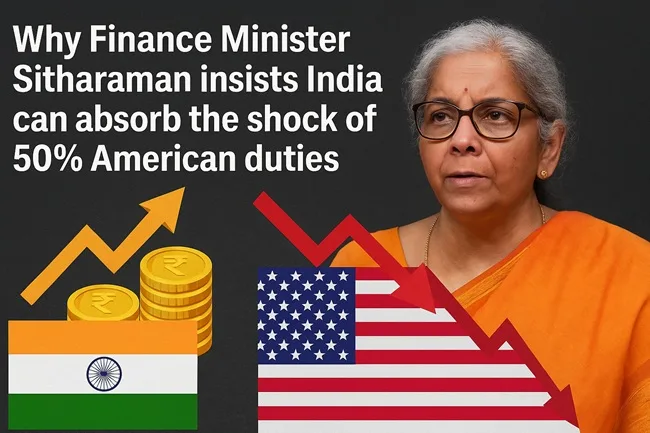
India’s Finance Minister Nirmala Sitharaman struck a confident tone even as the United States rolled out an unprecedented 50 percent tariff on a wide basket of Indian exports. Speaking at an economic forum, Sitharaman argued that India’s growth trajectory has become far more domestic-demand driven and resilient to global headwinds, giving the country room to absorb external shocks. Her comments came against the backdrop of fears that the new U.S. tariff regime could disrupt billions in trade, unsettle export-oriented clusters, and potentially shave half a percentage point off India’s GDP growth in the current fiscal year.
The minister pointed to strong foreign exchange reserves, robust consumer demand, and sustained capital expenditure as the pillars of resilience. However, she also urged against complacency, admitting that policy responses would need to be agile in supporting affected sectors. The broader narrative is that India has entered a phase where external shocks no longer derail overall growth but instead reconfigure trade flows, corporate strategy, and fiscal priorities.
How severe are the new US tariffs and what is their expected economic impact on India’s GDP?
The United States has introduced a sweeping 50 percent tariff on a wide range of Indian exports, a move linked partly to geopolitical disputes over energy sourcing and partly to Washington’s protectionist turn. Nearly 55 percent of India’s $48 billion exports to the U.S. are directly exposed. The most vulnerable industries are textiles, leather, gems and jewellery, chemicals, and low-margin manufactured goods that depend heavily on price competitiveness.
India’s Chief Economic Adviser, V. Anantha Nageswaran, has already quantified the likely hit, projecting a 0.5 to 0.6 percentage point reduction in GDP growth for fiscal 2025–26. This drag is material, considering the government’s growth forecast of 6.5 to 7 percent. Exporters report that forward bookings to the U.S. have collapsed, air cargo volumes have slumped, and some container lines are shifting toward European and Asian markets as alternative destinations.
Institutional investors are pricing in this risk. Analysts note that sectors such as textiles and specialty chemicals may see earnings downgrades if the tariffs remain in place for more than two quarters. Export-oriented small and medium enterprises, particularly in Tamil Nadu and Gujarat, have already begun cutting shifts or pausing production. The effect could ripple through employment in labor-intensive hubs like Tiruppur and Surat.
Why does the government believe domestic demand and capital spending will shield the Indian economy?
Sitharaman’s confidence stems from a decade-long shift in India’s economic structure. The country is now less dependent on exports as a share of GDP compared to the early 2000s. Instead, domestic consumption, services, and private investment are driving growth. Rising household incomes, formalization of the economy, and urbanization have created a resilient demand base that supports manufacturing and services even when external demand falters.
Capital expenditure has emerged as another stabilizer. The government’s infrastructure push, particularly in railways, roads, and renewable energy, has generated downstream demand for steel, cement, and services. This has created a buffer against export volatility. Credit availability, tax incentives, and public-private partnerships are ensuring that the pipeline of projects remains robust, providing employment and stimulating allied industries.
Analysts at leading brokerages argue that India’s strong foreign exchange reserves—well above $600 billion—and a relatively stable rupee provide additional insulation against sudden outflows. Compared to other emerging markets, India is less exposed to dollar liquidity shocks, giving the central bank room to intervene if capital markets wobble under the pressure of U.S. trade measures.
What immediate relief measures are being designed for exporters hit hardest by tariffs?
The government is preparing a targeted relief package to cushion exporters directly affected by the tariff hike. Early drafts of the plan include extending credit guarantees for loans overdue by up to 90 days, particularly for micro, small, and medium enterprises. Discussions are underway to provide subsidized working capital lines for sectors where margins are under acute stress, such as garments, leather, and handicrafts.
In addition, policymakers are considering expanding incentives under the Production Linked Incentive (PLI) scheme to help manufacturers pivot toward new markets and higher-value products. This aligns with the broader “China plus one” strategy, where India is positioning itself as a reliable supply chain partner for Europe and Asia even as the U.S. trade window narrows.
For investors, the relief plan signals that the government is determined to prevent large-scale job losses and factory closures. However, fiscal hawks caution that a wide-ranging subsidy program could strain the deficit at a time when India is already balancing capital spending commitments with welfare outlays.
How are exporters and institutional investors reacting to the tariff shock?
On the ground, exporters in labor-intensive industries have expressed deep anxiety. Some clusters report order cancellations and contract renegotiations, with American buyers either demanding steep discounts or shifting sourcing to Vietnam and Bangladesh. The loss of cost competitiveness under a 50 percent tariff is so steep that even established exporters with long-standing contracts are struggling to retain market share.
Institutional investors are weighing the tariff shock in their equity strategies. Shares of major export-oriented firms in textiles, chemicals, and specialty manufacturing have faced sharp corrections in recent sessions. The sentiment is cautious, with foreign institutional investors trimming exposure to mid-cap exporters while maintaining overweight positions in domestic-demand plays such as banking, IT services, and infrastructure.
Some analysts interpret Sitharaman’s remarks as a confidence-building measure designed to stabilize investor psychology. The message is that India’s structural growth story remains intact, even if the external sector faces temporary turbulence. Market participants, however, will be watching quarterly results closely to assess whether the impact on earnings is deeper than anticipated.
Can market diversification and trade diplomacy soften the long-term impact of US tariffs?
The government and corporate India are moving quickly to diversify export destinations. Southeast Asia, Africa, and Latin America have been identified as priority regions. Indian trade missions are accelerating negotiations with the European Union, where tariff barriers are lower, and with Africa, where demand for affordable manufactured goods is rising.
However, diversification has limits. New markets often have non-tariff barriers, lower purchasing power, or regulatory hurdles that slow expansion. Establishing new logistics chains and building trust with buyers takes time. Analysts suggest that while diversification may offset part of the U.S. shortfall, it cannot fully replace the scale and value of the American market in the short term.
Diplomatic engagement with Washington remains another variable. India may seek negotiations or carve-outs for sensitive sectors, but the broader U.S. trade posture underlines protectionist instincts. Without a political reset, businesses must prepare for a prolonged adjustment.
What are the risks to India’s growth outlook if tariffs persist longer than expected?
The consensus among economists is that the tariff shock is manageable if limited to one to two years. The risks multiply if the measures persist beyond that horizon. Exporters may permanently lose customers, global supply chains could bypass Indian clusters, and MSMEs may face consolidation pressures that force widespread closures.
The fiscal cost of relief packages could rise, forcing the government into a delicate balancing act between stimulus and deficit control. At the same time, inflationary pressures could re-emerge if currency depreciation accompanies capital outflows. For now, India’s growth story remains credible, but prolonged trade disruption risks eroding competitiveness and slowing job creation.
Can India’s domestic demand and policy buffers truly sustain growth momentum despite one of the harshest US tariff shocks in decades?
The Indian economy is entering one of its toughest stress tests in recent memory. Sitharaman’s claim of resilience is not misplaced—domestic demand, infrastructure investment, and foreign exchange reserves provide real buffers. Yet the tariffs present a structural risk that cannot be wished away.
For investors, the message is clear: India’s growth remains strong, but sectoral divergences will widen. Domestic demand-driven industries may outperform, while export-linked mid-caps could struggle until trade realignments are complete. Policymakers face the dual challenge of preventing long-term damage to employment hubs while preserving fiscal discipline.
If India can weather the 50 percent tariff era without destabilizing macroeconomic stability, it will reinforce the country’s reputation as one of the most resilient emerging markets. If not, this episode could mark a pivotal point in redefining the balance between domestic growth and external dependence.
Discover more from Business-News-Today.com
Subscribe to get the latest posts sent to your email.