




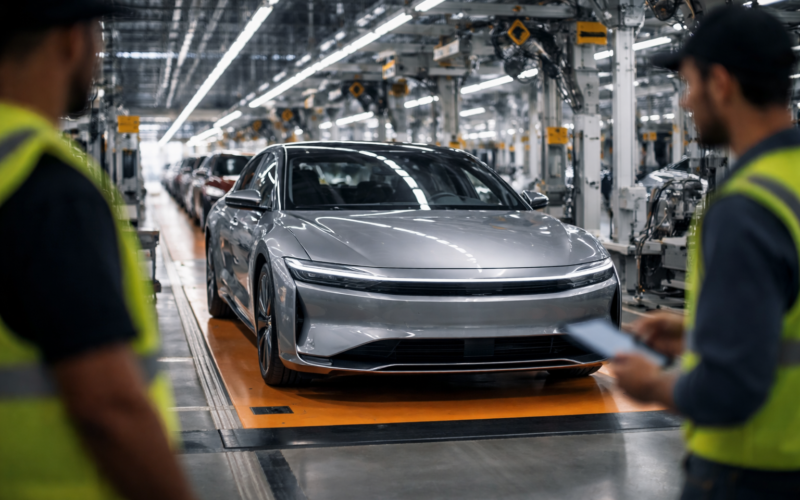
Lucid Group Inc (NASDAQ: LCID) is reducing approximately 12 percent of its United States workforce, a move that underscores mounting pressure on the luxury electric vehicle manufacturer to demonstrate operating discipline and a credible path toward profitability. The decision arrives just ahead of the company’s upcoming earnings release and reflects a strategic recalibration as investor tolerance for prolonged cash burn across the electric vehicle sector continues to erode.
The workforce reduction, communicated internally to employees, is designed to streamline corporate operations while preserving manufacturing execution at Lucid Group Inc’s Arizona production facility. Hourly manufacturing and logistics staff are excluded from the cuts, signaling that the company remains focused on sustaining vehicle output even as it tightens overhead and support functions.
Why Lucid Group Inc is cutting jobs now and what this signals about near term financial priorities
The timing of Lucid Group Inc’s workforce reduction is not incidental. It coincides with a moment when electric vehicle manufacturers face a materially different capital market environment than they did even two years ago. Cheap capital has disappeared, consumer demand has softened at the premium end of the market, and investors are increasingly unwilling to underwrite open ended losses without a clear operating leverage narrative.
For Lucid Group Inc, the layoffs represent an attempt to reset expectations ahead of earnings and reframe the company’s internal cost structure. Management is signaling that efficiency, margin discipline, and execution clarity now take precedence over expansionary ambition. This shift matters because Lucid Group Inc has already demonstrated it can build highly regarded electric vehicles. What it has not yet demonstrated is that it can do so at a scale and cost profile that supports sustainable economics.
The exclusion of factory workers from the reductions reinforces this message. Lucid Group Inc appears to view production continuity and delivery execution as non negotiable. The cost savings are instead targeted at salaried roles where management believes redundancies exist or productivity can be improved without directly impairing vehicle output.
How Lucid Group Inc’s workforce reduction fits into its broader restructuring history
This is not the first time Lucid Group Inc has turned to workforce reductions as a lever to control expenses. Over the past several years, the company has implemented multiple rounds of restructuring as it moved from early production challenges toward higher delivery volumes. Each round has followed a similar pattern. Expansionary hiring during periods of optimism has been followed by retrenchment as financial realities reasserted themselves.
What is different this time is the context. Earlier workforce adjustments occurred when the electric vehicle sector was still viewed as structurally underpenetrated and capital markets were willing to absorb losses in exchange for growth. The current round takes place against a backdrop of sector wide skepticism, heightened scrutiny of unit economics, and declining patience for aspirational narratives.
This shift increases the stakes. Investors are no longer asking whether Lucid Group Inc can eventually scale. They are asking whether it can survive long enough to do so without continuous external support.
What the layoffs reveal about Lucid Group Inc’s product and platform strategy
Lucid Group Inc continues to invest in its product roadmap, including the Gravity sport utility vehicle and a planned midsize electric vehicle positioned at a significantly lower price point than its flagship sedans. The workforce reduction suggests that management is attempting to protect these strategic initiatives while trimming costs elsewhere.
However, this balance introduces execution risk. Product development, software integration, and manufacturing optimization are all talent intensive activities. Reducing headcount too aggressively in engineering, program management, or systems integration could slow timelines or compromise quality. The market will be watching closely to see whether Lucid Group Inc can maintain momentum on its next generation platform while operating with a leaner organization.
The emphasis on a midsize vehicle also reflects a strategic acknowledgment that the ultra luxury electric vehicle segment alone cannot support long term scale. Whether Lucid Group Inc can successfully reposition itself without diluting brand perception remains an open question.
How investor sentiment toward Lucid Group Inc has evolved and why this move is aimed at reassurance
Investor sentiment toward Lucid Group Inc has cooled materially over the past year. The company’s share price has lagged both broader market indices and many electric vehicle peers, reflecting doubts about cash burn, demand elasticity, and long term margin potential.
The workforce reduction can be read as an attempt to reset that narrative. By acting decisively on costs, Lucid Group Inc is signaling to institutional investors that management recognizes the new operating reality. This is less about immediate savings and more about credibility. Investors want evidence that leadership understands the urgency of disciplined execution.
That said, layoffs alone do not change fundamentals. They buy time, not transformation. The next earnings report will be critical in determining whether this action is perceived as a proactive reset or a reactive measure taken under pressure.
What Lucid Group Inc’s workforce reduction reveals about competitive pressure and cost discipline across the electric vehicle sector
Lucid Group Inc’s move is emblematic of a broader recalibration underway across the electric vehicle industry. Premium electric vehicle manufacturers are discovering that early adopters are largely saturated, while mass market buyers remain price sensitive and cautious amid higher interest rates.
Competitors face similar trade offs. Those with greater scale and diversified revenue streams may absorb the downturn more easily. Smaller or more narrowly positioned manufacturers will be forced to make hard choices between growth investment and financial survival.
For Lucid Group Inc, the challenge is particularly acute because its differentiation rests on technology and performance rather than price. Preserving that edge while cutting costs requires precision. Missteps could erode the very attributes that justify the brand’s premium positioning.
What happens next if Lucid Group Inc’s cost discipline strategy succeeds
If Lucid Group Inc successfully executes this restructuring without disrupting production or product development, the company could emerge leaner and more resilient. Reduced operating expenses would improve cash runway and potentially narrow losses, creating space to demonstrate incremental margin improvement as volumes grow.
In this scenario, investor confidence could stabilize. The narrative would shift from survival to execution, with focus returning to delivery growth, manufacturing efficiency, and progress toward breakeven. Over time, this could support a re rating of the stock if accompanied by credible guidance and transparent metrics.
What happens if cost cuts fail to change the underlying trajectory
The downside scenario is equally clear. If demand remains soft, margins fail to improve, or execution stumbles due to reduced staffing, Lucid Group Inc may face renewed pressure to pursue additional restructuring, seek external capital, or reassess its strategic ambitions.
Further workforce reductions would risk compounding morale issues and slowing innovation. Additional capital raises could introduce dilution concerns. At that point, strategic optionality narrows, and the company’s future becomes more contingent on external support and market conditions beyond its control.
Why this moment matters more than previous restructuring cycles
The current workforce reduction matters because it takes place at a point where narrative flexibility has diminished. Earlier resets could be framed as temporary adjustments on the path to inevitable scale. Today’s environment is less forgiving.
Lucid Group Inc is being evaluated not as a promising newcomer, but as a public company expected to demonstrate operational maturity. The market is no longer willing to suspend disbelief indefinitely.
This makes the next twelve to eighteen months decisive. Cost discipline must translate into measurable improvement, not just reduced headcount.
What are the key takeaways from Lucid Group Inc’s workforce reduction for investors, competitors, and the EV industry
- Lucid Group Inc is reducing approximately 12 percent of its United States workforce to signal stronger cost discipline ahead of earnings.
- Hourly manufacturing employees are excluded, underscoring management’s priority on maintaining production continuity.
- The move reflects growing investor impatience with prolonged losses across the electric vehicle sector.
- This is Lucid Group Inc’s third major workforce reduction cycle, highlighting persistent structural challenges.
- Cost savings alone will not resolve margin pressure without sustained demand and execution improvement.
- The restructuring aims to protect core product programs, including the Gravity sport utility vehicle and a midsize platform.
- Investor reaction will hinge on whether upcoming earnings demonstrate tangible progress toward breakeven.
- Competitive pressure is intensifying as premium electric vehicle demand softens globally.
- Successful execution could stabilize sentiment and extend cash runway.
- Failure to improve fundamentals may force further restructuring or capital actions.
Discover more from Business-News-Today.com
Subscribe to get the latest posts sent to your email.
