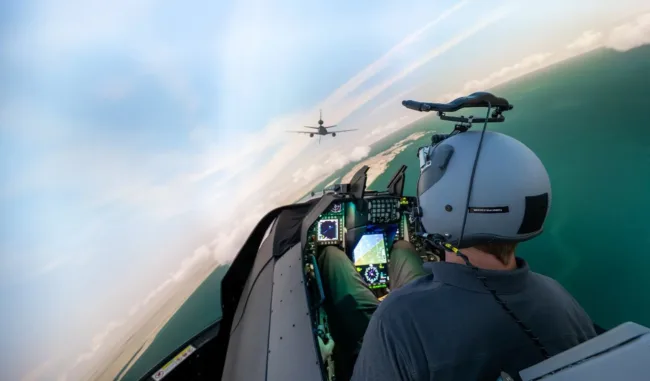
Lockheed Martin Corporation (NYSE: LMT) has added another milestone to its global sustainment portfolio after winning a contract to modernize the Republic of Korea Air Force’s F-16 Block 52 flight simulators. The simulators, based at Seosan and Chungju air bases, will be upgraded to match the advanced F-16 Viper configuration, reflecting Seoul’s commitment to enhancing pilot readiness and aligning training infrastructure with evolving aircraft capabilities. The announcement coincided with a modest uptick in Lockheed Martin’s share price, which closed at 474.32 dollars on September 16, up 0.23 percent, with after-hours trading pushing the stock further to 476 dollars. The move highlights how incremental but strategically significant contracts in training and sustainment continue to bolster confidence in the defense contractor’s resilience.
Why has South Korea prioritized upgrades to its F-16 simulators in 2025?
South Korea has long been one of the most active operators of the F-16, with aircraft procured under the Peace Bridge program in the late 1980s and subsequently upgraded through the locally branded KF-16 modernization program. The decision to bring simulators up to the F-16V standard is driven by multiple factors. First, the threat environment in Northeast Asia has grown more complex, requiring aircrews to master advanced electronic warfare, radar, and weapons systems without incurring the cost and risk of constant live flying. Second, upgrading simulators allows the Republic of Korea Air Force to replicate cutting-edge avionics and AESA radar capabilities now being rolled out across its frontline fighters. Finally, concurrency between training platforms and operational aircraft ensures that pilots train in a virtual environment that matches what they will experience in the cockpit, reducing transition time and increasing safety margins.

Lockheed Martin has stressed that it leverages real aircraft software and design data in its simulator solutions. This means that when a pilot encounters upgraded displays or new radar modes in the simulator, the experience is nearly identical to what they will face during live sorties. The six-year contractor logistics support embedded in the agreement also ensures that maintenance, software updates, and system integration remain aligned with aircraft developments.
How does the F-16 Viper configuration change the training landscape?
The F-16V represents the most advanced configuration of the world’s most widely flown fourth-generation fighter. It includes a modernized glass cockpit, a digital mission computer, advanced weapons integration, and an Active Electronically Scanned Array radar, which significantly enhances target detection and tracking. For simulators, these upgrades translate into high-fidelity scenarios where pilots can practice complex missions such as multi-target engagements, beyond-visual-range combat, and electronic warfare countermeasures.
In practical terms, upgrading simulators ensures that South Korean pilots are prepared to exploit the full capability of their aircraft. Training packages can now include realistic representations of networked combat environments, enabling multiple pilots to practice joint missions across bases. This networking capacity means pilots are not just flying against computer-generated adversaries but can train collaboratively with other crews, mirroring coalition operations. As defense planners in Seoul continue to emphasize readiness against regional threats, these training enhancements become a vital force multiplier.
How large is the military simulator market and why is South Korea investing in it?
The global military flight simulator and training systems market has steadily grown as nations look to balance cost efficiency with readiness. Training in simulators reduces fuel consumption, aircraft wear and tear, and operational risk while expanding the number of hours pilots can log in advanced mission scenarios. South Korea’s own military training systems market was valued at over six billion dollars in 2024 and is projected to grow at a compound annual rate exceeding six percent. This reflects not only its expanding defense budget but also its strategic pivot toward high-technology training ecosystems that combine domestic manufacturing with international partnerships.
While Korea Aerospace Industries has become a flag-bearer for indigenous aircraft programs, including the KF-21 Boramae, Seoul still relies on foreign partners for certain platforms and upgrades. Lockheed Martin’s contract demonstrates that even as South Korea builds its own aerospace capability, it continues to value global contractors that bring proven systems, experience with allied air forces, and interoperability benefits.
What does this mean for Lockheed Martin’s business model?
For Lockheed Martin, training and sustainment contracts are increasingly critical as they provide recurring, high-margin revenue streams that offset volatility in large platform programs. In recent quarters, the company has faced pressure from pre-tax charges on classified aeronautics programs and delays in the F-35 Technology Refresh initiative. By contrast, simulation and training projects are less capital-intensive and more predictable. The Korean simulator upgrade strengthens Lockheed’s positioning as not only a platform manufacturer but also as a long-term lifecycle partner to allied air forces.
Lockheed Martin has delivered simulator solutions since 2001, with training suites adopted by aviators in more than sixteen allied nations. Its systems replicate sensors, weapons, and mission environments with high fidelity, allowing pilots to train across a spectrum of operations. The Korea contract reinforces the company’s message to investors: training, sustainment, and software services can deliver steady returns, reduce revenue lumpiness, and extend customer relationships well beyond initial aircraft sales.
How is Lockheed Martin stock performing after the South Korea F-16 simulator deal and what is investor sentiment?
Lockheed Martin’s shares closed modestly higher on September 16, suggesting a cautiously positive market reception. At 474.32 dollars per share, the company remains below its 12-month target price of around 496 dollars, indicating analysts see a potential upside of nearly five percent. While the Korea simulator contract alone is not material enough to move the stock significantly, it contributes to a broader narrative of stability through recurring revenue.
Investor sentiment, as tracked by institutional flows, shows cautious accumulation rather than aggressive buying. Defense stocks as a sector continue to attract foreign institutional investors given geopolitical uncertainties and the steady growth of defense budgets. Domestic institutional investors in the U.S. have also been maintaining exposure, seeing Lockheed Martin as a defensive play in volatile markets. For retail investors, the stock has often been viewed as a “hold” rather than a strong buy, reflecting confidence in long-term earnings but caution about near-term cost overruns on larger projects.
How does this contract fit into the geopolitical and competitive landscape?
Regionally, the contract signals continued U.S.–Korea defense cooperation at a time of heightened security concerns in East Asia. By aligning training systems with the most advanced F-16 configurations, Seoul enhances deterrence while demonstrating commitment to interoperability with U.S. and allied forces. For Lockheed Martin, it also showcases competitive strength in the simulation market, where rivals are increasingly positioning digital training as a differentiator.
Competitors such as Boeing, CAE, and Northrop Grumman are investing in simulation and virtual training systems. However, Lockheed Martin benefits from owning the F-16 design and software baseline, allowing it to deliver exact concurrency between simulators and aircraft. This proprietary advantage makes Lockheed’s offerings attractive to countries modernizing their fleets without replacing them entirely.
What risks and financial challenges could Lockheed Martin face from F-16 simulator upgrades in South Korea?
Even in training contracts, risks remain. Software and hardware upgrades must remain synchronized with aircraft evolution, which can create cost pressures if integration proves more complex than anticipated. Fixed price elements may squeeze margins if Lockheed underestimates the scope of modernization work. Additionally, export regulations and technology transfer considerations can complicate timelines in international programs. For Korea, balancing indigenous development with foreign partnerships is a long-term challenge, while for Lockheed, maintaining competitiveness in a crowded training systems market requires continuous innovation.
What future opportunities could Lockheed Martin unlock after upgrading South Korea’s F-16 simulators?
Looking forward, the Korea simulator contract could pave the way for broader sustainment partnerships in Asia. Lockheed Martin is likely to pursue similar simulator modernization deals with other regional operators of the F-16, leveraging this success as a showcase. South Korea may also expand networked training to include joint exercises with allied nations, potentially creating opportunities for Lockheed to integrate simulators across countries.
For investors, the key question is whether training and sustainment revenues can scale enough to offset pressure from larger programs. With a global fleet of more than three thousand F-16s, the opportunity pool is significant. If Lockheed can continue winning these contracts while improving cost discipline in its flagship programs, sentiment may tilt more firmly toward buy recommendations in the quarters ahead.
Lockheed Martin’s upgrade of South Korea’s F-16 simulators underscores the company’s evolution from an aircraft manufacturer to a comprehensive defense lifecycle provider. For Seoul, it strengthens readiness and reduces risks in an uncertain regional security environment. For investors, it offers a reminder that steady, service-oriented revenue streams can stabilize performance even as flagship programs remain exposed to cost and schedule volatility. As global defense spending continues to climb, training and sustainment are emerging as growth anchors — and Lockheed Martin is determined to secure its place at the center of this trend.
Discover more from Business-News-Today.com
Subscribe to get the latest posts sent to your email.