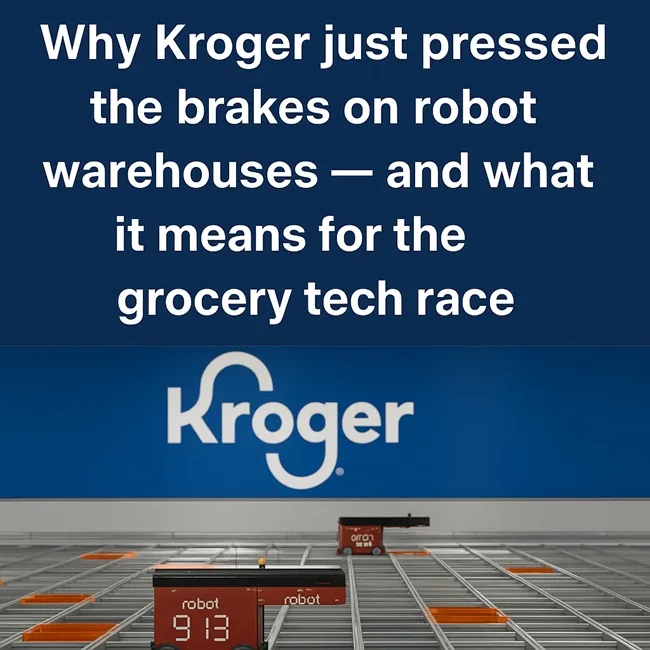
The Kroger Co. has initiated a major reset of its e-commerce fulfillment strategy, announcing plans to shutter three of its automated customer fulfillment centers developed in partnership with United Kingdom-based Ocado Group plc. The decision reflects a broader move to streamline digital grocery operations and focus on improving profitability after years of heavy investment in robotics infrastructure failed to generate the expected returns.
As part of this transition, The Kroger Co. will record a non-cash impairment charge of approximately $2.6 billion in the third quarter of fiscal 2025. The charge primarily reflects reduced asset valuations associated with the underperforming automated warehouses, which were designed to enable rapid grocery delivery via a centralized, high-tech model. However, the company now aims to improve its digital margins by $400 million by fiscal 2026 through a more flexible hybrid fulfillment approach that prioritizes proximity to customers, operational agility, and capital discipline.
Why Kroger is abandoning its large robotic fulfillment centers after years of heavy investment and what this shift reveals about the true economics of digital grocery
The Kroger Co. had bet heavily on a long-term automation strategy by launching high-capacity, robot-powered fulfillment centers in several states in partnership with Ocado Group plc. These facilities were designed to consolidate order picking and delivery into a few large hubs using Ocado’s proprietary grid and bot technology, with delivery fleets extending service across regional zones. However, the company has now concluded that the economics of these facilities do not work uniformly across all markets, particularly those with lower population density or less mature online grocery habits.
In a formal statement, The Kroger Co. explained that its most profitable and scalable model continues to be one anchored in its extensive store network. The company operates over 2,700 stores in the United States, with nearly all of them capable of fulfilling digital orders within two hours. This makes the high-cost, centralized fulfillment model less relevant in areas where stores already serve as local fulfillment nodes. By scaling back capital-intensive automation, Kroger is realigning toward an omnichannel strategy that better matches customer behavior and market-specific demand.
How closing three automated sites reshapes Kroger’s digital infrastructure and what remains of the Ocado-backed robotics network going into 2026
The three fulfillment centers scheduled to close are located in Groveland, Florida; Pleasant Prairie, Wisconsin; and Frederick, Maryland. All three are expected to cease operations by January 2026. The Kroger Co. said these closures will allow it to reallocate capital and workforce efforts to higher-performing parts of its digital business.
The company emphasized that it still sees value in its automation capabilities for specific high-density regions. The remaining five automated fulfillment centers, which include sites in Monroe, Ohio; Forest Park, Georgia; Dallas, Texas; Romulus, Michigan; and Aurora, Colorado, will remain operational for now. These centers are undergoing ongoing review to determine how well they are performing against revised efficiency metrics and customer satisfaction benchmarks.
In addition, The Kroger Co. is piloting micro-fulfillment solutions inside select stores where volume justifies the investment. These micro-fulfillment initiatives are capital-light, co-located with retail stores, and positioned to strike a balance between technology-driven efficiency and local flexibility.
Why Kroger is shifting toward store-based fulfillment, third-party logistics, and micro-automation to build a more profitable digital grocery model
As part of the broader transformation, The Kroger Co. is doubling down on third-party delivery partnerships and store-based fulfillment. It has expanded its integration with major on-demand delivery providers, including Instacart, DoorDash, and Uber Eats, to ensure faster last-mile execution without additional infrastructure costs.
These partnerships are not just convenience plays. They are part of a larger orchestration of assets to enhance digital customer experience while maintaining tight cost control. Rather than owning the full logistics stack, Kroger’s current model allows its stores to serve as agile fulfillment nodes, supported by third-party logistics for scale and reach.
The Kroger Co. has also cited the need to serve new customer segments and geographies more quickly. By using existing store infrastructure and flexible delivery options, the company is now able to respond to emerging e-commerce demand without waiting for long lead-time warehouse builds.
How investors are interpreting Kroger’s multibillion-dollar impairment and what the pivot signals for the future of Ocado’s automation model in the United States
Investor reaction to the announcement has been largely constructive, despite the significant impairment charge. Analysts have framed the $2.6 billion write-down as a one-time corrective measure that clears the decks for a more sustainable, profit-oriented digital growth plan. The promise of a $400 million operating profit improvement from e-commerce by 2026 is seen as a credible signal that Kroger is ready to move past the sunk-cost fallacy of its early automation ambitions.
At the same time, the announcement has had ripple effects beyond Kroger’s stock. Ocado Group plc, the robotics and software partner in these projects, saw its shares drop by more than 15 percent on the London Stock Exchange. Investors are now questioning the scalability of Ocado’s centralized fulfillment model in the United States, especially in contrast to retailers like Walmart Inc. and Amazon.com Inc., which rely heavily on store-based or flexible warehouse networks for their grocery e-commerce operations.
From a macro perspective, the move underscores a maturing phase in the digital grocery segment. It is no longer enough to grow online volume. Retailers are under pressure to deliver e-commerce profits that are at least margin-neutral with physical retail, if not accretive.
Why Kroger’s realignment could reshape digital grocery strategies across the sector and push competitors toward capital-light hybrid fulfillment
The Kroger Co.’s decision may serve as a turning point for other supermarket chains weighing the return on investment of automated warehouse systems. The balance appears to be tilting in favor of operational flexibility over fixed infrastructure. Retailers that can blend store-based fulfillment with delivery partner ecosystems are increasingly viewed as better positioned to scale profitably.
This is particularly relevant in the current cost environment. Rising labor costs, volatile fuel prices, and constrained delivery economics are pushing grocers to adopt models with lower break-even thresholds. The Kroger Co.’s pivot toward a capital-light hybrid model is reflective of these broader pressures.
Moreover, as consumers grow more accustomed to two-hour delivery windows and hybrid shopping journeys such as ordering online for curbside pickup, retailers must design fulfillment strategies that are not just efficient but adaptable. Technology must fit around customer habits, not force them into new ones.
Why Kroger’s shift back to a store-led fulfillment model may or may not deliver sustainable e-commerce profitability by 2026 according to expert analysis
The Kroger Co.’s latest strategic reset illustrates a hard lesson in digital transformation: technology only creates value when tightly aligned with customer behavior and localized economics. The ambition to reinvent grocery fulfillment through large-scale automation was bold but ultimately overextended in a market where customer density varies significantly by region.
What stands out in this pivot is the return to fundamentals. Kroger’s store network has always been its strongest asset. By anchoring digital growth in stores rather than warehouses, the company is playing to its core advantage while reducing risk and improving speed to market.
However, execution risk remains. The shutdown of three fulfillment centers is operationally complex and may temporarily affect customer experience and internal morale. Additionally, the success of Kroger’s updated digital strategy hinges on how well its logistics and technology teams can harmonize in-store processes with third-party delivery platforms.
Looking ahead, investors should watch whether The Kroger Co. meets its $400 million e-commerce profit target by 2026. Margin improvements, fulfillment cost per order, and service reliability will all be critical metrics to assess the success of this new chapter.
Key takeaways: Kroger’s digital strategy reset, warehouse closures, and future profit focus
- The Kroger Co. is shutting down three automated fulfillment centers in Florida, Wisconsin, and Maryland, aiming to phase out underperforming robotics infrastructure.
- The company will take a $2.6 billion non-cash impairment charge in Q3 FY25 tied to these closures and associated asset write-downs.
- Kroger is targeting a $400 million improvement in e-commerce operating profit by fiscal 2026, pivoting to store-led fulfillment and capital-light digital expansion.
- Ocado Group plc, the automation technology partner, saw its share price drop over 15 percent following the announcement as market confidence in the U.S. robotics model weakened.
- Store-based fulfillment now accounts for 97 percent of digital order capacity across Kroger’s network of more than 2,700 locations.
- The company is expanding partnerships with Instacart, DoorDash, and Uber Eats to scale e-commerce reach without large infrastructure investments.
- Remaining Ocado-powered fulfillment centers will remain open but are under active review for financial and operational performance.
- Analysts generally support the profitability-focused pivot, with many viewing the write-down as a one-time correction to improve digital ROI.
- The strategic shift is likely to influence how other U.S. grocers approach automation, favoring hybrid models over fully centralized robotics.
- Success will depend on how effectively Kroger integrates third-party delivery, maintains service levels, and optimizes digital margin performance.
Discover more from Business-News-Today.com
Subscribe to get the latest posts sent to your email.