



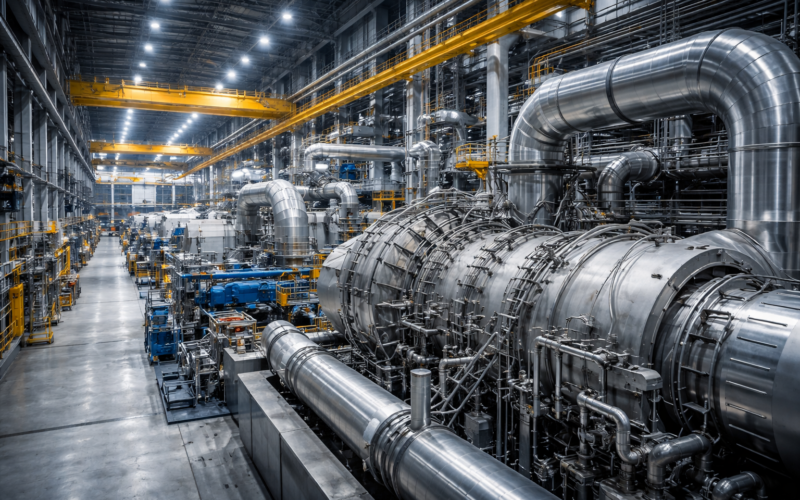
Hanwha Impact has combined Hanwha Power Systems and United States-based PSM under a single brand called Hanwha Power, marking a strategic shift from equipment-led operations toward a more integrated energy infrastructure business. The move is more than a name change because it brings together compressor systems, gas turbine equipment, plant auxiliary systems, and aftermarket services under one commercial identity. Hanwha Power is positioning itself to capture rising demand from conventional power plants, industrial energy users, and data center-related electricity infrastructure at a time when global grid reliability has become a strategic concern. The integration also suggests that Hanwha sees a widening commercial opportunity in lifecycle optimization, retrofit programs, and lower-carbon gas-based power solutions rather than in standalone hardware sales alone.
Why is Hanwha Power combining compressor and gas turbine businesses at this stage of the energy cycle?
The timing is not accidental. Electricity demand is no longer being driven only by legacy industrial growth or normal urban expansion. It is increasingly being reshaped by electrification, digital infrastructure, and especially the rapid expansion of data centers, which have become one of the most talked-about power demand themes in global infrastructure circles. In that context, Hanwha Power appears to be reorganizing around a simple but commercially important reality: buyers increasingly want fewer vendors, faster execution, and more integrated responsibility across plant performance.
That matters because the gas turbine market has changed from a business centered purely on original equipment sales into one that increasingly rewards lifecycle service depth, fuel-flexibility, operational upgrades, and response speed. A company that can provide compressors, fuel systems, combustor technologies, auxiliary systems, and services across installed fleets has a stronger argument when customers are looking to reduce outage risk or modernize existing plants without starting from scratch. Hanwha Power is effectively betting that in a tighter, faster-moving power market, integration itself becomes a product.
This also reflects a broader shift in how energy equipment providers are trying to defend margins. Standalone machinery can become commoditized, or at least price-pressured, over time. Service contracts, retrofit packages, performance upgrades, and plant optimization offerings tend to create stickier customer relationships and better long-term economics. By unifying Hanwha Power Systems and PSM, Hanwha is attempting to move further in that direction.
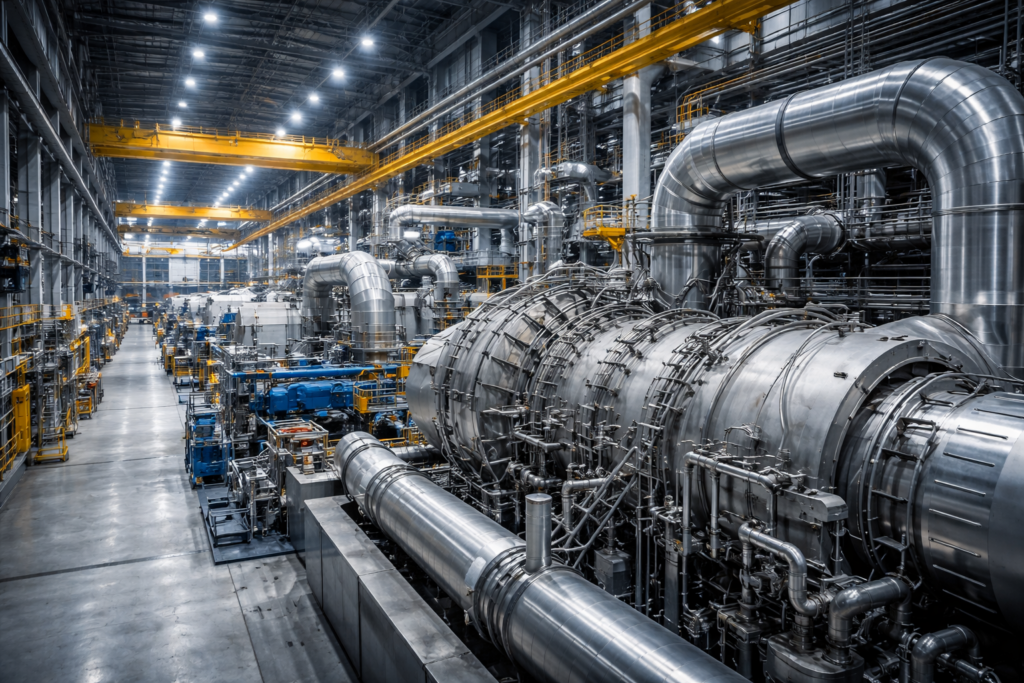
How could Hanwha Power use this integration to compete for power plant and data center opportunities?
The data center angle is especially important because it changes the nature of power market demand. Data center developers care deeply about uptime, response time, fuel availability, and deployment speed. In many regions, the limiting factor for new digital infrastructure is not real estate or even server procurement. It is access to reliable power. That creates an opportunity for turbine-linked and gas-based infrastructure providers that can support fast, dispatchable generation or backup systems that complement constrained grids.
Hanwha Power’s combined positioning could appeal to customers that want a single counterparty for multiple layers of plant functionality. That does not automatically make Hanwha the dominant player, of course. Established competitors in the turbine, rotating equipment, and power services markets already have scale, installed fleets, and long customer relationships. But the more fragmented the procurement environment becomes, the more valuable a bundled pitch can be.
There is also a subtle strategic message here. Hanwha is not presenting this business as only a turbine service provider or only a compressor manufacturer. It is trying to reframe itself as an energy solutions company with cross-functional capability. Corporate presentations often make that claim a little too easily, but in this case there is at least a clear industrial logic behind it. If the group can actually coordinate engineering, sales, service, and technology development across regions and products, it stands a better chance of winning larger and more complex contracts.
What does Hanwha Power’s low-carbon fuel strategy suggest about its longer-term decarbonization ambitions?
The mention of hydrogen and ammonia is not just a box-ticking exercise. It shows Hanwha Power wants relevance beyond the current gas cycle. Gas turbines remain central to balancing intermittent renewable generation and supporting fast-growing electricity systems, but long-term positioning increasingly depends on whether existing infrastructure can be adapted to lower-carbon fuels. That is where combustor design, retrofit capability, and plant modification expertise become commercially significant.
Hanwha Power’s emphasis on combustor technology suggests it sees retrofit economics as a practical entry point into decarbonization-linked spending. New-build clean energy infrastructure often attracts the headlines, but retrofits may prove to be the more immediate revenue opportunity for many industrial suppliers. Utilities and industrial operators with installed gas turbine fleets are unlikely to scrap usable assets overnight. They are more likely to seek staged improvements that extend asset life, improve emissions performance, and keep options open as future fuel economics evolve.
That puts Hanwha Power in a potentially useful niche, provided the technology proves commercially viable and customers are willing to fund conversions. Hydrogen and ammonia narratives are easy to state in announcements and far harder to scale in the field. Fuel supply chains remain uneven, regulatory treatment varies by region, and the economics depend heavily on policy support and infrastructure availability. So the opportunity is real, but it is not a free pass to decarbonization glory. Energy markets are rude like that.
Why does Hanwha Power’s global operating footprint matter for service quality and commercial execution?
Hanwha Power says it plans to integrate operations across North America, Europe, the Middle East, and Asia. That is strategically important because rotating equipment and power plant service businesses are won or lost on execution credibility as much as on engineering claims. Customers want proof that technical support, spare parts logistics, outage response, and field service talent can actually be delivered close to where assets operate.
A wider footprint can improve local responsiveness, but only if integration is operationally real rather than cosmetic. Cross-border industrial combinations often look efficient on presentation slides and messy in actual execution. Sales teams may overlap. Engineering priorities may differ across legacy units. Regional customers may be accustomed to distinct brands, service processes, or decision chains. The success of Hanwha Power will therefore depend less on the elegance of the rebrand and more on whether it can simplify internal coordination without slowing customer-facing delivery.
Still, the geographic logic is compelling. Energy infrastructure demand is not uniform. North America is dealing with data center-driven power stress and generation additions. Europe is balancing decarbonization ambitions with energy security concerns. The Middle East remains a major market for large-scale energy and industrial infrastructure. Asia continues to require both capacity growth and technology upgrades. A company able to align global technology capabilities with local execution has a broader runway than one operating in silos.
Can Hanwha Power realistically move from equipment provider to full energy solutions company?
This is the core strategic question. Many industrial groups talk about becoming solution providers because the phrase sounds modern, comprehensive, and conveniently higher margin. The harder question is whether they truly possess the commercial architecture to do it. That means not just owning multiple product lines, but coordinating them into a single customer proposition with measurable value.
Hanwha Power appears to be trying to make that leap by combining main equipment, auxiliary systems, and services into a unified offering. If it succeeds, the benefits could be meaningful. Customers may prefer fewer interfaces, more coherent accountability, and a partner that can optimize performance across the plant lifecycle rather than selling only one component of it. For Hanwha, that could improve customer retention, expand service revenue, and create more resilience against cyclical swings in individual equipment categories.
But the risks should not be understated. Integration can dilute focus if leadership is not disciplined. Customers may still prefer specialist vendors for certain critical systems. Competing against entrenched global players in plant services and turbine ecosystems is not easy. And in energy infrastructure, reputation compounds slowly but execution mistakes travel fast. Hanwha Power’s next few years will therefore be defined not by branding language, but by whether it can turn combined capability into repeatable contract wins and demonstrable plant outcomes.
What does the Hanwha Power launch signal about broader trends in gas turbines, energy security, and grid reliability?
The bigger takeaway is that this combination reflects a market moving back toward dispatchable power, flexible thermal assets, and service-led modernization. Renewable energy remains central to the long-term transition, but grid operators, utilities, and industrial customers are rediscovering that reliability still needs machinery that can respond when the wind does not cooperate and the sun decides to clock out.
That does not mean the energy transition is reversing. It means the transition is becoming more operationally honest. Companies like Hanwha Power are trying to position themselves where energy security, capacity expansion, and decarbonization overlap awkwardly but profitably. Gas turbines, fuel systems, retrofits, and lifecycle services sit right in that tension zone. They are neither the old energy story alone nor the final low-carbon end state. They are part of the messy middle, which is often where the money is.
Hanwha Power’s formation therefore looks less like a routine corporate tidy-up and more like a play for relevance in an era where power demand is rising faster than comfort with supply risk. If the company can execute across installed fleets, new project opportunities, and lower-carbon technology adaptation, it may carve out a stronger place in the global energy equipment hierarchy. If not, it risks becoming another well-branded industrial integration whose ambition outpaced its operational muscle.
What are the key takeaways on how Hanwha Power could reshape competition in gas turbines, compressors, and energy infrastructure?
- Hanwha Power’s formation signals a deliberate shift from component sales toward a broader lifecycle and solutions-based energy infrastructure model.
- The integration is strategically timed to rising global electricity demand driven by electrification, industrial load growth, and especially data center expansion.
- Combining compressors, gas turbine systems, auxiliary equipment, and services gives Hanwha Power a stronger bundled offering for customers seeking fewer counterparties.
- The biggest commercial upside may come from aftermarket services, retrofits, and performance optimization rather than from one-off equipment orders alone.
- Hydrogen and ammonia positioning suggests Hanwha Power wants relevance in lower-carbon thermal power, but real commercial traction will depend on fuel economics and policy support.
- Global regional coverage could strengthen local responsiveness, though execution quality will depend on how effectively the legacy businesses are operationally integrated.
- Hanwha Power is trying to compete on system-level accountability, which could become more valuable as power customers prioritize reliability and speed of deployment.
- The rebrand reflects a broader market reality that dispatchable generation and turbine-linked infrastructure remain important even as decarbonization accelerates.
- The main risk is that solution-provider ambition can fail if internal coordination, service delivery, and customer trust do not keep pace with strategic messaging.
- If Hanwha Power executes well, it could become a more credible challenger in the global market for gas turbine services, low-carbon retrofits, and energy infrastructure support.
Discover more from Business-News-Today.com
Subscribe to get the latest posts sent to your email.