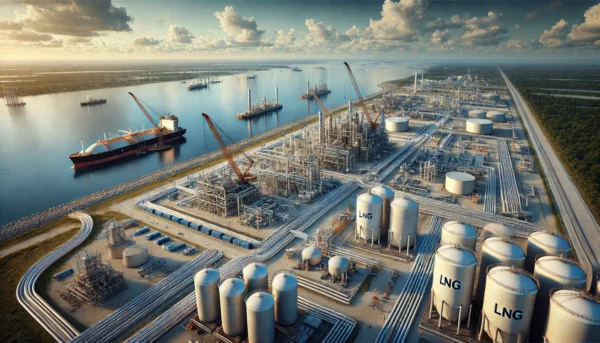
Energy Transfer LP (NYSE: ET) has suspended development of the Lake Charles LNG export project in Louisiana after failing to secure sufficient commercial commitments to support a final investment decision. The company is shifting its capital focus to expanding its U.S. natural gas pipeline systems, citing stronger near-term returns, faster execution cycles, and more stable regulatory dynamics.
The decision halts one of the most advanced brownfield LNG export developments in the United States and signals a broader pivot across the midstream sector, where capital discipline and execution certainty are now being favored over megaproject ambition. For the U.S. LNG industry, it also removes a key potential source of capacity expansion through 2030 at a time of heightened global energy demand and uncertain investment appetite.
Why did Energy Transfer abandon its LNG export ambitions at Lake Charles despite regulatory readiness?
The Lake Charles LNG facility had been positioned as a cornerstone project for Energy Transfer LP’s expansion into the global liquefied natural gas market. The project aimed to transform an underutilized regasification terminal into a 16.45 million tonnes per annum export facility on the U.S. Gulf Coast. Regulatory approvals from the Federal Energy Regulatory Commission and the Department of Energy had already been secured, and the site benefited from existing infrastructure and deepwater access. However, the project was unable to advance to a final investment decision due to a lack of binding offtake agreements and financing partners.
Despite multiple rounds of marketing and ongoing discussions with potential equity participants, the company acknowledged that it could not assemble the long-term commercial support necessary to de-risk the project in the current market. Management concluded that continuing to pursue development would tie up significant resources with uncertain payoff, especially when high-return alternatives exist across its existing pipeline network. The move effectively withdraws Energy Transfer LP from the next wave of U.S. LNG expansion, despite its previous positioning as a late-cycle entrant.
How does the shift reflect changing priorities in U.S. midstream capital allocation?
The suspension of Lake Charles LNG reveals a larger strategic reorientation across the U.S. midstream space. While global LNG demand remains strong, the capital costs, development timelines, and commercial complexities of greenfield and brownfield export projects have prompted companies like Energy Transfer LP to recalibrate. In its announcement, the company emphasized the stronger economics and execution profiles of pipeline and gathering system expansions, particularly those serving fast-growing basins such as the Permian, Haynesville, and Bakken.
Energy Transfer LP is now prioritizing projects like the Desert Southwest Pipeline system, which would increase capacity on the Transwestern Pipeline to serve the Arizona, Nevada, and Southern California markets. This expansion is expected to provide up to 2.3 billion cubic feet per day of additional takeaway capacity. In addition to the Desert Southwest initiative, the company is pursuing compression upgrades, interconnects, and optimization projects across its Permian and Haynesville assets that offer higher certainty on returns and faster construction schedules.
Unlike LNG terminals, these pipeline investments typically operate under fee-based contracts with regulated rate structures, resulting in more predictable cash flows. Capital costs are lower, permitting timelines are shorter, and the projects require fewer long-term commercial lock-ins to justify investment. For a company like Energy Transfer LP, which operates under a master limited partnership model with a focus on distribution growth and balance sheet management, these characteristics are highly attractive in the current market.
What does the cancellation mean for the U.S. LNG export landscape?
The removal of Lake Charles LNG from the development queue will slightly temper U.S. LNG capacity expansion expectations through the early 2030s. With a nameplate capacity of over 16 million tonnes per annum, the project was expected to come online later in the decade and provide a major brownfield counterweight to greenfield buildouts like NextDecade’s Rio Grande LNG and Venture Global’s CP2. Its cancellation reduces the number of viable near-term projects in the U.S. Gulf Coast region and underscores the challenges faced by legacy import facilities seeking conversion.
Although the U.S. remains on pace to become the world’s top LNG exporter by 2026, long-term growth will now rely more heavily on players like Cheniere Energy, Sempra Infrastructure, and Venture Global LNG, which have already achieved final investment decisions on their next phases. The capital and credit challenges that Lake Charles LNG encountered may also affect smaller developers with limited sponsor strength or uncertain offtaker interest.
This development also alters the competitive balance between newbuild projects and brownfield conversions. The latter are no longer seen as inherently lower-cost or lower-risk. The complexity of converting existing import terminals, integrating them into liquefaction operations, and upgrading support infrastructure can often outweigh the perceived benefits of reuse. With EPC inflation, skilled labor constraints, and supply chain delays continuing to affect the U.S. Gulf Coast construction environment, even retrofit projects now face high execution risk.
How have investors responded to Energy Transfer’s capital reallocation?
Investor response to Energy Transfer LP’s LNG exit has been measured and generally supportive. While the move eliminates a potential source of long-term growth, the market appears to view the pivot as a sign of capital discipline rather than strategic retreat. Given Energy Transfer LP’s focus on maximizing distributable cash flow and maintaining conservative leverage ratios, the decision to abandon a high-cost, low-visibility megaproject aligns with investor preferences for near-term payout stability and risk-adjusted returns.
The company’s unit price remained relatively stable following the announcement, with some analysts noting that the removal of capital expenditure overhang and development risk could be a net positive. Energy Transfer LP is expected to redeploy the shelved LNG capital toward its more accretive pipeline portfolio, which has historically delivered faster payback periods and contributed meaningfully to earnings before interest, taxes, depreciation, and amortization.
Moreover, the decision reinforces Energy Transfer LP’s positioning as a core U.S. midstream operator rather than a global LNG player. That clarity may help institutional investors differentiate its strategy from LNG-pure-play peers, many of whom face higher volatility and longer investment cycles.
What happens next for the Lake Charles site and Energy Transfer’s LNG ambitions?
Energy Transfer LP has indicated that it will retain the Lake Charles LNG site and associated permits, allowing for potential reactivation if market conditions improve. The company is also open to partnerships with third-party developers or investors who may wish to pursue the project independently. This approach leaves a strategic option open while freeing the company from the near-term capital and execution burdens of LNG development.
In the meantime, Energy Transfer LP’s gas assets in the region will continue to serve existing demand, particularly from neighboring LNG facilities. The company operates more than 140,000 miles of pipelines across North America and maintains strong interconnections with key export terminals and power generation markets.
The shelving of Lake Charles LNG is unlikely to affect Energy Transfer LP’s long-term gas throughput volumes, given the broader growth in U.S. natural gas production and domestic demand. However, it may delay any ambitions the company had to become a vertically integrated LNG supplier capable of monetizing its own molecules on a global basis.
Strategically, Energy Transfer LP’s move signals to the market that megaproject optionality must now compete with modular, margin-accretive infrastructure investment that can be executed without global risk exposure. The bar for committing to long-cycle LNG projects has risen materially, and unless market dynamics shift—through sustained price increases, government-backed guarantees, or material shifts in global demand—the likelihood of similar projects reaching final investment decision will remain low.
What are the key takeaways from Energy Transfer LP’s suspension of the Lake Charles LNG project?
- Energy Transfer LP has officially suspended the Lake Charles LNG export project, choosing instead to prioritize domestic pipeline investments with faster paybacks.
- The project had secured regulatory approvals but lacked long-term offtake agreements and equity partnerships necessary to support a final investment decision.
- The company will redirect capital toward pipeline expansions in the Permian, Haynesville, and Desert Southwest regions, including a 2.3 Bcf/d capacity boost on the Transwestern system.
- This shift reflects broader midstream sector trends favoring capital discipline, near-term EBITDA uplift, and reduced exposure to global commodity volatility.
- Investors responded positively to the decision, viewing it as a de-risking step aligned with Energy Transfer LP’s income-oriented distribution model.
- The U.S. LNG growth narrative through 2030 remains strong, but the cancellation of Lake Charles LNG removes a key brownfield project from the expansion pipeline.
- Energy Transfer LP retains the site and permits, leaving open the possibility of third-party development or future reactivation if market conditions improve.
- The move underscores rising execution risk in LNG projects, even those with brownfield advantages, amid inflation, labor constraints, and weakening financing appetite.
Discover more from Business-News-Today.com
Subscribe to get the latest posts sent to your email.