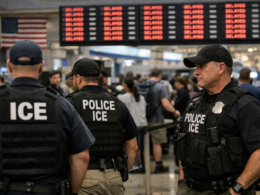




On January 24, 2026, federal immigration agents fatally shot 37-year-old Alex Jeffrey Pretti, a U.S. citizen and registered nurse, during an enforcement operation in Minneapolis. The incident occurred amid a controversial federal immigration crackdown led by the Department of Homeland Security and authorized under the Trump administration’s Operation Metro Surge.
The U.S. Border Patrol claimed Pretti was shot in self-defense after he resisted arrest and allegedly approached officers with a firearm. Senior DHS officials maintained that agents followed protocol and neutralized a perceived threat.
However, video evidence and eyewitness accounts from the scene have challenged that version of events. Footage circulating online and verified by major outlets showed Pretti holding a cell phone, and not a weapon, at the time of the confrontation. He was then tackled by several federal officers before being shot multiple times on a residential Minneapolis street.
Local authorities and elected officials, including Minnesota Governor Tim Walz, quickly disputed the federal account and demanded an independent state-led investigation into what Walz called a “horrific shooting.”
How do videos and eyewitness accounts compare with official federal narratives about the shooting
Multiple eyewitness videos paint a vastly different picture than the federal version of events. In widely shared clips, Pretti can be seen standing alone, holding what appears to be a phone, when federal officers confront him. Pepper spray is deployed, and a scuffle ensues before several gunshots ring out. Nowhere in the publicly released footage is Pretti shown brandishing a weapon.
Minneapolis Police Chief Brian O’Hara confirmed that Pretti had a legal firearm permit but stated that no local law enforcement officer at the scene had visual confirmation of a weapon in Pretti’s hands at the time of the shooting. Pretti had no known criminal history aside from minor traffic infractions.
The DHS later circulated a photo of a handgun it said was recovered at the scene. But whether that weapon was in Pretti’s possession during the incident remains unclear.
Why has the Minnesota governor criticized the federal investigation and demanded state oversight
Governor Tim Walz issued a sharp rebuke of the Department of Homeland Security’s conduct, stating that he had reviewed footage from “multiple angles” and found the incident to be “sickening.” Walz announced that Minnesota would not accept a federal-led review and would initiate its own investigation through the state’s Bureau of Criminal Apprehension.
The governor also confirmed he had spoken with the White House in the hours following the shooting and activated the Minnesota National Guard to help contain growing protests across Minneapolis.
The shooting of Pretti is the third confirmed fatality tied to federal enforcement actions in Minnesota in January alone. Earlier this month, Renee Good, also a U.S. citizen, was shot and killed during a separate immigration operation. Those back-to-back incidents have prompted state leaders to seek new legal frameworks to limit federal authority in residential enforcement actions.
What has been the public reaction on the streets and in political discourse
Protesters began gathering at the shooting site within hours. Demonstrations grew over the weekend, with chants of “feds out” and “justice for Alex” echoing across Minneapolis. Federal agents deployed tear gas and flashbang grenades as tensions escalated.
The political response has fallen sharply along partisan lines. Governor Walz and Minneapolis Mayor Jacob Frey both called for the full withdrawal of DHS personnel, arguing that federal intervention has only deepened public mistrust and worsened community-police relations.
In contrast, House Majority Whip Tom Emmer defended federal actions and accused Democratic leaders of enabling chaos. Former President Donald Trump, who has overseen the renewed crackdown under executive authority, said the enforcement operation was critical to restoring “law and order.”
How does this incident fit into broader enforcement operations and recent shootings by federal officers in Minnesota
Pretti’s death is the latest flashpoint in a month-long surge of federal immigration enforcement in Minneapolis. Under Operation Metro Surge, more than 3,000 agents have conducted coordinated sweeps, home entries, and street-level operations in immigrant neighborhoods and working-class districts.
The campaign has been linked to two other shootings and multiple injuries, including the high-profile death of Renee Good and the wounding of a 28-year-old Venezuelan man earlier in January.
Immigration and Customs Enforcement (ICE) and Border Patrol officials have refused to share detailed operational maps or tactical justifications with local police, exacerbating institutional mistrust.
What institutional and legal challenges are emerging in response to repeated shootings by federal agents
In response to Pretti’s death, civil rights groups and local lawmakers are calling for both congressional investigations and state-level legal restrictions on how and when federal agencies can conduct operations within Minnesota.
Attorneys for the Pretti family have indicated they may pursue wrongful death litigation and challenge the constitutionality of administrative warrant enforcement. Legal experts note that in many cases, DHS agents are bypassing court-issued warrants in favor of less transparent administrative directives—raising questions about due process.
Local lawmakers have begun drafting a legislative package to limit cooperation between Minnesota law enforcement and federal immigration authorities. Minneapolis City Council members are also exploring a formal resolution to declare the city a federal “enforcement-free zone.”
What questions remain as investigations continue and what are the next steps for authorities
There is still no clear timeline for the federal investigation’s conclusion. The FBI and DHS Office of Inspector General are conducting internal reviews, but Minneapolis city officials remain skeptical of any outcome absent independent oversight.
The Minnesota Bureau of Criminal Apprehension, operating under Governor Walz’s directive, has begun gathering evidence, soliciting public video submissions, and interviewing witnesses. But friction over access to federal files and redacted footage continues to stall progress.
Meanwhile, protests show no signs of slowing. Civil society groups have announced a “Week of Action” demanding justice for Pretti and an end to Operation Metro Surge. Faith leaders have also joined calls for accountability, citing rising anxiety among immigrant communities.
Until more information is released, the fatal shooting of Alex Pretti stands as a powerful symbol of the risks posed by opaque federal crackdowns—and the institutional fault lines they expose in America’s ongoing immigration enforcement debate.
What are the key takeaways from the fatal shooting of a U.S. citizen by federal agents in Minneapolis?
- A U.S. citizen named Alex Jeffrey Pretti, age 37, was fatally shot by federal immigration agents in Minneapolis on January 24, 2026.
- The incident occurred during a federal immigration enforcement operation under “Operation Metro Surge,” led by the Department of Homeland Security.
- Federal officials claim the shooting was in self-defense, stating that Pretti resisted arrest and allegedly approached agents with a firearm.
- Eyewitness videos and social media footage appear to contradict federal claims, showing Pretti holding a phone before being tackled and shot.
- Minneapolis Police confirmed Pretti had a lawful firearm permit and no serious criminal record; they were not informed in advance about the operation.
- Minnesota Governor Tim Walz condemned the shooting, saying he had viewed the video and lost confidence in a federal-led investigation.
- Walz activated the Minnesota National Guard and directed the state Bureau of Criminal Apprehension to lead the investigation.
- The shooting sparked large protests, with demonstrators calling for the removal of DHS and Border Patrol agents from the city.
- This is the third civilian shooting linked to federal agents in Minneapolis in January 2026, following the deaths of Renee Good and another injured civilian.
- Legal and institutional tensions are escalating, with state officials proposing limits on federal enforcement authority and increased oversight.
Discover more from Business-News-Today.com
Subscribe to get the latest posts sent to your email.