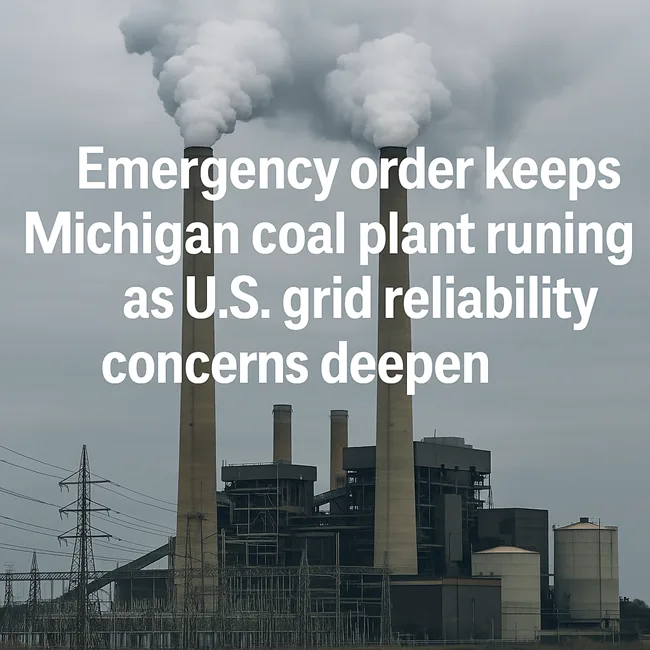
The United States Department of Energy (DOE) has extended the emergency operation of the J.H. Campbell Generating Plant in West Olive, Michigan, through November 19, 2025, in a sweeping move aimed at securing grid reliability across the Midwest. U.S. Secretary of Energy Chris Wright signed Order No. 202-25-7 on August 20, 2025, citing persistent shortfalls in electric generation capacity, extreme summer weather conditions, and the accelerating pace of dispatchable power plant retirements.
The extension builds on an earlier directive—Order No. 202-25-3—issued in May 2025, which kept the 1,420 MW coal-fired plant operational for an initial 90-day period. Consumers Energy Company, the plant’s primary owner, had originally planned to retire the facility on May 31, fifteen years ahead of its scheduled design life. The DOE intervened to prevent that shutdown, warning that MISO (Midcontinent Independent System Operator) could face unacceptable risks to reliability without the baseload support the Campbell Plant provides.
What were the reliability threats that prompted DOE to invoke its emergency powers under section 202(c) of the Federal Power Act?
Secretary Wright cited multiple reliability assessments, operational alerts, and long-term generation forecasts to justify invoking emergency powers under section 202(c) of the Federal Power Act. The 2025 Summer Reliability Assessment from the North American Electric Reliability Corporation (NERC) warned that MISO faced elevated risks of reserve shortfalls, particularly during periods of high demand or intermittent renewable output.
This concern was substantiated by operational data. Between June 11 and August 18, 2025, MISO issued reliability alerts on 40 of 69 days. These included Energy Emergency Alerts (EEAs), Max Generation Warnings, and Capacity Advisories. On June 23, for example, MISO issued a Max Gen Step 1b alert, enabling emergency dispatch procedures amid soaring temperatures and grid strain.
During this period, the Campbell Plant ran at an average of 61% capacity, generating over 664,000 MWh in June alone. DOE officials emphasized that restarting such coal units after deactivation is not only technically difficult but could take 30 to 60 days to repair if structural stress occurs during restart cycles.
How do seasonal and structural generation issues compound the Midwest’s power supply challenges?
MISO’s reliability concerns are no longer confined to summer. In 2022, MISO successfully petitioned the Federal Energy Regulatory Commission (FERC) to shift from a summer-only capacity requirement model to a seasonal one. This structural change acknowledged the emergence of reliability risks throughout the year, driven by dispatchable plant retirements, weather-dependent renewable capacity, and unpredictable load surges.
According to MISO’s 2024 “Reliability Imperative” report, more than 60% of Max Generation events now occur outside the traditional summer window. Risks are increasing in the fall and winter months, especially as legacy plants go offline without firm replacement capacity in place.
What is the long-term outlook for MISO’s generation adequacy, and what role does the Campbell Plant play in that forecast?
The DOE’s emergency order underscores that the Campbell Plant is not just filling a short-term gap—it is acting as a buffer against a projected multi-year capacity crisis. According to the 2025 OMS-MISO Resource Adequacy Survey, the region may face a capacity shortfall of 8.2 GW by 2030 if current retirement and demand trends continue. These deficits widen dramatically over time, especially in winter.
MISO has tried to mitigate the crunch with its new Expedited Resource Addition Study (ERAS) process, approved by FERC in July 2025. However, DOE officials noted that ERAS-backed resources are unlikely to become operational before 2028 due to supply chain constraints—some turbine wait times now stretch up to seven years. As a result, Secretary Wright ruled that Campbell must remain available for emergency dispatch through late November.
What institutional sentiment has emerged around baseload retention and AI-driven load growth?
Institutional sentiment is increasingly tilting toward a reevaluation of premature plant closures, especially as the energy intensity of new industrial and AI-driven infrastructure begins to manifest. DOE’s July 2025 “Resource Adequacy Report” warned that AI data centers could overwhelm legacy grids without stable baseload support. More than 20 AI companies are already operating in Michigan, and Consumers Energy has committed an additional 1 GW of new capacity to power hyperscale data centers in the state.
MISO echoed this urgency during testimony before Congress in March 2025. Its Senior VP for Planning and Operations, Jennifer Curran, stated that retirements of dispatchable resources were outpacing the addition of new assets with comparable operational characteristics. She also pointed to the compounding effect of weather volatility, manufacturing resurgence, and data center expansion as major reliability disruptors.
What does the emergency order require from MISO and Consumers Energy, and how is environmental compliance being addressed?
Order No. 202-25-7 mandates that MISO and Consumers Energy maintain the Campbell Plant’s operational readiness through November 19, 2025. MISO is also directed to minimize costs to ratepayers by using economic dispatch protocols. Consumers is required to file tariff revisions with FERC to effectuate the order and is expected to comply with all dispatch directives.
While the DOE order emphasizes reliability, it includes explicit provisions for environmental monitoring. Operations must comply with applicable emissions reporting, monitoring, and offset obligations. However, the order does not waive fees or allow emissions cap exemptions—it instructs MISO and Consumers to operate within environmental frameworks “to the maximum extent feasible.”
MISO must submit an implementation update to DOE by September 4, 2025, including operational actions taken and projected environmental impacts during the extended emergency period.
How have federal policy actions, including executive orders, shaped this intervention?
The emergency order follows a series of federal directives under President Donald Trump’s second term, which explicitly acknowledged a national energy crisis. Executive Order 14262, issued in April 2025, focused on grid reliability amid AI-led load growth. Executive Order 14156, issued earlier in January, declared a National Energy Emergency, citing risks from insufficient generation capacity and foreign interference in energy supply chains.
Both executive actions catalyzed a wave of regulatory interventions and policy adjustments. DOE’s July report, created in response to EO 14262, outlined grid risks tied to reindustrialization and AI data centers, specifically calling out Michigan as a pressure point. The Campbell Plant’s emergency extension appears directly aligned with those federal priorities.
What is the broader takeaway for investors and policymakers watching America’s energy transition?
The reactivation and extension of aging coal-fired assets like Campbell may seem counterintuitive in the age of net-zero commitments. But the underlying reality is that grid operators are prioritizing reliability over ideology as electrification accelerates. The order does not reverse decarbonization goals, but it offers a data-driven signal that baseload shortfalls are growing faster than anticipated—and that current renewable buildout timelines may not be sufficient.
Institutional investors and utility stakeholders may interpret the DOE’s order as a warning: capacity risk is no longer theoretical. For regulated utilities like Consumers Energy, state and federal pressure may increasingly favor grid reliability investments—even if they temporarily slow down fossil retirements. Energy developers and equipment manufacturers, meanwhile, will likely focus on FERC’s ERAS process to accelerate interconnections amid tight market windows.
Discover more from Business-News-Today.com
Subscribe to get the latest posts sent to your email.