

The global race to commercialize microreactors is no longer a theoretical contest—it’s a rapidly maturing competition among a few frontrunners now pushing toward deployment. As 2025 progresses, four companies—Westinghouse Electric Company, Ultra Safe Nuclear Corporation, Oklo Inc., and X-energy—stand out in the push to redefine nuclear energy through portable, scalable, and resilient systems that can serve off-grid sites, military bases, and high-demand edge infrastructure.
Microreactors promise to change how power is generated in remote or constrained environments. With sealed cores, autonomous safety systems, and minimal site preparation, these units aim to replace diesel, complement renewables, and deliver energy in places where traditional nuclear plants or grid extensions are unviable. But while each design has similar goals, their technological paths and commercial readiness vary widely.
Here’s how the four leading microreactor platforms—eVinci, MMR, Aurora, and Xe-Mobile—stack up across technical maturity, licensing status, deployment potential, and target applications.
Why 2025 is a turning point in the global race to commercialize nuclear microreactors
After years of design evolution and pre-licensing activity, 2025 marks a critical inflection point for microreactors. Government agencies including the U.S. Department of Energy, Department of Defense, and the Canadian Nuclear Safety Commission have advanced review frameworks that allow for first-of-a-kind designs to move toward pilot deployment.
At the same time, demand signals from sectors like mining, defense, off-grid research, and data centers have crystallized, giving developers clearer commercialization targets. TRISO fuel production, once a bottleneck, is expanding. Licensing paths, while still complex, have been clarified for several designs.
As of mid-2025, only a handful of companies have crossed both the engineering and regulatory thresholds necessary to begin building the next generation of deployable nuclear power.
How Westinghouse’s eVinci positions itself with heat-pipe simplicity and regulatory momentum
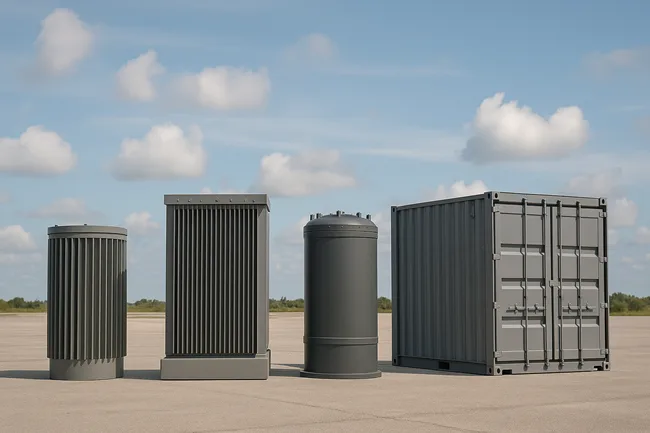
Westinghouse’s eVinci microreactor is one of the most recognizable entries in the category, known for its heat pipe–cooled, TRISO-fueled design that delivers up to 5 MWe and can run for 8+ years without refueling. The entire system is containerized, airlift-ready, and designed to operate passively—ideal for austere locations.
In March 2025, the U.S. Nuclear Regulatory Commission approved Westinghouse’s Principal Design Criteria (PDC) Topical Report, validating the foundational safety framework. By June, the Department of Energy approved the Preliminary Safety Design Report (PSDR) for a test unit to be built at Idaho National Laboratory, putting eVinci ahead of most U.S. competitors in terms of regulatory progress.
Deployment is still pending; the company has yet to announce a signed site or commercial customer. However, Westinghouse has indicated plans to begin demonstration testing in 2026, targeting full commercial production before 2030.
What makes Ultra Safe Nuclear’s MMR the most deployment-ready reactor in North America
While Westinghouse leads on U.S. regulatory approvals, Ultra Safe Nuclear Corporation (USNC) is arguably closer to actual deployment. Its Micro Modular Reactor (MMR) is a 15 MWt, 5 MWe graphite-moderated, helium-cooled TRISO system, designed for up to 20 years of sealed operation.
USNC’s flagship project—at Chalk River Laboratories in Ontario—is the most advanced deployment in North America. Backed by Canadian Nuclear Laboratories and Ontario Power Generation, the site has passed initial licensing stages with the Canadian Nuclear Safety Commission (CNSC). Construction is expected to begin in 2026.
Unlike eVinci, which is power-focused, the MMR also emphasizes district heating, process heat, and multi-purpose energy applications. USNC has also established a fuel manufacturing facility in Oak Ridge, Tennessee, and has signed deployment MOUs in Alaska, South Korea, and with U.S. military interests.
As of 2025, the MMR remains the most likely to become the first operational commercial microreactor in North America.
Why Oklo’s Aurora reactor faces unique technical hurdles and regulatory delays
Oklo Inc., once considered a bold disruptor in the microreactor space, has faced setbacks since the NRC rejected its initial license application in 2022, citing insufficient safety and environmental data. The company’s Aurora design, based on a fast-spectrum sodium-cooled reactor, remains in pre-application status as of 2025, with no new COLA (Combined License Application) formally submitted.
Technologically, Aurora is unique. It does not use TRISO fuel but instead plans to operate with metallic HALEU (high-assay low-enriched uranium), offering potential efficiency gains but introducing new regulatory and supply chain hurdles. The fast-spectrum sodium cooling system also introduces complexity not present in gas- or heat-pipe-cooled designs.
Despite these challenges, Oklo has maintained traction through Department of Defense collaborations and interest from tech investors. However, with no approved license or testbed deployment underway, Aurora is currently behind competitors in the regulatory and construction timeline.
How X-energy’s Xe-Mobile strategy targets modular energy delivery with HTGR flexibility
X-energy, better known for its Xe-100 small modular reactor (SMR) program, is also developing the Xe-Mobile, a transportable, high-temperature gas-cooled reactor intended for military and industrial microgrid applications.
Like the MMR, Xe-Mobile uses TRISO fuel and helium cooling, but its design is optimized for containerized delivery and flexible siting. X-energy has yet to publish detailed specifications for Xe-Mobile, though the company has indicated a power output of 1–5 MWe, depending on configuration.
The platform is still in early-stage engineering under Department of Energy support. It has not yet entered the U.S. NRC licensing pipeline specifically as a microreactor, and no pilot deployments have been publicly confirmed. However, X-energy’s established supply chain, strong fuel credentials, and SMR partnerships may allow it to ramp quickly if demand materializes.
As of 2025, Xe-Mobile remains in the pre-deployment concept phase, but with technical credibility built atop X-energy’s broader reactor program.
Which reactor leads in deployment timeline, licensing approvals, and use case readiness in 2025
In terms of commercial readiness, the MMR leads. It has a licensed project site, public deployment timeline, and aligned fuel production strategy. Westinghouse’s eVinci is a close second, with regulatory momentum but no committed site yet.
Oklo’s Aurora, while technically bold, is still navigating the consequences of its failed NRC application and has yet to regain deployment momentum. X-energy’s Xe-Mobile remains promising but undefined, with progress dependent on follow-through from DoD or DOE programs.
Comparing the top four microreactors by technology maturity, regulatory progress, and deployment status
| Reactor | Developer | Fuel Type | Cooling | Licensing Status | Deployment Target | Readiness Rank |
|---|---|---|---|---|---|---|
| eVinci | Westinghouse | TRISO | Heat pipe | NRC PDC + DOE PSDR approved | Demo by 2026 | ▲▲ |
| MMR | Ultra Safe Nuclear | TRISO | Helium | CNSC site review, fuel plant ready | Chalk River 2026–27 | ▲▲▲ |
| Aurora | Oklo | HALEU | Sodium | NRC rejection in 2022, no resubmission | TBD | ▲ |
| Xe-Mobile | X-energy | TRISO | Helium | Early engineering, no NRC sub | TBD | ▲ |
What investors, defense agencies, and utilities should watch in the microreactor race going forward
The next 12–24 months will be pivotal for the microreactor sector as key projects move from development into real-world execution. One of the most closely watched milestones will be the start of construction for Ultra Safe Nuclear’s MMR at Chalk River Laboratories, which could become the first operational microreactor in North America.
Westinghouse’s eVinci is expected to begin prototype deployment at Idaho National Laboratory, building on its recent NRC and DOE approvals. Meanwhile, Oklo will need to re-engage with the U.S. Nuclear Regulatory Commission or file a revised license application if it intends to regain momentum following its earlier regulatory setback.
X-energy’s Xe-Mobile platform may see integration into pilot programs backed by the Department of Energy or the U.S. Department of Defense, depending on strategic alignment and funding. Supporting all of these programs, TRISO fuel production is also set to scale, with major capacity expansions underway at Oak Ridge, BWXT Technologies, and Centrus Energy.
The winners in this race will not be determined by media buzz or exotic designs but by licensing traction, fuel availability, and deployment credibility. In 2025, Ultra Safe Nuclear is in the lead. But if Westinghouse executes, or X-energy accelerates, the field remains dynamic.
Discover more from Business-News-Today.com
Subscribe to get the latest posts sent to your email.