



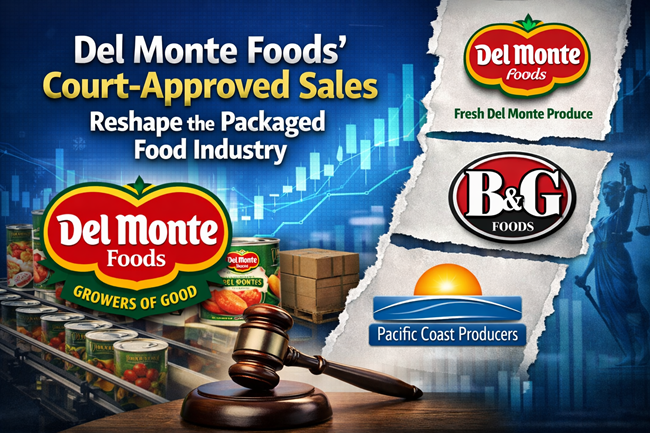
Del Monte Foods Corporation II Inc. has received U.S. Bankruptcy Court approval for asset purchase agreements covering substantially all of its operating businesses, formally clearing the way for a multi-buyer sale process that dismantles the company’s historic portfolio into distinct category-focused platforms. The ruling validates transactions with Fresh Del Monte Produce Inc., B&G Foods Inc., and Pacific Coast Producers, marking the most consequential restructuring moment for the Del Monte Foods business since it entered Chapter 11 protection in mid-2025.
The approval provides a clear execution path for Del Monte Foods Corporation II Inc. to close its sale transactions in the first quarter of 2026, subject to customary conditions, while maintaining operating continuity for customers, growers, and retail partners. Strategically, the outcome confirms that the highest-value solution for creditors and stakeholders was not a single-platform rescue, but a category-by-category separation that places each brand set with owners aligned to their operating economics.
Why the court-approved sale confirms that Del Monte Foods’ value now lies in category separation, not corporate scale
The court’s decision underscores a reality that has been building across the packaged food sector for years. Scale alone no longer guarantees resilience when categories face divergent cost structures, consumer demand patterns, and margin pressures. Del Monte Foods Corporation II Inc. entered Chapter 11 after concluding that its balance sheet and capital structure could not be sustainably repaired without a fundamental reset, despite the strength of its individual brands.
By approving three separate asset purchase agreements, the court effectively endorsed the view that vegetables, tomatoes, broth, and fruit no longer belong under a single operating umbrella. Each category now moves to an owner with a clearer strategic rationale, whether that is vertical integration, portfolio fill-in, or cooperative-based distribution efficiency. For industry observers, the ruling is less about bankruptcy mechanics and more about how legacy food companies are being unbundled to restore focus and cash discipline.
How the Fresh Del Monte Produce transaction reshapes vegetables, tomatoes, and brand ownership economics
Under the approved agreement, Fresh Del Monte Produce Inc. will acquire Del Monte Foods’ vegetable, tomato, and refrigerated fruit businesses, along with global ownership of the Del Monte brand and related intellectual property, subject to existing licensing arrangements. This is the most strategically significant leg of the breakup, as it transfers brand control to a company already deeply embedded in fresh produce logistics and global sourcing.
For Fresh Del Monte Produce Inc., the acquisition extends its reach from fresh into value-added and packaged segments where brand equity still commands shelf presence. It also provides optionality to better integrate upstream sourcing with downstream branded offerings, potentially improving margin stability in a category often exposed to commodity volatility. From Del Monte Foods’ perspective, this sale monetises its most globally recognisable asset while placing it with an owner capable of supporting long-term brand investment rather than short-term financial engineering.
What B&G Foods gains by absorbing the broth and stock business in a margin-driven portfolio
B&G Foods Inc. will acquire the broth and stock segment, including the College Inn and Kitchen Basics brands, adding a defensive, pantry-staple category to its portfolio. This transaction aligns closely with B&G Foods Inc.’s long-standing strategy of acquiring stable, cash-generative brands that can be optimised through cost control, pricing discipline, and focused marketing.
For investors, the appeal lies in category fit. Broth and stock products exhibit more predictable demand patterns than many centre-of-store items, particularly during periods of consumer trade-down. The acquisition also allows B&G Foods Inc. to deepen its presence in cooking essentials, a segment that benefits from both home cooking trends and foodservice overlap. Execution risk remains, particularly around input costs and promotional intensity, but the strategic logic is coherent.
Why Pacific Coast Producers’ shelf-stable fruit deal highlights cooperative advantages in legacy brands
Pacific Coast Producers will acquire the shelf-stable fruit business assets, excluding production assets, with rights and licences to use the Del Monte and S&W brands for ambient fruit products in the United States, Puerto Rico, and Mexico. As an agricultural cooperative, Pacific Coast Producers brings a structurally different ownership model to the equation, one that prioritises grower alignment and distribution efficiency over corporate consolidation.
This transaction illustrates how cooperatives can act as natural stewards for mature, volume-driven categories where brand awareness matters but aggressive innovation cycles are less critical. For Pacific Coast Producers, the deal secures branded access to retail channels while allowing it to leverage existing grower relationships. For the broader industry, it reinforces the idea that not all legacy brands require public-company ownership to remain viable.
How the Chapter 11 process and DIP financing shaped the final outcome
The court-approved sales are the culmination of a restructuring process initiated in July 2025, when Del Monte Foods Corporation II Inc. entered voluntary Chapter 11 proceedings and secured commitments for approximately $912.5 million in debtor-in-possession financing. That liquidity, combined with ongoing operating cash flow, enabled the company to run a court-supervised auction without disrupting seasonal production cycles or customer supply commitments.
Crucially, the restructuring support agreement with lenders provided a framework that balanced speed with value maximisation. Rather than forcing a distressed fire sale, the process allowed multiple strategic buyers to emerge for different asset pools. The court’s approval signals that the auction delivered the highest or otherwise best offers available, a key consideration for creditor recoveries and future restructuring precedents.
What this means for investor sentiment toward packaged food restructurings and asset carve-outs
Investor sentiment toward traditional packaged food companies has been cautious, shaped by margin compression, private-label competition, and shifting consumer preferences. The Del Monte Foods outcome is likely to reinforce a growing preference for targeted carve-outs over broad-based turnarounds. Public market participants have shown greater willingness to back companies that simplify portfolios and focus on core competencies, even if that means shrinking in absolute terms.
For Fresh Del Monte Produce Inc. and B&G Foods Inc., the market response will hinge on integration discipline and early evidence that the acquired assets meet return thresholds. While short-term share price movements can be volatile around acquisition announcements, institutional investors are more likely to assess these deals through the lens of cash flow durability and capital allocation credibility.
How this breakup could influence peers considering balance sheet resets or brand divestitures
The Del Monte Foods case provides a practical roadmap for other food companies facing similar pressures. It demonstrates that Chapter 11, while disruptive, can be used as a tool to reassign assets to owners better suited to their economics, rather than as a prelude to liquidation. Peers with sprawling brand portfolios may increasingly evaluate whether separation, rather than incremental cost cutting, offers a clearer path to value preservation.
At an industry level, the transaction mix highlights where strategic demand still exists. Brands tied to fresh supply chains, cooking essentials, or cooperative distribution models appear more attractive than those dependent on heavy promotional spend in commoditised categories. This insight is likely to inform boardroom discussions well beyond Del Monte Foods Corporation II Inc.
What happens next as Del Monte Foods moves toward transaction close in early 2026
With court approval secured, Del Monte Foods Corporation II Inc. now shifts into execution mode, focusing on regulatory clearances, transition services, and operational handovers. Management has indicated that discussions with buyers are already underway to ensure continuity for employees, customers, and vendors through closing.
The company’s non-U.S. subsidiaries remain outside the Chapter 11 process and continue to operate as usual, reducing cross-border complexity. Once the transactions close, Del Monte Foods Corporation II Inc. as it has existed for decades will effectively cease to be a unified operating entity, replaced by three owners pursuing distinct strategies with familiar brands.
Key takeaways on what Del Monte Foods’ court-approved sale means for owners, competitors, and the industry
- The court ruling confirms that Del Monte Foods’ highest value was realised through category separation rather than a single-company turnaround.
- Fresh Del Monte Produce Inc. gains brand ownership that strengthens its move beyond fresh into branded packaged segments.
- B&G Foods Inc. adds a defensive broth and stock category that fits its cash-focused acquisition strategy.
- Pacific Coast Producers demonstrates how cooperative ownership can sustain mature, shelf-stable brands efficiently.
- The Chapter 11 process functioned as a value-preserving restructuring tool rather than a liquidation pathway.
- Investor sentiment is likely to favour disciplined integration and cash flow performance over headline deal size.
- The outcome reinforces a broader industry trend toward portfolio simplification and targeted divestitures.
- Other packaged food companies may view this case as a precedent for using asset carve-outs to reset balance sheets.
Discover more from Business-News-Today.com
Subscribe to get the latest posts sent to your email.