Microreactors are no longer just an engineering experiment—they are fast becoming instruments of geopolitical competition. Compact, transportable, and designed to provide long-duration power in remote and high-risk settings, these small nuclear reactors are attracting attention from governments that see them as more than just clean energy. They are emerging as tools of influence, sovereignty, and energy security.
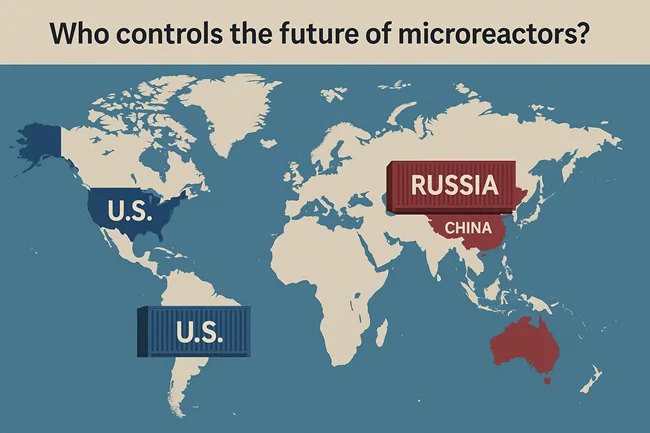
In 2025, three powers dominate the field: the United States, Russia, and China. Each is pursuing microreactors not only to serve domestic needs but also to shape global energy markets, defense logistics, and overseas partnerships. Around them, smaller players such as Canada, South Korea, and European nations are positioning themselves as collaborators or niche suppliers.
This convergence of nuclear innovation and geopolitics is reshaping how microreactors are perceived—not as isolated projects but as strategic platforms in the broader struggle for energy and technological dominance.
Why the United States is prioritizing microreactors through DOE, DoD, and ARDP funding in 2025
The United States has made microreactors a core part of its advanced nuclear strategy. The Department of Energy (DOE) continues to fund demonstration projects under the Advanced Reactor Demonstration Program (ARDP), providing billions in cost-sharing agreements to developers like Westinghouse, X-energy, and Oklo.
The DOE’s dedicated Microreactor Program Plan calls for a coordinated national effort to bring compact reactors from concept to deployment within five to seven years. These reactors are seen as critical not only for clean energy goals but also for industrial resilience and defense applications.
On the defense side, the Department of Defense (DoD) has championed nuclear microreactors under initiatives such as Project Pele, which aims to test portable reactors for forward-deployed bases. The logic is straightforward: reliance on diesel convoys for fuel makes U.S. forces vulnerable, while microreactors could deliver secure, autonomous power in contested environments.
By combining DOE funding, DoD procurement interest, and a streamlined regulatory push, the United States hopes to anchor itself as the leading global hub for microreactor development.
How Russia is leveraging microreactors and floating reactors for Arctic dominance and export leverage
Russia’s approach to microreactors is built on decades of experience with nuclear marine propulsion. Having operated nuclear-powered icebreakers and submarines for generations, the country has leveraged this expertise to launch floating nuclear plants.
The most prominent example is the Akademik Lomonosov, a floating power station equipped with two KLT-40S reactors. It began commercial operation in Chukotka in 2020 and recently surpassed one billion kilowatt-hours of electricity delivered. Building on this success, Russia is rolling out RITM-200 reactors for both land-based and floating platforms. Planned deployments in regions such as Yakutia are tied to powering remote mining operations and Arctic settlements.
These floating and modular designs extend Moscow’s energy reach deep into the Arctic, where competition over shipping routes, minerals, and strategic influence is intensifying. Rosatom is also positioning microreactors as exportable units for coastal or resource-dependent nations. This aligns with Russia’s broader strategy of using nuclear energy as a lever of diplomacy and long-term influence.
Why China’s microreactor development links to Belt and Road energy strategy and overseas influence
China is scaling nuclear power at an unprecedented rate, targeting over 110 gigawatts of installed capacity by 2030 and potentially doubling that by 2035. While its flagship projects remain large-scale plants, microreactors and small modular reactors (SMRs) are increasingly central to Beijing’s energy and geopolitical playbook.
The Linglong-1 (ACPR100) reactor, under construction in Hainan, is the world’s first commercial small modular reactor nearing completion. Although larger than typical microreactors, its successful deployment demonstrates China’s ability to design and build compact nuclear systems domestically.
China has also developed floating SMR concepts and continues to integrate nuclear offerings into its Belt and Road Initiative (BRI). By coupling nuclear exports with overseas infrastructure financing, Beijing aims to build long-term dependencies among partner countries. For smaller nations looking to decarbonize and secure baseload power, Chinese-built microreactors could be an attractive option—albeit one tied to Beijing’s strategic interests.
This combination of domestic scale, export ambition, and geopolitical leverage positions China as a formidable contender in the global microreactor race.
How Canada, South Korea, and Europe are positioning themselves as partners in nuclear microgrids
While the U.S., Russia, and China dominate the headlines, other nations are building important roles in the microreactor ecosystem.
Canada has been at the forefront of licensing innovation. Its staged licensing process under the Canadian Nuclear Safety Commission (CNSC) allows developers to advance site approvals while continuing design refinement. The Chalk River project, once linked to Ultra Safe Nuclear’s MMR, remains a symbolic test bed for how Canada can integrate microreactors into Arctic communities and industrial projects. Following USNC’s bankruptcy in late 2024, Nano Nuclear Energy acquired the MMR technology, now rebranded as KRONOS MMR, with plans to continue pursuing Canadian deployment opportunities.
South Korea has also aligned with U.S. developers through past partnerships and maintains strong capabilities in nuclear engineering. With global ambitions in advanced reactors, Korean companies are expected to contribute to supply chains for TRISO fuel and reactor components.
Europe, though more fragmented, is evaluating SMRs and microreactors as part of energy diversification and industrial decarbonization. Nations such as the UK and Poland are prioritizing SMRs, but interest in microreactors for remote military bases or industrial hubs is also rising. Europe may not develop its own fleet but will likely serve as a partner market for North American vendors.
What this geopolitical race means for global fuel supply chains, TRISO production, and HALEU access
Fuel supply is the silent driver of the microreactor competition. Most U.S. and allied designs depend on TRISO fuel, while Oklo’s Aurora design requires HALEU (high-assay low-enriched uranium). Both face supply constraints.
In the United States, BWXT Technologies, Centrus Energy, and the DOE’s Oak Ridge facilities are ramping up TRISO capacity. Nano Nuclear Energy is also planning to manufacture TRISO as part of its expanded portfolio. However, until production scales, TRISO fuel will remain costly and limited, restricting microreactor deployment.
HALEU faces even bigger challenges. With Russia historically the largest supplier, Western developers now face shortages due to geopolitical restrictions. The DOE is working to expand enrichment capacity, but Oklo and others remain dependent on uncertain timelines.
Russia and China, meanwhile, have more centralized and vertically integrated fuel cycles, giving them greater control over their reactor deployments and export promises. This divergence in fuel access could prove decisive in shaping global leadership.
Could microreactors become the next frontier of energy diplomacy and security competition?
Microreactors are quickly becoming more than just engineering projects—they are strategic instruments in global energy diplomacy. The U.S. is betting on regulatory innovation, defense contracts, and industrial scale to retain leadership. Russia is leveraging its floating and Arctic systems to project influence across resource-rich frontiers. China is embedding compact nuclear within its Belt and Road strategy, positioning itself as the nuclear exporter of choice for emerging markets.
The outcome of this race will depend not only on technology but also on fuel supply, financing, regulatory agility, and diplomatic alignments. For smaller nations, the choice of which microreactor to adopt will increasingly be a geopolitical decision, linking energy independence to great-power competition.
As of 2025, microreactors represent one of the clearest intersections of the clean energy transition and national security strategy. Their small size belies their strategic weight. The next decade may see microreactors not only powering remote mines and Arctic towns but also reshaping the balance of global influence in the nuclear age.
Discover more from Business-News-Today.com
Subscribe to get the latest posts sent to your email.