

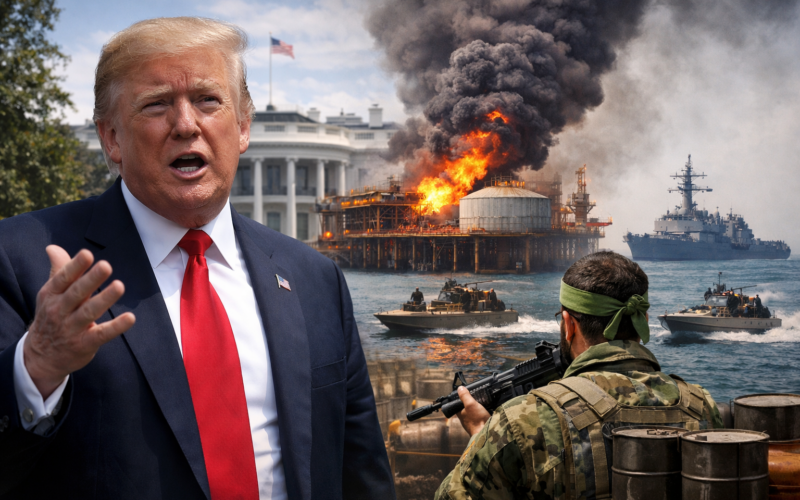
As the United States-Israeli military campaign against Iran entered its third week, President Donald Trump threatened further strikes on Kharg Island, Iran’s primary oil export hub, and called on allied nations to deploy warships to keep the Strait of Hormuz open to global shipping. Tehran rejected any ceasefire or negotiation, with Iranian Foreign Minister Abbas Araghchi asserting that Iran was prepared to defend itself indefinitely. Trump administration officials, responding to acute economic anxiety over crude oil prices approaching 100 US dollars a barrel, simultaneously insisted the conflict would resolve within weeks and that energy prices would fall sharply once it ended.
Trump threatened further strikes on Kharg Island and urged allies to deploy warships to secure the Strait of Hormuz, an artery for global energy supplies, as Tehran vowed to intensify its response. Trump told NBC News on Saturday that United States strikes had totally demolished much of the island and warned of more. He added that the United States military may hit the site a few more times. The remarks marked a sharp escalation from Trump, who had previously said the United States was targeting only military sites on Kharg Island.
United States Central Command said it had conducted precision strikes on more than 90 military targets on Kharg Island while preserving the oil infrastructure. Trump confirmed the strikes on Truth Social, stating that the United States had totally obliterated every military target on the island. He said he had chosen not to destroy the oil infrastructure, noting that rebuilding it would take years, but warned he would immediately reconsider that decision should Iran interfere with free and safe passage of ships through the Strait of Hormuz.
The Trump administration has separately discussed the possibility of seizing Kharg Island, according to a report citing four unnamed sources with knowledge of the discussions. White House press secretary Karoline Leavitt said the president keeps all options on the table. White House officials have previously said they expect oil prices to fall dramatically once the operation comes to an end.
Trump said that Iran wants to negotiate, but Araghchi disputed that claim. Araghchi told CBS on Sunday that Iran had never asked for a ceasefire and had never asked for negotiations. He added that Iran was ready to defend itself for as long as it takes.
Why US Energy Secretary Chris Wright’s timeline prediction matters for global oil markets and energy supply
With crude oil prices hovering around 100 US dollars a barrel, Trump administration officials insisted that all signs point to a relatively quick end to the conflict. United States Energy Secretary Chris Wright told ABC’s This Week program that the conflict would certainly come to an end in the next few weeks, and possibly sooner, and that a rebound in supplies and a fall in prices would follow.
Araghchi, speaking in the same media cycle, presented a contrasting picture of Iranian resilience. He told CBS that it was not a war of survival, that Iran was stable and strong enough, and that Tehran saw no reason to engage with Washington given that the United States had attacked Iran while negotiations were still under way between the two sides. He said Iran had been talking with the Americans when they decided to attack, and that this was for the second time.
The gap between Washington’s stated expectations and Tehran’s declared posture has deepened uncertainty in global energy markets. The Strait of Hormuz is the conduit for approximately one fifth of global oil and liquefied natural gas supply. Although some Iranian vessels have continued to pass through the waterway, the strait has been effectively closed for most of the world’s shipping since the United States and Israel launched the military campaign against Iran on February 28, 2026.
The International Energy Agency on Sunday said oil from its emergency reserves will begin flowing to global markets soon, with member countries pledging to make available 411.9 million barrels in response to the supply disruption.
How Kharg Island became the central military and economic flashpoint in the United States-Iran conflict
Kharg Island has been thrust into the global spotlight as one of Iran’s most sensitive economic targets. The terminal handles approximately 90 percent of Iran’s crude oil exports and has a loading capacity of roughly 7 million barrels per day. The five-mile-long coral island is located about 15 miles off the coast of mainland Iran in the northern Persian Gulf and had been left untouched during the first two weeks of United States and Israeli-led strikes against Iran.
Iran’s state-affiliated Fars News Agency said no oil infrastructure was damaged in the United States strikes on Kharg Island. More than 15 explosions were reported on the island, with thick smoke rising after United States forces targeted army defenses, the Joshen Sea Base, an airport control tower, and a helicopter hangar, according to field sources cited by the agency.
Araghchi warned on Sunday that any occupation of Kharg Island would be a bigger mistake than attacking it. He reiterated that if Iran’s energy facilities were targeted, Iran’s armed forces would respond by striking the facilities of American companies in the region. He also claimed that the Kharg Island strikes had been launched from two locations inside the United Arab Emirates territory: Ras Al-Khaimah and a location near Dubai. Araghchi described the use of UAE territory for the strikes as dangerous given the proximity to civilian populations. United States Central Command declined to comment on Araghchi’s claim.
What Iran’s Revolutionary Guard strikes on Israel and US bases signal about Tehran’s military posture in week three
Iran’s Islamic Revolutionary Guard Corps said it carried out missile and drone strikes on targets in Israel and three United States bases in the region, describing the attacks as the first round of retaliation for workers killed in Iran’s industrial areas. The Islamic Revolutionary Guard Corps also said it had launched a joint operation with Lebanese proxy Hezbollah against targets in Israel, framing the operation as part of Iran’s annual Al-Quds Day activities.
Washington has brushed aside attempts by Middle Eastern allies to open talks, according to three sources cited by Reuters. Iran’s Revolutionary Guards said on Sunday they had fired more missiles at Israel and at three United States military bases in the region. Saudi Arabia’s defense ministry said it had intercepted and destroyed 10 drones in Riyadh and the east. The Iranian Revolutionary Guard Corps said it had no connection to that attack, according to semi-official Fars news agency reporting.
The United Arab Emirates defense ministry said its air defense systems had engaged four ballistic missiles and six drones in the latest round of attacks. Since the start of the conflict, UAE air defenses have engaged 298 ballistic missiles and 15 cruise missiles, and the ministry said these attacks have killed six people and injured a further 142. The ministry separately indicated that it had intercepted more than 1,600 drones since the conflict began on February 28, 2026.
In Iraq, officials said five rockets targeted Baghdad airport on Sunday, injuring five people including four airport staff and security personnel and one engineer. The rockets struck multiple areas including on the grounds of Baghdad Central Prison, near the former United States base Camp Victory on the airport grounds. The Islamic Revolutionary Guard Corps spokesperson Ali Mohammad Naini said in comments carried by Iranian state media that Iran had not yet used its newest missiles.
How the UAE’s disputed role in the Kharg Island strikes is reshaping diplomatic dynamics across the Gulf region
The United Arab Emirates denied that the strikes on Kharg Island came from its territory but said it had the right to defend itself against what it characterized as imposed terrorist aggression. UAE presidential adviser Anwar Gargash said the Gulf nation was still prioritizing reason and logic, continuing to exercise restraint, and seeking a way out for Iran and the region. Gargash said the United Arab Emirates had made sincere efforts until the very last moment to mediate between Washington and Tehran to avoid the war.
A drone attack disrupted a major United Arab Emirates energy hub on Saturday. Some oil-loading operations were suspended in the Fujairah emirate, a global ship-refueling hub, after the attack. The emirate’s media office said a drone was intercepted, though civil defense forces were still working to extinguish a fire caused by falling debris. Industry and trade sources confirmed that loading operations had been halted.
Iran’s Islamic Revolutionary Guard Corps said in a statement that facilities connected to United States businesses in the region, even indirectly through shareholders, could become potential targets if the conflict intensified. United States Central Command rejected Iranian Foreign Minister Araghchi’s separate claim that the United States was using drones to attack Gulf countries, describing the assertion as a lie. Araghchi had claimed that the United States had developed a drone similar to the Iranian Shahed drone that was being used to target objectives in Arab countries.
Why allied nations face constitutional and political barriers to sending warships to the Strait of Hormuz
President Trump called on China, France, Japan, South Korea, the United Kingdom, and others affected by what he described as an artificial constraint to send ships to the Strait of Hormuz area to help secure the waterway. France has been seeking to assemble a coalition to secure the strait once the security situation stabilizes. Britain is discussing a range of options with allies to ensure the security of shipping, officials have said.
Japan faces specific legal constraints. The Japanese government interprets its pacifist postwar constitution to mean it can deploy its military only if the nation’s survival is threatened, and any deployment would require invoking a 2015 security law that has not previously been used. Iran’s new Supreme Leader Ayatollah Mojtaba Khamenei, who replaced his father following his death in the opening strikes on February 28, 2026, has stated that the Strait of Hormuz should remain closed.
British Prime Minister Keir Starmer discussed the situation in the Middle East with Canadian Prime Minister Mark Carney on Sunday, including the impact of the continued closure of the Strait of Hormuz on international shipping. The two leaders agreed to discuss the ongoing conflict further at a meeting scheduled for the following day. United States Central Command earlier said it believes United States Navy escorts for tankers through the Strait of Hormuz will happen soon.
What the Lebanon and Hezbollah escalation means for a broader regional ceasefire and civilian displacement crisis
Israel and Lebanon are expected to hold talks in coming days aimed at securing a ceasefire that would see Iran-backed Hezbollah disarmed, according to two Israeli officials. Lebanon was drawn into the wider conflict when Hezbollah opened fire at Israel, saying it was acting to avenge the killing of Iran’s supreme leader. Israel responded with a fierce and sustained offensive targeting Hezbollah launch sites, command infrastructure, and military leadership across southern Lebanon, the Beirut southern suburbs, and the Beqaa Valley.
Lebanon’s health ministry reported that the death toll in Lebanon since Israel renewed widespread attacks on the country now stands at 826, with at least 98 of those killed being children. At least 2,000 people have also been wounded. More than 800,000 people have fled their homes in Lebanon since the Israeli offensive began. Israel’s military said it had carried out approximately 7,600 strikes in Iran and 1,100 in Lebanon since launching its joint operation with the United States on February 28, 2026.
Lebanon’s Health Ministry strongly condemned an Israeli strike on a healthcare center in Borj Qalaouiye that killed 12 medical staff, including doctors, nurses, and paramedics. Israeli shells also struck the headquarters of a Nepalese peacekeeping battalion serving with the United Nations Interim Force in Lebanon in the southern Lebanese town of Meiss el-Jabal.
The World Health Organization said it had released 2 million US dollars in emergency funds to countries in the region. More than 100,000 people in Iran have been displaced, and up to 700,000 in Lebanon are internally displaced, according to World Health Organization figures. The war that President Trump and Israeli Prime Minister Benjamin Netanyahu launched on February 28, 2026 has killed more than 2,000 people in total, mostly in Iran, according to reports from governments and state media. At least 15 people were killed when an airstrike hit a factory in the central Iranian city of Isfahan, according to semi-official Fars news agency.
Key takeaways: What the Kharg Island strikes and the US-Iran timeline standoff mean for the conflict, energy markets, and regional security
- United States President Donald Trump threatened additional strikes on Kharg Island, which handles roughly 90 percent of Iran’s crude exports, after United States Central Command struck more than 90 military targets on the island on March 13 and 14, 2026, while explicitly preserving the oil infrastructure and framing its potential destruction as a conditional threat tied to Iranian interference with shipping through the Strait of Hormuz.
- United States Energy Secretary Chris Wright stated on March 15, 2026 that the conflict with Iran would end within weeks and that oil prices would fall once it concluded. Iranian Foreign Minister Abbas Araghchi directly contradicted this assessment, asserting that Iran had never requested a ceasefire or negotiations and was prepared to sustain its defense indefinitely.
- The Strait of Hormuz, the conduit for approximately 20 percent of global oil and liquefied natural gas supply, has been effectively closed to most international shipping since the United States and Israel launched Operation Epic Fury on February 28, 2026. Iran’s new Supreme Leader Mojtaba Khamenei has vowed to keep the waterway shut.
- Iran’s Islamic Revolutionary Guard Corps continued to fire missiles and drones at targets in Israel and at United States military bases across the region, while threatening that any attack on Iranian energy infrastructure would trigger retaliatory strikes against regional oil and gas facilities with American commercial links.
- Israel and Lebanon are expected to hold ceasefire talks focused on disarming Hezbollah, while France is seeking to assemble an allied naval coalition to secure the Strait of Hormuz, and the International Energy Agency has pledged to release 411.9 million barrels from emergency reserves to stabilize global oil markets.
Discover more from Business-News-Today.com
Subscribe to get the latest posts sent to your email.