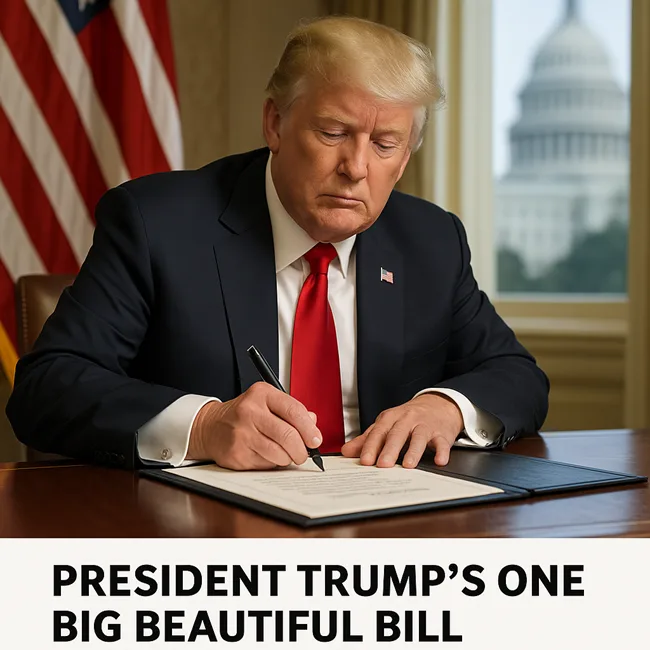
US President Donald Trump signed the sweeping One Big Beautiful Bill Act into law on July 4, 2025, delivering what the White House called a once-in-a-generation legislative achievement. Promising historic tax cuts, fossil fuel expansion, defense modernization, and Medicaid reform, the new law restructures multiple pillars of the U.S. economy while cementing several key elements of Trump’s campaign agenda.
The legislation, passed narrowly along party lines in both chambers of Congress, touches nearly every aspect of American life—from take-home pay and energy prices to missile defense and family savings. While the administration heralds it as a triumph for working families and national sovereignty, critics warn of steep costs to healthcare access, public debt, and climate resilience.
What tax benefits will working families and middle-income earners see under the One Big Beautiful Bill?
The bill features what the Trump administration describes as the “largest tax cut in history” for households earning under $50,000 annually. Key provisions include elimination of federal taxes on tips, overtime, and Social Security income, along with a permanent expansion of the Child Tax Credit. According to the Joint Committee on Taxation, many families could see take-home pay increases exceeding $10,000 per year—particularly those in service, retail, and gig economy roles.
The legislation also revives and extends core components of the 2017 Tax Cuts and Jobs Act, including lower marginal income tax rates and doubled standard deductions. Analysts note that while the bill eases short-term burdens on lower-income Americans, it also embeds structural changes that reduce federal revenues, raising concerns about sustainability over the long term. Institutional investors have responded cautiously, questioning whether these cuts can be maintained without triggering broader economic imbalances.
How does the bill reshape U.S. energy priorities and affect domestic production incentives?
The One Big Beautiful Bill marks a significant reversal of the Biden-era clean energy agenda. It eliminates many tax credits for solar, wind, and electric vehicles, while allocating billions toward expanded oil and gas production. The Department of Energy has been tasked with streamlining permits for drilling on federal lands, and the bill mandates offshore lease auctions in the Gulf of Mexico and Alaska’s Arctic waters.
The administration argues that these measures will reduce consumer energy costs and enhance national security. However, climate analysts and renewable developers have expressed concern that the rollback of clean-energy subsidies will stall decarbonization goals. With the International Energy Agency projecting that U.S. emissions could rise by 6% over the next three years, institutional sentiment toward utility-scale renewables has grown more cautious.
What defense investments and missile systems are included under the Golden Dome initiative?
One of the bill’s most significant national security elements is funding for the Golden Dome, a next-generation missile defense system positioned as a U.S.-first alternative to Israel’s Iron Dome. Backed by a $75 billion appropriation, the system is designed to detect and neutralize hypersonic threats and UAV swarms in real time, using AI-enhanced radar and satellite integration.
The bill also earmarks $150 billion over the next five years for broader military modernization, including new weapons systems, upgraded fleet infrastructure, and AI-driven command platforms. Industry players in the defense sector have welcomed the increased spending, with defense contractor equities seeing upward momentum following the bill’s signing. However, critics argue that these expenditures come at the expense of domestic welfare and international diplomacy.
How will Medicaid, food stamps, and other social programs be impacted by spending cuts?
The bill reduces federal spending by an estimated $1.5 trillion over the next decade, with significant cuts to Medicaid and the Supplemental Nutrition Assistance Program (SNAP). Medicaid recipients will now face work requirements, biometric identity checks, and tighter eligibility renewal cycles. Estimates from healthcare policy researchers at Yale and the University of Pennsylvania suggest that up to 10 million Americans could lose Medicaid coverage by 2030.
Additionally, undocumented immigrants will be blocked from accessing any Medicaid-funded services under new Department of Health and Human Services enforcement protocols. The White House frames these changes as efforts to eliminate fraud, waste, and abuse, but public health advocates warn of rising mortality and lower preventive care access in underserved communities. Analysts view this as a potential drag on state-level health systems, which may be forced to backfill coverage gaps.
What are Trump Accounts and how do they reflect the bill’s pro-family economic strategy?
Another centerpiece of the bill is the creation of so-called “Trump Accounts”—federally seeded, tax-advantaged savings vehicles opened automatically for every American newborn. Each account is initially funded with a $1,000 government deposit, with families able to contribute up to $5,000 per year, earmarked for education, housing, or business startup purposes.
Modeled after “baby bond” proposals with a conservative twist, Trump Accounts are designed to encourage family formation, intergenerational wealth-building, and long-term investment in human capital. Conservative think tanks have praised the measure as a pro-natalist policy with minimal bureaucratic overhead. However, progressive economists argue that without strong income redistribution mechanisms, the accounts will benefit wealthier families disproportionately.
How does the bill redefine immigration enforcement and border security infrastructure?
The bill allocates over $100 billion for expanding border enforcement operations, including the completion of the southern border wall, the hiring of over 15,000 new ICE officers and Border Patrol agents, and the development of advanced biometric surveillance infrastructure. These measures have drawn strong responses from civil liberties groups, which argue the legislation institutionalizes a surveillance-heavy immigration regime.
From a policy standpoint, institutional investors in defense and border technology firms have expressed confidence in the durable revenue streams these initiatives may offer. However, governors in several blue states have hinted at legal challenges, citing federal overreach and the strain on state resources due to potential increases in detentions and deportations.
What are the macroeconomic and fiscal risks associated with this legislation?
While the bill’s backers tout its potential to stimulate economic growth, the Congressional Budget Office estimates that the combined tax cuts and new spending will add at least $2.8 trillion to the federal deficit over the next ten years. Independent assessments from think tanks place the figure as high as $4.5 trillion.
In response, credit-rating agency Moody’s has downgraded the U.S. outlook from AAA to AA+, citing long-term fiscal sustainability concerns. Bond markets are already pricing in higher Treasury yields, and fiscal hawks in both parties have warned that increased interest payments could offset many of the bill’s gains. Despite this, proponents argue that strong GDP growth, fueled by deregulation and energy self-reliance, will help counterbalance these risks over time.
Could this bill shift the foundation of American economic policy?
Experts across the political spectrum agree that the One Big Beautiful Bill is the most sweeping legislative package since the Affordable Care Act. Its focus on border militarization, fossil-fuel dominance, aggressive tax relief, and anti-welfare sentiment reorients the American policy consensus toward Trump-era priorities.
Institutional investors are cautiously optimistic in sectors like defense, fossil fuels, and consumer spending—but deeply wary of the fiscal outlook and regulatory volatility. The longer-term implications for income inequality, environmental degradation, and healthcare access remain unresolved, making this a high-stakes experiment in economic realignment.
Discover more from Business-News-Today.com
Subscribe to get the latest posts sent to your email.